
Anyone who has sat through a fast-moving lecture knows the dilemma: write everything down and risk missing the explanation, or listen closely and realize later that your notes have gaps. Add a strong accent, a poor microphone, a technical term you have never heard before, or a language that is not your first, and the problem gets even harder.
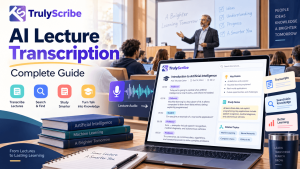
AI lecture transcription removes that trade-off. By converting recorded lectures into accurate, searchable text, it lets students concentrate in class and revisit the material properly afterward, and it gives educators a faster way to create accessible, reusable course content. This complete guide explains how it works, who benefits, a step-by-step study workflow, tips for better accuracy and how TrulyScribe fits in.
Key Takeaways
- AI lecture transcription converts recorded lectures into searchable text in minutes, so students can focus on understanding instead of frantic note-taking.
- It supports different learners. International students, students with hearing or processing differences, and anyone who needs to revisit a tricky concept all benefit from a reliable transcript.
- Educators gain too: transcripts support accessibility, make course content reusable and turn lectures into study guides, summaries and FAQs.
- Audio quality drives accuracy. A good microphone, a quiet room and checking technical terms matter more than any setting. Formulas and equations still need manual review.
- Transcripts become study material. Search for key terms, highlight concepts, create summaries and build revision notes from what was actually said.
- Always get permission to record and follow your institution’s policies. TrulyScribe offers an accurate, multilingual way to turn lecture recordings into text with free monthly hours to get started.
What Is AI Lecture Transcription?
AI lecture transcription uses speech-recognition technology to turn the audio or video of a lecture, whether in person, online or recorded for later, into written text. A good transcript includes timestamps, so you can jump to the moment a concept was explained, and clear punctuation, so it reads like a document rather than a wall of words. An editor then lets you correct names, terms and numbers against the original recording.
It is different from traditional note-taking. Notes capture what you chose to write down; a transcript captures what was actually said. Many students use both: the transcript as a complete reference, and their own notes and highlights as the layer of understanding on top. New to the technology? Our beginner’s guide explains what AI transcription is and how it works.
Why Transcribe Lectures?
1. Listen first, write later
When you are not racing to keep up, you absorb more. Students can listen actively, ask questions and follow the reasoning, knowing the full text will be available afterward.
2. Never miss a detail
Definitions, examples, dates, names and deadlines mentioned in passing are easy to lose. A transcript preserves them, including the offhand hint about what will appear on the exam.
3. Learn at your own pace
Reading is often faster than replaying audio, and you can slow down on difficult sections. This is particularly valuable for international students and anyone studying in a second language, who can read along while listening and look up unfamiliar words.
4. Search instead of scrubbing through recordings
Searching a transcript for a keyword takes seconds. Scrubbing through an hour of video to find one explanation can take much longer, especially during revision.
5. Support accessibility
Transcripts and captions help students who are deaf or hard of hearing, as well as those with attention or processing differences, access the same content as everyone else. For institutions and course creators, they also support accessibility requirements. See our guide to video transcription and accessibility for more.
6. Turn one lecture into many resources
A single transcript can become a summary, a study guide, flashcards, an FAQ, a blog post or subtitles. Educators and course creators can repurpose the same material across formats without starting from scratch.
Who Benefits from Lecture Transcription?
| Who | How they use lecture transcripts | Main payoff |
|---|---|---|
| Students | Review recordings, search for topics, build summaries and revision notes | Better understanding and faster exam prep |
| International / ESL students | Read along with the audio and look up unfamiliar terms | Easier comprehension at their own pace |
| Students needing accessibility support | Use captions and transcripts alongside or instead of audio | Equal access to lecture content |
| Teachers and professors | Create notes, handouts, FAQs and accessible course materials | Less admin and more reusable content |
| Course creators and coaches | Turn webinars and lessons into blog posts, guides and subtitles | Wider reach from one recording |
| Institutions | Archive lectures and support accessibility requirements | Searchable knowledge base and compliance support |
A Step-by-Step Workflow for Transcribing Lectures
- Get permission and check policy. Ask your instructor before recording and follow your institution’s rules. Many courses already provide recordings, and some students have approved accommodations.
- Record with the best audio you can. Sit near the front, place your device or microphone close to the speaker and avoid noisy spots. For online classes, use the platform’s recording feature or save the file after class.
- Upload to TrulyScribe. Add the audio or video file, choose the language and let the AI generate the transcript. If your lectures are on video calls, our guide shows how to transcribe Zoom and Google Meet recordings for free.
- Review key terms. Use the editor to compare the transcript with the recording and fix subject-specific terms, names and numbers.
- Highlight and organize. Mark definitions, formulas, examples and anything your instructor stressed. Add your own comments and questions.
- Create study material. Write a short summary, build flashcards from key terms and list questions to ask in the next session.
- Export and store. Download the transcript as DOCX or PDF and file it by course and date so you can find it when exams arrive.
For more study ideas, see our guide to AI transcription for students.
How to Get More Accurate Lecture Transcripts
AI transcription is impressive, but lectures are a demanding use case: long recordings, distant speakers, shared rooms and specialized vocabulary. These habits improve results:
- Improve the audio. A microphone near the speaker makes a bigger difference than any software setting. Our tips on transcribing audio with background noise cover what to do in imperfect rooms.
- Expect to review technical terms. Scientific, medical, legal and engineering vocabulary can trip up any AI. Read our guide to handling technical jargon for practical advice.
- Check formulas and equations manually. Spoken mathematics rarely transcribes into correct notation, so treat the transcript as a guide and verify any formula against your textbook or slides.
- Set the correct language and accent. Selecting the right language helps, especially for accented speech and multilingual classrooms.
- Cross-check with slides. Use the lecture slides to confirm spelling of names and key terms.
- Handle long recordings sensibly. Lectures can run for hours. Choose a tool that copes with long files. The same long-form considerations are covered in our guide to the best AI transcription for long podcasts.
Lecture Transcription for Educators and Course Creators
Teachers, professors and online course creators can use transcripts to work smarter:
- Accessible materials. Provide transcripts alongside recordings so every learner can follow along. Review the text before sharing to correct errors.
- Reusable content. Convert lectures into study guides, summaries, FAQs and blog posts. Our guide to building a knowledge base from transcripts shows how to organize them.
- Captions and subtitles. Export text for video captions and subtitles. See our overview of export formats for video editing.
- Feedback on teaching. Reading your own transcripts can reveal unclear explanations, filler words and moments where students may have struggled.
- Global reach. Transcripts are the first step toward translation and localization for international students.
Multilingual Lectures and International Students
Universities and online platforms serve students from many countries, and lectures often mix languages, accents and technical terms. A transcription tool with broad language support helps students follow along and lets instructors reach a wider audience. TrulyScribe supports 100+ languages, and our article on multilingual AI transcription shares tips for reliable results across accents and dialects.
Choosing the Right Tool for Lecture Transcription
Different tools suit different needs. This table shows how common options compare for lecture work:
| Tool | Category | Best for lecture work |
|---|---|---|
| TrulyScribe | Transcription platform | Accurate, timestamped transcripts of recorded lectures in 100+ languages, with an editor and DOCX/PDF export |
| Otter.ai | AI notetaker | Live transcription of lectures and meetings, with shareable notes |
| Notta | AI notetaker / transcription | Recording and transcribing in many languages, with summaries |
| Rev | AI plus human transcription | Human-verified transcripts when every word must be exact |
| Sonix | Transcription and translation | Browser editor and translation for international content |
| Descript | Audio and video editor | Course creators who also want to edit recordings by editing text |
Features and pricing change often, so confirm current details on each vendor’s website before you decide.
When comparing, look at accuracy on your own recordings, how long files can be, language support, the editor, export formats and the pricing model. Students on a budget will usually prefer a generous free tier or an unlimited plan over paying per minute. For a wider market view, read our roundup of the best AI transcription tools in 2026 and our comparison of TrulyScribe vs Otter AI vs Descript, or see our guide to Notta alternatives.
How TrulyScribe Supports Lecture Transcription
TrulyScribe is built to turn audio and video into accurate, usable text, which is exactly what lecture recordings need. Here is what that looks like in practice:
- Accurate, timestamped transcripts. TrulyScribe cites accuracy of up to 99.8% on clear audio, with timestamps that make it easy to jump to any moment.
- An editor for fast corrections. Compare the transcript with the recording and fix terms, names and numbers in seconds.
- Unlimited approach with free monthly hours. Courses generate hours of audio each week. New users can start with free monthly hours, and the pricing page lists current plans.
- 100+ languages. Helpful for international students, language courses and multilingual classrooms.
- Easy exports. Download transcripts as DOCX or PDF for revision notes, handouts or course materials.
- Secure handling. Encryption and secure servers help protect recordings and personal data.
TrulyScribe focuses on transcribing recordings you already have, so it works alongside whichever video platform or recording device you use. If you need live captions during the lecture itself, pair it with a live captioning tool and use TrulyScribe for the polished transcript afterward.
Consent, Privacy and Academic Integrity
Recording a lecture is not always allowed by default. Ask the instructor first, follow your institution’s policy and respect other students’ privacy, especially in discussions and group work. Use transcripts for personal study or approved accommodations, and avoid sharing them publicly without permission, since lectures are often the instructor’s intellectual property. Recording laws also vary by region, so check your obligations. This article is general information and not legal advice.
Common Mistakes to Avoid
- Relying on the transcript alone. It captures speech, not diagrams, whiteboards or slides. Pair it with your notes and course materials.
- Skipping the review. AI is accurate, but subject-specific terms and numbers deserve a quick check.
- Recording from the back of the room. Distance and echo reduce accuracy more than anything else.
- Never revisiting the transcript. Reviewing and annotating it soon after class is what turns text into learning.
- Ignoring permissions. Always confirm that recording and sharing are allowed.
Conclusion
Lectures are packed with information, but human attention is limited. AI lecture transcription closes that gap by giving students a complete, searchable record and giving educators accessible, reusable content. The result is less stress during class, better revision afterward and learning that is open to more people.
Try it on a recent lecture: upload the recording, review the key terms and turn the transcript into a one-page summary. When you are ready, you can sign up for TrulyScribe and use your free monthly hours on your next class.
Frequently Asked Questions (FAQs)
What is AI lecture transcription?
It is the use of speech recognition to convert recorded lectures into written, searchable text, usually with timestamps and punctuation. Students and educators use it for revision, accessibility and creating course materials.
How accurate is AI transcription for lectures?
Accuracy depends on audio quality, accents, background noise and technical vocabulary. With clear audio, leading tools perform very well, and TrulyScribe cites accuracy of up to 99.8%. Always check subject-specific terms, names and formulas against the recording or slides.
Can AI transcribe long lectures?
Yes, though limits vary by tool. Check maximum file length and pricing for long recordings. TrulyScribe is built around an unlimited approach, which suits courses that generate many hours of audio.
Can AI transcribe lectures in other languages?
Yes. Many tools support multiple languages, and TrulyScribe supports 100+ languages. Test your specific language and accent with a sample recording before relying on it for a whole course.
Is it legal to record and transcribe a lecture?
It depends on your location, your institution’s policy and the instructor’s permission. Always ask first, use recordings for approved purposes and avoid sharing them publicly. Consult your institution or legal counsel if unsure.
Will AI transcribe math formulas and equations correctly?
Not reliably. Spoken mathematics is hard to convert into correct notation, so use the transcript as a guide and verify formulas against your textbook or lecture slides.
Is lecture transcription good for students with disabilities?
It can be a valuable support. Transcripts and captions help students who are deaf or hard of hearing and those with attention or processing differences. Review text for accuracy and check with your institution’s accessibility office about requirements.
What is the best tool for transcribing lectures?
It depends on your needs. TrulyScribe suits accurate transcripts of recorded lectures with an editor and easy export, Otter.ai and Notta suit live capture, Rev suits human-verified work and Descript suits creators who edit video.
Relevant Articles
Keep exploring with these related guides from the TrulyScribe blog:
- AI Transcription for Students: Study Smarter: practical study workflows.
- Video Transcription for Accessibility: ADA and WCAG: why transcripts and captions matter.
- How to Transcribe a YouTube Video to Text for Free: turn online lessons into text.
- How to Transcribe Google Meet or Zoom Recordings for Free: a step-by-step upload guide.
- Build a Knowledge Base from Video Transcripts: organize course content.
- AI Transcription and Technical Jargon: handle specialist vocabulary.
- Best AI Transcription Tools in 2026: an up-to-date comparison of leading platforms.