

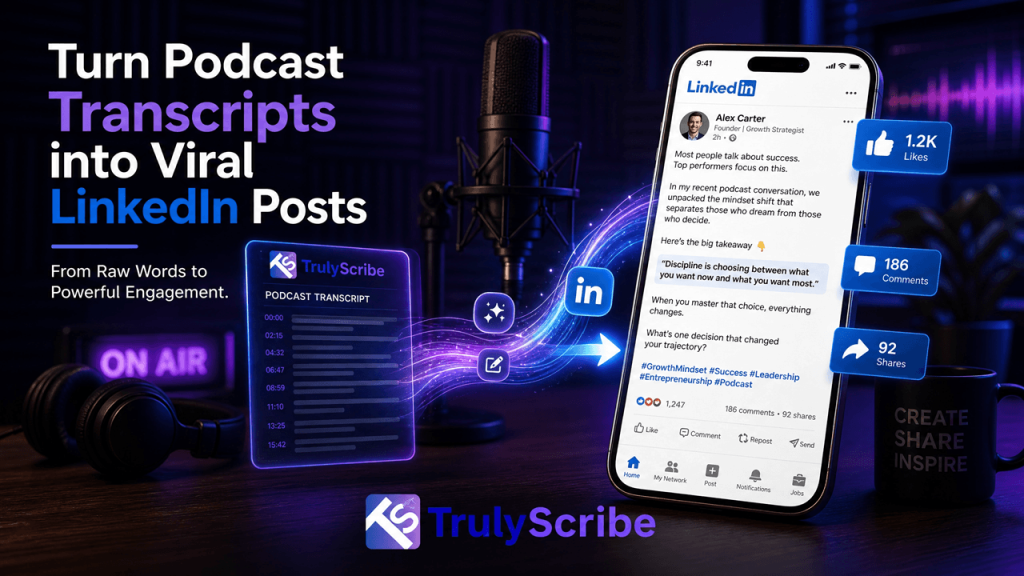
Turn Podcast Transcripts into Viral LinkedIn Posts
You spend hours preparing for every episode. You research your guest, craft your questions, record, edit, and publish. Then the episode goes live—and most of the gold buried inside that conversation disappears into an audio file that maybe 5% of your audience will ever fully listen to. What if you could take everything said in that episode and turn it into content that reaches 10x more people? That’s exactly what the smartest podcasters, founders, and B2B marketers are doing in 2026. They’re using AI transcription to pull every quotable insight, every counterintuitive claim, every story worth sharing out of their episodes—and they’re building a LinkedIn content engine around it. This guide walks you through the exact process: from getting your podcast transcript in minutes, to structuring LinkedIn posts that stop the scroll, to the formats that consistently perform best on the platform. Whether you host a weekly business show or record the occasional conversation with a colleague, this workflow will change how much mileage you get from every episode. Why LinkedIn Is the Best Platform for Podcast Repurposing Not all social platforms are created equal for long-form audio repurposing, and LinkedIn has a structural advantage that most creators underutilize. LinkedIn’s algorithm rewards dwell time—how long someone spends reading your post. This means text-heavy, idea-rich content performs exceptionally well. A 300-word LinkedIn post that shares a genuine insight from a podcast conversation will routinely outperform a polished 30-second video clip, simply because readers engage with it longer. The audience fit matters just as much. LinkedIn’s user base skews heavily toward professionals, decision-makers, and people actively trying to grow in their careers. If your podcast covers business, leadership, entrepreneurship, marketing, technology, finance, or any professional domain, your ideal listener and your ideal LinkedIn reader are essentially the same person. Finally, LinkedIn has generous organic reach compared to other major platforms. You don’t need a following of tens of thousands to see a post perform well. A post that lands with your network can easily reach 3x to 10x your follower count through comments and reposts—especially if it touches on a professional pain point or a genuinely surprising insight. A single well-crafted podcast episode contains enough material for 8 to 15 LinkedIn posts. Most creators are getting one post per episode, if that. Step 1: Get a Full Transcript of Your Episode in Minutes The starting point for everything is the transcript. Without it, mining a 45-minute episode for great content means listening to the whole thing again, manually noting timestamps, and trying to paraphrase ideas you half-remember. That’s why most podcasters don’t repurpose consistently—it’s just too slow. With AI transcription, this step takes minutes rather than hours. Upload your episode audio to TrulyScribe’s free podcast transcription tool, and you’ll have a complete, accurate, time-stamped transcript ready within minutes of your episode wrapping. No credit card, no long setup—just upload and go. The transcript you get back isn’t just a wall of text. Speaker labels tell you who said what, timestamps let you jump to any section, and the output is clean enough to work with immediately. Export it as a DOCX or PDF and you have a working document you can highlight, annotate, and slice into content. 💡 Pro tip: Transcribe every episode the day it’s recorded—before editing, even before it goes live. Having the transcript ready means you can start building LinkedIn content before the episode is even published, so your posts and the launch go out together. TrulyScribe supports all major podcast audio formats—MP3, WAV, M4A, AAC, and more—so there’s no friction regardless of what your recording setup outputs. For teams with a back catalogue, bulk upload support means you can process multiple episodes at once and build a content library overnight. Step 2: Mine the Transcript for LinkedIn-Ready Gold With the transcript open, your job is to become an editor. Read through it with a highlighter mindset—you’re not trying to summarize the episode, you’re looking for moments that could stand alone as a piece of LinkedIn content. Here’s what to look for: Counterintuitive claims. Any time someone says something that contradicts conventional wisdom, that’s LinkedIn gold. ‘Most founders raise money too early.’ ‘Great onboarding starts before the contract is signed.’ These are the statements that make someone stop scrolling. Specific numbers and data points. Specificity builds credibility. ‘We reduced churn by 34% in 90 days by changing a single email.’ That’s more compelling than any general observation about customer retention. Memorable frameworks and mental models. If your guest or co-host described a way of thinking about something in a structured, nameable way, that’s post material. People on LinkedIn love frameworks they can apply immediately. Personal stories with a professional lesson. The moment in the conversation where someone got vulnerable about a failure, a turning point, or an unexpected lesson—these resonate deeply on LinkedIn because they’re rare. Strong opinions stated plainly. Not controversial for controversy’s sake, but genuine convictions stated directly. ‘I don’t think cold outreach works for enterprise sales anymore and here’s why.’ A clear point of view attracts engagement. Aim to pull 8–12 moments per episode. You won’t use all of them immediately, but you’ll build a content buffer that lets you post consistently for weeks after a single recording session. Step 3: Choose the Right LinkedIn Post Format LinkedIn rewards variety. If you post the same format every time, your audience habituates and engagement drops. Mix these five formats across the posts you create from each episode: Format 1: The Hook + Insight Post (300–500 words) This is the workhorse format. Start with a single-line hook—the most surprising or provocative thing that came up in the conversation. Follow it with context, the insight itself, and what it means for the reader. End with a question or a direct call to listen to the full episode. [ Example Hook + Insight Post ]We interviewed 200 founders who sold their companies.Only 31% said the exit felt worth it. That number surprised us when we recorded this episode.But the