Trulyscribe

Security & Privacy

gdpr-ai-transcription-what-businesses-need-to-know
AI Transcription, Business Tools, Compliance, Security & Privacy

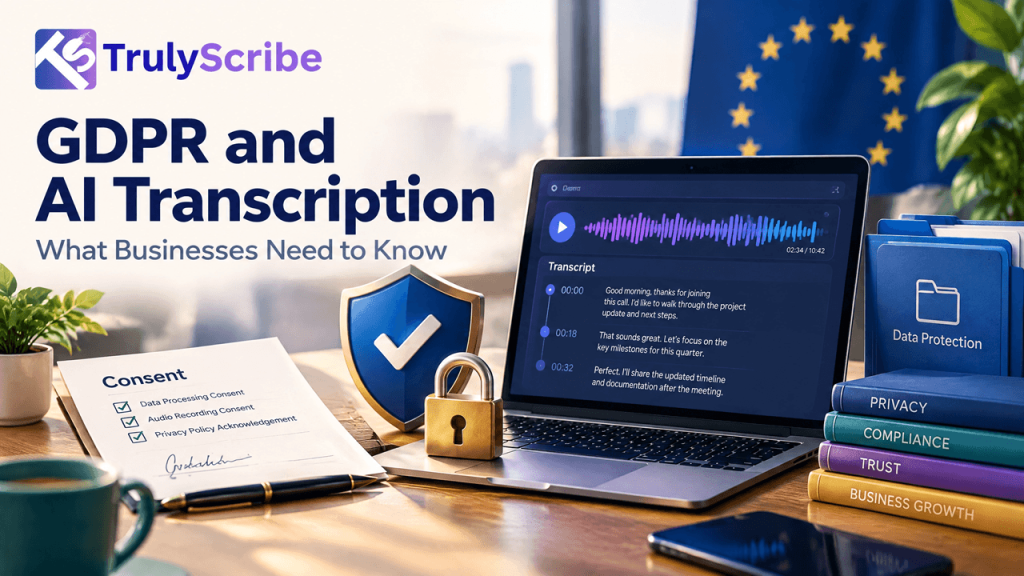
GDPR and AI Transcription: What Businesses Need to Know

Key Takeaways Every time a business transcribes a meeting, a customer call, an interview, or a training session, it creates a new document full of personal data: names, voices, opinions, job titles, and sometimes health or financial details. Under the EU’s General Data Protection Regulation, that document comes with obligations — and so does the tool that produced it. Enforcement is not theoretical. DLA Piper’s GDPR Fines and Data Breach Survey reports about €1.2 billion in fines during 2025, a cumulative total of €7.1 billion since 2018, and an average of 443 personal data breach notifications a day across Europe, up 22% year on year. Transcription is rarely the headline case, but it is the kind of everyday processing that regulators look at when they ask whether an organisation treated data protection as a design principle. This guide explains what GDPR means for AI transcription in plain terms: what counts as personal data, who is responsible for what, which contracts and transfer rules apply, what to ask a vendor, and how to keep your own use of transcription defensible. It is general information, not legal advice, so involve your data protection officer or counsel for decisions specific to your organisation. Is a Transcript Personal Data Under GDPR? Yes, in almost every business setting. GDPR covers any information relating to an identifiable person. A recording of a sales call captures voices, names, and company details. The transcript adds searchable text that can be stored, copied, and shared far more easily than audio ever was. Both are personal data, and both need handling accordingly. Two nuances matter. First, what people say inside a recording can include special category data, such as health information mentioned in a HR call or union membership mentioned in an interview. Article 9 prohibits processing these categories unless one of a short list of conditions applies, and the ICO’s guidance notes there are ten such conditions, with explicit consent being one. Second, a voice becomes biometric data only when it is processed to uniquely identify someone, such as a voiceprint used for authentication. Ordinary speech-to-text is not that, but it is worth confirming with counsel if a tool advertises voice identification features. Controller vs. Processor: Who Is Responsible for What? GDPR splits responsibility between the party that decides why and how data is used (the controller) and the party that processes it on the controller’s behalf (the processor). When a company uploads meeting recordings to a transcription service, the company is normally the controller and the service is the processor. Responsibility You (Controller) Transcription Vendor (Processor) Lawful basis and purpose Decide why you are recording and transcribing Process only on your documented instructions Telling participants Inform people they are being recorded and transcribed Support you with information about processing Security Choose vendors with sufficient guarantees Implement appropriate technical and organisational measures Sub-processors Authorise them, in writing Flow the same obligations down and stay liable Breach handling Notify the regulator within 72 hours where required Tell you without undue delay Rights requests Respond to access and erasure requests Help you retrieve, correct, or delete data End of contract Decide what happens to your data Delete or return it The GDPR Principles Applied to Transcription Article 5 sets out the principles behind every other rule. Here is what each one looks like in a transcription workflow. Principle What It Means for Transcription Lawfulness, fairness, transparency Have a lawful basis, and tell participants a call is being recorded and transcribed and why. Purpose limitation Use transcripts for the stated purpose, such as meeting minutes, not for unrelated profiling. Data minimisation Transcribe what you need. Do not record or keep entire calls out of habit. Accuracy Correct misheard names and terms, especially before a transcript feeds decisions about a person. Storage limitation Set retention periods for recordings and transcripts and delete them when the purpose ends. Integrity and confidentiality Encrypt files, restrict access, and choose vendors with real security controls. Lawful Basis, Consent, and Telling Participants Article 6 lists six lawful bases, and consent is only one of them. For internal meetings, many organisations rely on legitimate interests or contractual necessity and document their reasoning. For external participants, such as customers, candidates, or research subjects, consent or a clearly explained legitimate interest is more common. Regulators have repeatedly cautioned that employee consent is hard to treat as freely given because of the power imbalance, so employers should not lean on it by default. Whatever basis you choose, be transparent. Say at the start of a call that it is being recorded and transcribed, explain the purpose, and tell people how to raise concerns. If you record calls on platforms like Zoom or Google Meet, the same rule applies when you later upload those recordings for transcription. Where recordings touch special category data, add the Article 9 condition on top of your Article 6 basis, and consider a data protection impact assessment for large-scale or high-risk use. Data Processing Agreements: The Contract You Cannot Skip Article 28 requires a binding written contract whenever a processor handles personal data for you. It must cover the subject matter, duration, purpose, types of data, and the processor’s obligations, including confidentiality, security, assistance with data subject rights, and deletion or return of data at the end. It must also control sub-processors: as the ICO explains, a processor cannot engage another processor without your prior specific or general written authorisation, and must impose the same obligations on that sub-processor. In practice, this means asking any transcription vendor for its Data Processing Agreement and its current list of sub-processors, such as cloud hosting and speech recognition providers, before you upload anything containing personal data. A generic terms-of-service page is not a substitute. International Transfers: Where Does Your Audio Actually Go? If a transcription service processes data outside the European Economic Area, GDPR requires a valid transfer mechanism, such as an adequacy decision or Standard Contractual Clauses. For US-based processing, the usual route has been the EU-US Data Privacy
is-ai-transcription-secure-data-retention-encryption
AI Transcription, Business Tools, Security & Privacy

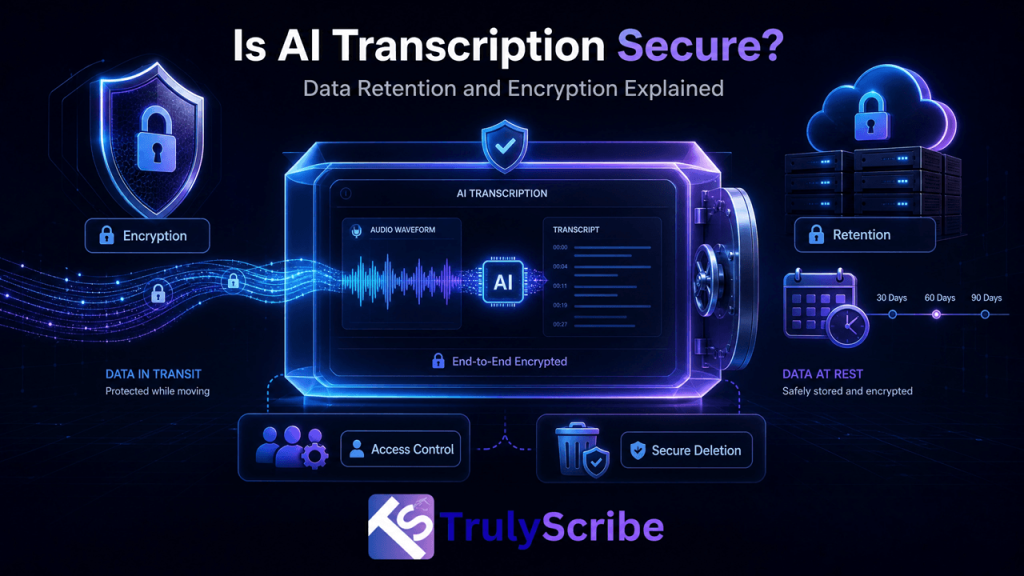
Is AI Transcription Secure? Data Retention and Encryption Explained

AI transcription tools now sit in the middle of some genuinely sensitive conversations: legal depositions, HR interviews, board meetings, therapy-adjacent coaching calls, sales negotiations, and internal strategy discussions. That’s a big shift from what these tools were originally used for — quick notes on a podcast or a casual meeting — and it raises a fair question that doesn’t get answered clearly enough: is any of this actually secure? The honest answer is that it depends entirely on the tool, and “secure” isn’t a single yes-or-no property. It’s a combination of specific, checkable practices: how data is encrypted, how long it’s retained, who can access it, and what happens to it after you’re done. This guide breaks down each of those in plain terms, so you can evaluate any AI transcription tool — including TrulyScribe — on the actual practices that matter, rather than a vague “your data is safe with us” claim. This matters because “secure” gets used as a one-word marketing badge far more often than it gets explained. Two tools can both claim to be secure while handling your data in meaningfully different ways — one deleting the original audio within days, the other keeping everything indefinitely; one clearly stating it never trains models on your content, the other staying silent on the question entirely. The word alone tells you nothing; the specifics behind it tell you everything. Why This Question Matters More Than It Used To Recording a conversation used to mean it existed in one place: a physical recorder, or a video file on your own device. AI transcription changes that by design — the recording typically gets uploaded to a third-party server, processed by a speech recognition model, and stored as both an audio file and a text file, sometimes indefinitely, sometimes across multiple systems if the tool integrates with other software. That’s not inherently a problem. It’s just a different risk profile than a conversation that never left the room, and it means the security practices of whatever tool you’re using directly determine how exposed that conversation actually is. As AI transcription use expands into legal discovery and document review and HR interviews and recruitment, the stakes of getting this wrong go up accordingly. The Three Things That Actually Determine Security Marketing pages love the word “secure,” but it only means something specific when it’s backed by these three things. 1. Encryption — in Transit and at Rest Encryption in transit means your file is protected while it’s traveling from your device to the transcription service’s servers, typically via TLS/HTTPS — the same standard securing online banking. Without it, a file could theoretically be intercepted while uploading. This part is largely table-stakes at this point — any legitimate web-based service, transcription or otherwise, should have TLS/HTTPS enabled by default. If a tool doesn’t, that alone is a strong enough warning sign to look elsewhere before evaluating anything else about it. Encryption at rest means the file stays encrypted once it’s sitting on the provider’s servers, not just during the upload. This matters because a server breach that exposes unencrypted stored files is a very different (and much worse) outcome than one that exposes encrypted files an attacker can’t actually read without the keys. Reputable transcription providers, TrulyScribe included, encrypt files both in transit and at rest as a baseline practice, not an add-on. 2. Data Retention — How Long Your Files Actually Stick Around This is the part most people never think to ask about. Every transcription service has some policy on how long it keeps your audio files, video files, and generated transcripts after processing — and that policy varies widely between providers, and sometimes between plan tiers on the same platform. None of these is automatically wrong, but you should know which one applies to you before uploading anything sensitive — and you should be able to find that answer in a vendor’s actual privacy policy, not just infer it from marketing copy. 3. Access Control — Who Can Actually See Your Data Encryption protects data from outside attackers; access control determines who inside the company, and inside your own organization if you’re on a team plan, can view it. Look for role-based permissions on team accounts, limited internal employee access to raw files, and clear answers about whether human staff ever review transcripts — and under what circumstances. This is the pillar most often overlooked, partly because it’s harder to verify from the outside than encryption or a stated retention window. Asking directly — “who at your company can access my uploaded files, and why” — is a reasonable question to put to any vendor handling sensitive material, and a specific, confident answer is a good sign in itself. Compliance Frameworks You’ll See Referenced Vendors often cite specific compliance frameworks as shorthand for their security posture. Here’s what each one actually signals: Framework What It Actually Means GDPR An EU regulation giving individuals control over their personal data, requiring companies to justify data collection, allow deletion requests, and secure data by design. Applies to any company handling EU residents’ data, regardless of where the company is based. SOC 2 An independent audit certification confirming a company’s security controls meet specific standards across areas like access control and monitoring. It’s a third-party verification, not a self-declared claim. HIPAA A US regulation governing protected health information. Relevant if you’re transcribing anything touching patient data; most general-purpose transcription tools are not HIPAA-covered by default and require a specific business associate agreement to be usable for healthcare data. ISO 27001 An international standard for information security management systems, covering how a company identifies and manages security risk as an ongoing process, not a one-time checklist. The key takeaway: these frameworks aren’t interchangeable, and a vendor citing one doesn’t automatically mean it covers your specific use case. If you’re transcribing legal or medical content specifically, confirm the exact certification and scope with the vendor directly rather than assuming general “compliance” language covers it. Common

Scroll to Top