

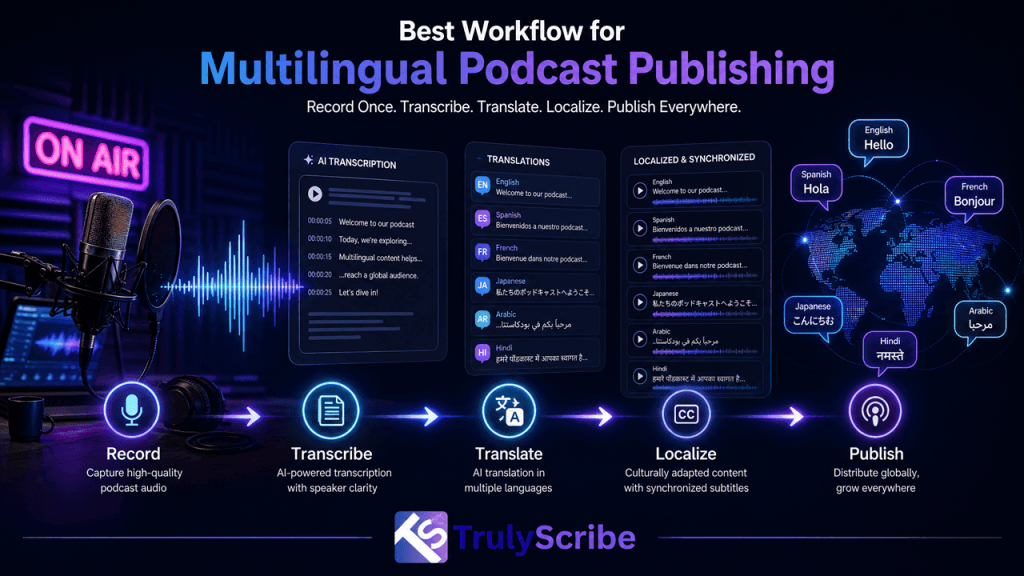
Best Workflow for Multilingual Podcast Publishing
Most podcasts are recorded once and published in exactly one language, even though a huge share of potential listeners live outside that language’s core market. A business podcast recorded in English never reaches the Portuguese-speaking founder in São Paulo who’d genuinely benefit from the episode, or the German product team that would happily subscribe if the show notes and captions existed in their language. For years, going multilingual meant hiring translators, voice actors, and a localization agency — a workflow so expensive and slow that most independent podcasters and even mid-sized media teams simply skipped it. That’s no longer the case. AI transcription, machine translation, and voice synthesis have made it realistic to publish a podcast episode in five, ten, or twenty languages without a translation agency on retainer or a month of turnaround time. This guide walks through the best end-to-end workflow for multilingual podcast publishing in 2026: what to do at each stage, which tools actually matter, and how to avoid the mistakes that derail most first attempts at going multilingual. The workflow below is built around one principle: do the accuracy-critical work once, in the source language, and let automation carry it across every target language from there. Trying to manage translation, captioning, and dubbing as separate projects per language is exactly what makes multilingual publishing feel unmanageable — a single, well-structured pipeline is what makes it sustainable episode after episode. Why Multilingual Podcast Publishing Is Worth the Effort None of this requires localizing every episode into every language from day one. The workflow below is built to start small and scale, which is exactly how most successful multilingual podcasts actually got there. The Old Way vs. the AI-Powered Way Traditional podcast localization involved a translator for the script, a voice actor or dubbing studio for the audio, and a separate person formatting show notes and captions for each language — often coordinated through an agency charging a per-minute rate across every step. For a 45-minute episode in three languages, that could easily run into four figures and take one to two weeks per language. The AI-powered workflow collapses most of that into a single pipeline: transcribe once, translate automatically, generate captions and show notes in every target language, and optionally add AI-dubbed audio — all from one accurate source transcript. What used to be a multi-vendor project is now something one person can run in an afternoon per episode. The economics matter as much as the speed. Agency-based localization typically required a minimum project size to be worth a vendor’s time, which meant only shows with real budget behind them could justify localizing even a single episode. An AI-powered pipeline has no such minimum — it’s just as practical to localize one episode as it is to localize fifty, which is what makes ongoing, episode-by-episode multilingual publishing realistic for independent podcasters, not just well-funded media companies. The Best Workflow for Multilingual Podcast Publishing, Step by Step Step 1: Record Clean Source Audio Everything downstream depends on the quality of your original recording. A decent microphone, a quiet room, and consistent levels between speakers will noticeably improve transcription accuracy and, by extension, translation quality — errors in the source transcript get carried into every language version that follows. Step 2: Transcribe the Episode Accurately Once the episode is recorded or published, the next step is turning it into an accurate, speaker-labeled transcript. If you’re working from an existing episode rather than a fresh recording, you can transcribe directly from Spotify or Apple Podcasts in a few minutes. For interview-style shows with multiple hosts or guests, getting speaker diarization right for multi-speaker recordings matters a lot, since it keeps translated dialogue correctly attributed later. If your recording setup isn’t studio-quality, it’s worth knowing that modern transcription tools now handle background noise far better than older auto-caption tools did. Step 3: Clean Up and Structure the Transcript A raw transcript needs a light pass before it’s ready to translate: correcting names, technical terms, or brand-specific vocabulary the AI may have misheard. This is also the point to add timestamps and section breaks if you plan to publish detailed, timestamped show notes — doing this once in the source language saves redoing it for every translation afterward. It’s worth treating this step as non-negotiable rather than optional. A misheard product name or guest name in the source transcript doesn’t just create one error — it creates the same error repeated across every translated language, every set of show notes, and every repurposed blog post that comes from this episode. A few minutes of review here saves far more cleanup time later. Step 4: Translate the Transcript Into Target Languages With a clean, structured source transcript, translating into multiple languages becomes a matter of running it through a machine translation engine rather than briefing a human translator from scratch. Because the source is already timestamped, translated text stays aligned to the original audio timing, which matters for the caption and dubbing steps that follow. This is the core of a broader multilingual content strategy built around AI transcription, and it’s worth checking which languages a transcription platform actually supports before committing to a target list, since coverage and accuracy vary meaningfully between languages. Step 5: Generate Translated Show Notes and Captions Every translated transcript can become a localized show notes page and, for any video or clip versions of the episode, subtitle files in SRT or VTT format. This step is where a lot of the SEO value shows up: a Portuguese show notes page targets Portuguese search queries directly, rather than relying on listeners to find an English page and translate it themselves. Step 6: Add AI Dubbing for Priority Languages Not every language needs a fully dubbed audio track — translated show notes and captions are often enough for listeners who read along or prefer subtitles on a video version. But for your top two or three priority markets, AI voice synthesis can generate a dubbed audio track