

Most podcasts are recorded once and published in exactly one language, even though a huge share of potential listeners live outside that language’s core market. A business podcast recorded in English never reaches the Portuguese-speaking founder in São Paulo who’d genuinely benefit from the episode, or the German product team that would happily subscribe if the show notes and captions existed in their language.
For years, going multilingual meant hiring translators, voice actors, and a localization agency — a workflow so expensive and slow that most independent podcasters and even mid-sized media teams simply skipped it. That’s no longer the case. AI transcription, machine translation, and voice synthesis have made it realistic to publish a podcast episode in five, ten, or twenty languages without a translation agency on retainer or a month of turnaround time.
This guide walks through the best end-to-end workflow for multilingual podcast publishing in 2026: what to do at each stage, which tools actually matter, and how to avoid the mistakes that derail most first attempts at going multilingual.
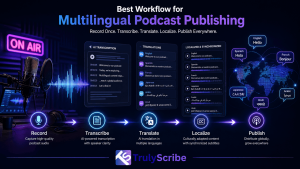
The workflow below is built around one principle: do the accuracy-critical work once, in the source language, and let automation carry it across every target language from there. Trying to manage translation, captioning, and dubbing as separate projects per language is exactly what makes multilingual publishing feel unmanageable — a single, well-structured pipeline is what makes it sustainable episode after episode.
Why Multilingual Podcast Publishing Is Worth the Effort
- Audience growth: most podcast categories have far less competition outside English, making it easier to rank and build an audience in a second or third language.
- Sponsorship and monetization: brands increasingly pay for reach across specific regions and languages, not just downloads in one market.
- SEO and discoverability: translated show notes and transcripts get indexed by search engines and AI answer tools in each language, multiplying the number of queries your episode can surface for.
- Longevity: a well-localized back catalog keeps generating listens and traffic in new markets long after the original release date.
None of this requires localizing every episode into every language from day one. The workflow below is built to start small and scale, which is exactly how most successful multilingual podcasts actually got there.
The Old Way vs. the AI-Powered Way
Traditional podcast localization involved a translator for the script, a voice actor or dubbing studio for the audio, and a separate person formatting show notes and captions for each language — often coordinated through an agency charging a per-minute rate across every step. For a 45-minute episode in three languages, that could easily run into four figures and take one to two weeks per language.
The AI-powered workflow collapses most of that into a single pipeline: transcribe once, translate automatically, generate captions and show notes in every target language, and optionally add AI-dubbed audio — all from one accurate source transcript. What used to be a multi-vendor project is now something one person can run in an afternoon per episode.
The economics matter as much as the speed. Agency-based localization typically required a minimum project size to be worth a vendor’s time, which meant only shows with real budget behind them could justify localizing even a single episode. An AI-powered pipeline has no such minimum — it’s just as practical to localize one episode as it is to localize fifty, which is what makes ongoing, episode-by-episode multilingual publishing realistic for independent podcasters, not just well-funded media companies.
The Best Workflow for Multilingual Podcast Publishing, Step by Step
Step 1: Record Clean Source Audio
Everything downstream depends on the quality of your original recording. A decent microphone, a quiet room, and consistent levels between speakers will noticeably improve transcription accuracy and, by extension, translation quality — errors in the source transcript get carried into every language version that follows.
Step 2: Transcribe the Episode Accurately
Once the episode is recorded or published, the next step is turning it into an accurate, speaker-labeled transcript. If you’re working from an existing episode rather than a fresh recording, you can transcribe directly from Spotify or Apple Podcasts in a few minutes. For interview-style shows with multiple hosts or guests, getting speaker diarization right for multi-speaker recordings matters a lot, since it keeps translated dialogue correctly attributed later. If your recording setup isn’t studio-quality, it’s worth knowing that modern transcription tools now handle background noise far better than older auto-caption tools did.
Step 3: Clean Up and Structure the Transcript
A raw transcript needs a light pass before it’s ready to translate: correcting names, technical terms, or brand-specific vocabulary the AI may have misheard. This is also the point to add timestamps and section breaks if you plan to publish detailed, timestamped show notes — doing this once in the source language saves redoing it for every translation afterward.
It’s worth treating this step as non-negotiable rather than optional. A misheard product name or guest name in the source transcript doesn’t just create one error — it creates the same error repeated across every translated language, every set of show notes, and every repurposed blog post that comes from this episode. A few minutes of review here saves far more cleanup time later.
Step 4: Translate the Transcript Into Target Languages
With a clean, structured source transcript, translating into multiple languages becomes a matter of running it through a machine translation engine rather than briefing a human translator from scratch. Because the source is already timestamped, translated text stays aligned to the original audio timing, which matters for the caption and dubbing steps that follow. This is the core of a broader multilingual content strategy built around AI transcription, and it’s worth checking which languages a transcription platform actually supports before committing to a target list, since coverage and accuracy vary meaningfully between languages.
Step 5: Generate Translated Show Notes and Captions
Every translated transcript can become a localized show notes page and, for any video or clip versions of the episode, subtitle files in SRT or VTT format. This step is where a lot of the SEO value shows up: a Portuguese show notes page targets Portuguese search queries directly, rather than relying on listeners to find an English page and translate it themselves.
Step 6: Add AI Dubbing for Priority Languages
Not every language needs a fully dubbed audio track — translated show notes and captions are often enough for listeners who read along or prefer subtitles on a video version. But for your top two or three priority markets, AI voice synthesis can generate a dubbed audio track timed to match the original episode, giving listeners a fully native-language listening experience. This mirrors the same AI-powered pipeline that’s made affordable webinar localization realistic for businesses — the underlying transcribe-translate-dub sequence is nearly identical.
Step 7: Publish With Localized Metadata
Uploading a translated audio file isn’t enough on its own — episode titles, descriptions, and tags need to be translated too, since that’s what search engines and podcast directories actually index. Publishing full transcripts alongside each language version also helps search engines read and index your content, and increasingly influences how content gets surfaced in AI search tools like ChatGPT, which are becoming a meaningful discovery channel in their own right.
Step 8: Repurpose Every Language Version
The same transcript-and-translation pipeline that powers captions and show notes can also feed content marketing in each language. Teams routinely turn podcast transcripts into social and LinkedIn posts, repurpose episodes into blog content, or build a searchable archive from their back catalog — all of which can now be done in every language the episode was translated into, multiplying the content generated from a single recording session.
Workflow at a Glance
| Step | What Happens | Output |
| 1. Record | Capture clean, consistent-level audio | Source recording |
| 2. Transcribe | Convert audio to accurate, speaker-labeled text | Source transcript |
| 3. Clean up | Fix names/terms, add timestamps and sections | Structured transcript |
| 4. Translate | Machine-translate into target languages | Translated transcripts |
| 5. Caption | Generate show notes and SRT/VTT subtitles | Localized captions and notes |
| 6. Dub | AI voice synthesis for priority languages | Dubbed audio tracks |
| 7. Publish | Upload with translated titles, tags, and metadata | Live multilingual episodes |
| 8. Repurpose | Turn transcripts into blogs and social content | Multilingual content library |
Choosing Which Languages to Start With
Trying to localize into every language at once is the most common reason multilingual podcast projects stall. A more sustainable approach:
- Check your existing analytics for listener locations and language settings — you likely already have some non-native-language demand hiding in the data.
- Prioritize languages with large, underserved audiences in your topic area rather than simply the most widely spoken languages globally.
- Start with captions and translated show notes for three to five languages before committing to full AI dubbing, which is the most resource-intensive step.
- Expand gradually, adding a new language once the previous one shows measurable traction, rather than launching everything simultaneously.
Where TrulyScribe Fits Into the Workflow
Every step in this workflow depends on one thing: an accurate source transcript. Get that wrong, and every translation, caption, and dubbed track downstream inherits the error. TrulyScribe is built to be that reliable starting point — it turns podcast audio into accurate, speaker-labeled, timestamped transcripts across 100+ languages and dialects, and exports directly into the formats a multilingual publishing workflow actually needs: DOCX and TXT for show notes, and SRT and VTT for subtitles.
Its built-in editor lets you review the transcript against the original audio and correct names, terminology, or speaker labels before translation, which keeps errors from compounding across every language version. And because the same transcript can feed captions, show notes, and repurposed blog or social content, TrulyScribe effectively turns one recorded episode into the foundation of a full multilingual content library — which is exactly the leverage that makes this workflow affordable at podcast-production scale.
Common Mistakes in Multilingual Podcast Publishing
- Skipping the transcript cleanup step: uncorrected names and terms compound across every translated language, multiplying small errors into a much bigger cleanup job later.
- Translating audio only, not metadata: a translated episode with an English title and description is largely invisible to listeners searching in their own language.
- Going straight to full dubbing everywhere: dubbing is the most expensive and time-consuming step — most shows get more value starting with captions and show notes across more languages first.
- Treating each language as a one-time project: consistent, ongoing translation for new episodes matters more for audience growth than perfectly localizing a handful of old episodes.
- Ignoring platform-specific formatting: different podcast directories and video platforms expect different metadata and caption formats, so confirm requirements before a big multilingual push.
The Bottom Line
Multilingual podcast publishing used to be reserved for well-funded shows with a localization budget. AI transcription, machine translation, and voice synthesis have made it realistic for any podcaster to reach listeners well beyond their original language, without a translation agency or a month of turnaround time between recording and publishing in a new market.
The workflow starts the same place every localized episode does: an accurate transcript. TrulyScribe makes that step fast and multilingual from the start, ready to feed straight into translation, captioning, and repurposing — turning a single recorded episode into content your entire global audience can actually understand.
Frequently Asked Questions (FAQs)
What’s the fastest way to start publishing a podcast in multiple languages?
Start with translated show notes and subtitles rather than full audio dubbing. Transcribe the episode, translate the transcript into two or three target languages, and publish translated show notes alongside the original audio — this delivers most of the SEO and discoverability benefit without the cost of dubbing every episode.
Do I need to dub every episode into every language?
No. Most shows get the best return by reserving full AI dubbing for their top one to three priority markets, while covering additional languages with translated captions and show notes, which are far cheaper and faster to produce.
How accurate does the source transcript need to be before translating?
As accurate as possible. Errors in the source transcript carry through every translated language, so it’s worth spending a few minutes correcting names, technical terms, and brand vocabulary before translation rather than after.
Does multilingual publishing actually help a podcast grow?
Yes, primarily through reduced competition and better discoverability. Most podcast categories have far more English-language content than content in other languages, making it easier to rank and build an audience once translated show notes and captions exist.
What file formats do I need for a multilingual podcast workflow?
DOCX or TXT for translated show notes and blog content, and SRT or VTT for subtitles on any video version of the episode. Keeping the source transcript in a structured, timestamped format from the start makes generating all of these far easier.
Can I use this workflow for an existing back catalog, not just new episodes?
Yes, and it’s often a good place to start. Older, high-performing episodes are usually the best candidates for localization first, since they already have a track record of listener interest that’s likely to translate into other languages.