

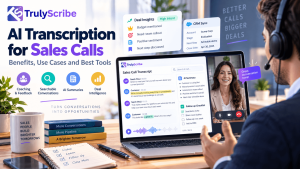
Every sales call is a small goldmine. Buyers tell you what is slowing them down, which competitors they are weighing, who else needs to approve the purchase and what would make them say yes. The trouble is that most of that detail evaporates the moment the call ends. Reps jot down half-notes, managers cannot listen to every recording, and the specifics that decide a deal get lost somewhere between the call and the CRM.
AI transcription for sales calls closes that gap. By converting conversations into accurate, searchable text, it gives revenue teams a dependable record of what was actually said, not what someone remembers. In this guide, we cover what it is, the main benefits, practical use cases, the best tools available and how to pick the right one, including where a flexible platform like TrulyScribe fits into a sales workflow.
Key Takeaways
| AI transcription turns every sales call into searchable text, giving your team an accurate record instead of fading memories and rushed notes. Reps sell better when they are not typing. Automatic transcripts let them focus on listening, asking sharper follow-up questions and building trust. Managers coach faster. Searchable transcripts and timestamps replace hours of replaying recordings with targeted, evidence-based feedback. Transcripts feed everything downstream: CRM updates, follow-up emails, objection libraries, onboarding material and win/loss analysis. There are three tool types: standalone transcription (such as TrulyScribe), AI notetakers (Fireflies.ai, Otter.ai, Fathom) and full conversation intelligence suites (Gong, Avoma). Choose on accuracy, speaker labels, language support, security and pricing model, not just on dashboards, and always get recording consent first. |
What Is AI Transcription for Sales Calls?
AI transcription for sales calls uses speech-recognition technology to convert recorded or live sales conversations, such as discovery calls, demos, negotiations and renewals, into written text. Modern systems go well beyond a wall of words. They add timestamps, label who is speaking and make the whole transcript searchable, so you can jump straight to the moment a prospect mentioned pricing or a competitor.
It helps to separate three layers, because buyers often blur them together:
- Transcription: accurate speech-to-text with speaker labels and timestamps.
- AI notes and summaries: the transcript condensed into key points, action items and draft follow-up emails.
- Conversation intelligence: analysis across many calls to surface patterns such as talk-to-listen ratio, objection trends and deal risk.
Accurate transcription is the foundation of the other two. If the text is wrong, the summaries and analytics built on top of it will be wrong as well. That is why accuracy, speaker identification and language coverage deserve more attention than flashy dashboards. If you are new to the technology itself, our beginner’s guide on what AI transcription is and how it works is a good starting point.
Key Benefits of AI Transcription for Sales Calls
1. A complete, unbiased record of every conversation
Memory is selective. After a few calls in a day, reps blend details together or remember what they hoped to hear. A transcript captures the buyer’s exact words, including the offhand comment about a budget freeze or the second stakeholder who was never named in the CRM. That shared source of truth ends internal debates about what a prospect “really” said.
2. More attentive, more human conversations
Typing notes while talking splits a rep’s attention. When a tool like TrulyScribe handles the record-keeping, sellers can maintain eye contact, listen for emotion and ask the follow-up question that moves a deal forward. Better listening almost always translates into better discovery.
3. Faster, more targeted sales coaching
Few managers have time to replay hours of recordings. Searchable transcripts let them scan a call in minutes, search for keywords like “pricing” or “legal review” and jump to the exact timestamp worth discussing. Coaching shifts from vague impressions to specific, evidence-based feedback that reps can act on the same day.
4. Cleaner CRM data and quicker follow-up
Manual CRM updates are tedious, so they are often late or incomplete. With a transcript in hand, reps can copy accurate next steps, pain points and decision criteria into the CRM and send a recap email while the conversation is still fresh. Speed to follow-up is one of the simplest ways to stay ahead of competitors.
5. Customer insight that reaches the whole company
Sales calls reveal the language buyers use, the objections that stall deals and the features they keep asking for. When transcripts are searchable, product, marketing and customer success teams can mine them for messaging ideas and roadmap input. For more inspiration, see these 25 ways businesses use AI transcription and how to build a knowledge base from transcripts.
6. Faster onboarding for new reps
New hires ramp more quickly when they can read and listen to real calls instead of relying only on scripts. A curated library of annotated transcripts, covering great discovery calls, tough objections and successful closes, gives them a realistic picture of what good looks like.
7. Accountability and dispute resolution
When a customer says, “You told us this was included,” a transcript settles the question quickly and fairly. It protects both the buyer and the seller and reduces friction during contract review and renewals.
8. Lower cost than manual transcription
Paying people to transcribe every call is rarely practical for a busy team. AI delivers results in minutes at a fraction of the price, and you can reserve human review for the few recordings where every word matters. Our comparison of human vs AI transcription breaks down when each approach makes sense.
Top Use Cases for Sales Call Transcription
Discovery and qualification calls
Transcripts make it easy to confirm that reps are capturing the essentials of frameworks such as BANT or MEDDIC: budget, authority, need, timeline and decision process. Managers can quickly see which calls surfaced real pain and which stayed on the surface.
Product demos and presentations
Review which features prospects reacted to, which questions came up repeatedly and where the demo lost momentum. Those patterns help you tighten the demo flow and prepare better answers.
Objection handling libraries
Search transcripts for phrases like “too expensive” or “we already use” and collect the best responses from your top performers. The result is a living playbook grounded in real conversations rather than hypotheticals.
SDR-to-AE handoffs
A common source of lost deals is the handoff gap. When an account executive can read the full discovery transcript, the buyer is not asked to repeat everything, and the next conversation starts from context instead of from scratch.
Pipeline reviews and win/loss analysis
Compare the language in won and lost deals. Did buyers who signed mention a specific pain point early? Did lost deals share the same competitor or the same unanswered question? Transcripts turn those hunches into patterns you can verify.
Customer success, renewals and onboarding
Account managers can document commitments made during implementation and spot early churn signals in check-in calls. The same approach works for recruiting teams hiring sellers, as we explain in our guide to AI transcription for HR and recruitment.
Global and multilingual selling
Selling across regions means conversations in many languages and accents. A transcription platform with broad language support helps distributed teams review calls they could not otherwise follow. TrulyScribe supports a long list of languages, and our article on multilingual content and AI transcription shows how to make the most of it.
Best AI Transcription Tools for Sales Calls
There is no single best tool for every team. The right choice depends on whether you need a simple, accurate transcript, an automated meeting notetaker or a full conversation intelligence platform. The table below groups popular options by what they do best.
| Tool | Best for | What to know |
|---|---|---|
| Gong | Full conversation and revenue intelligence | Deep call analytics, deal tracking and forecasting insights. Built for mid-size to enterprise revenue teams and typically priced accordingly. |
| Avoma | AI meeting assistant with coaching | Combines transcription, notes, scorecards and coaching workflows. A good middle ground for growing sales teams. |
| Fireflies.ai | Automated notetaking across meetings | Records and transcribes calls, generates summaries and syncs with common CRMs. Works for sales and non-sales meetings alike. |
| Otter.ai | Live transcription and collaboration | Popular for real-time transcripts and shareable notes. Suits reps who want a simple notetaker for everyday calls. |
| Fathom | Lightweight AI notes for individual reps | Quick summaries and highlights for Zoom, Meet and Teams calls. Appeals to small teams and solo sellers. |
| TrulyScribe | Accurate, unlimited transcription of recorded calls | Upload audio or video, get speaker-labeled, timestamped transcripts in many languages, edit alongside the recording and export to DOCX or PDF. |
Features and pricing change often, so confirm current details on each vendor’s website before you decide.
For a wider look at the market, see our roundup of the best AI transcription tools in 2026 and our head-to-head TrulyScribe vs Otter AI vs Descript comparison.
Where TrulyScribe Fits in a Sales Workflow
TrulyScribe is built around one job: turning audio and video into accurate, usable text. For sales teams that already record calls in Zoom, Google Meet, Microsoft Teams or a phone system, that focus is a real advantage. You upload the recording, and TrulyScribe returns a transcript with speaker labels and timestamps, ready to review, edit and share.
Here is what that looks like in practice:
- Accuracy you can verify. TrulyScribe cites accuracy of up to 99.8%, and its built-in editor lets you compare the transcript against the audio or video in real time, so corrections to names, product terms and numbers take seconds.
- Unlimited usage with a free tier. New users can start with 15 free hours every month, and paid plans are designed for unlimited transcription, which suits teams with a heavy call volume. See the pricing page for current plans.
- Many languages and accents. Useful for global teams, partners and customers who do not all speak the same language.
- Flexible exports. Download transcripts as DOCX or PDF to attach to deal notes, share with legal or paste into your CRM.
- Privacy-minded processing. Sales calls often include pricing and sensitive business details, so secure handling matters.
If your priority is a precise transcript that works with the tools you already use, TrulyScribe is a strong, cost-effective fit. If you also need bots that auto-join every meeting or dashboards that score deal risk, a full conversation intelligence suite may be the better primary tool, with TrulyScribe covering recordings that fall outside it. Our guides on how to transcribe Zoom and Google Meet recordings for free and free conference call transcription show the upload workflow step by step. Smaller teams can also explore our picks of AI transcription tools for solopreneurs.
How to Choose the Right Tool for Your Team
Use this checklist when you compare options:
- Accuracy in real conditions. Test with your own calls, including accents, product jargon and imperfect audio. Our tips on transcribing audio with background noise and handling technical jargon can help you set realistic expectations.
- Speaker identification. Sales calls involve multiple voices, so clear speaker labels are essential. See how this works in our guide to transcribing multiple speakers accurately.
- Language and accent coverage. Make sure the tool handles every market you sell into.
- Workflow fit. Check whether you need CRM integrations and auto-join bots, or whether uploading recordings is enough.
- Security and data handling. Look for encryption, clear retention policies and compliance with the privacy rules in your regions.
- Pricing model. Per-seat subscriptions add up quickly as teams grow. Usage-based or unlimited plans can be far more predictable.
- Editing and export options. You will want to correct, highlight and share transcripts easily.
How to Get Started: A Simple 5-Step Process
- Define your goal. Decide whether you want better coaching, cleaner CRM data, objection research or all three. A clear goal keeps the rollout focused.
- Set up consent and policy. Tell prospects that calls are recorded and transcribed, and document who can access the transcripts.
- Improve audio quality. Encourage reps to use headsets, quiet spaces and stable connections. Clean audio is the single biggest driver of transcript accuracy.
- Standardize the workflow. For example: record the call, upload the file to TrulyScribe, review the transcript, highlight key moments and add next steps to the CRM within an hour.
- Review and coach weekly. Pick two or three calls per rep each week, discuss specific moments and track changes in conversion, call quality and ramp time.
Privacy, Consent and Compliance
Recording laws vary widely. Some regions require only one party’s consent, others require everyone on the call to agree, and regulations such as GDPR add rules about storing and processing personal data. Always inform participants, follow your company’s policy and consult legal counsel for your specific situation. Choose a provider that encrypts data and gives you control over how long transcripts are kept. This article is general information and not legal advice.
Conclusion
Sales teams have always known that the best insights live inside conversations. AI transcription finally makes those insights easy to capture, search and share. The payoff shows up everywhere: sharper coaching, faster follow-ups, cleaner pipeline data, quicker onboarding and a clearer view of what buyers truly care about.
Start small. Transcribe a handful of recent calls, review them with your team and see what you learn. If you want an accurate, affordable way to begin, you can sign up for TrulyScribe and use your free monthly hours to turn your next sales call into searchable, shareable text.
Frequently Asked Questions (FAQs)
What is AI transcription for sales calls?
AI transcription for sales calls is the automatic conversion of recorded or live sales conversations into written text using speech recognition. Good tools add speaker labels and timestamps and make the transcript searchable, so teams can review, coach and extract insights without replaying the audio.
How accurate is AI transcription for sales calls?
Accuracy depends mostly on audio quality, accents, background noise and technical vocabulary. With clear recordings, leading tools perform very well; TrulyScribe cites accuracy of up to 99.8%. For high-stakes details such as pricing, legal terms or names, review the transcript against the recording before relying on it.
What is the difference between call transcription and conversation intelligence?
Call transcription converts speech into text. Conversation intelligence analyzes many transcripts to reveal trends such as objections, talk-to-listen ratios and deal risk. Transcription is the foundation, so the quality of the transcript directly affects the quality of any analysis built on it.
Can AI transcribe sales calls in different languages?
Can AI transcribe sales calls in different languages?
Yes. Many platforms support multiple languages and accents. TrulyScribe supports a broad range of languages, which helps international sales teams review calls with prospects and partners across different markets.
Can I transcribe Zoom or Google Meet sales calls?
Yes. Record the call in Zoom, Google Meet or Microsoft Teams, then upload the audio or video file to a transcription tool such as TrulyScribe. You will receive a speaker-labeled, timestamped transcript that you can edit and export.
Is it legal to record and transcribe sales calls?
It depends on your location and the location of the people on the call. Some places require consent from one party, others from all parties, and data-protection laws may also apply. Always notify participants and consult legal counsel for your situation.
Which is the best AI transcription tool for sales calls?
It depends on your needs. Gong and Avoma suit teams that want full conversation intelligence, Fireflies.ai, Otter.ai and Fathom work well as automated notetakers, and TrulyScribe is a strong choice when you want accurate, affordable transcripts of recorded calls with editing and easy export.
How does call transcription improve sales performance?
It frees reps to listen instead of typing, speeds up follow-up, improves CRM accuracy and gives managers specific moments to coach. Over time, searchable transcripts also reveal which messages and responses win deals, so the whole team can repeat them.
Relevant Articles
Keep exploring with these related guides from the TrulyScribe blog:
- Best AI Transcription Tools in 2026: an up-to-date comparison of leading platforms.
- TrulyScribe vs Otter AI vs Descript: a side-by-side look at features and value.
- How to Transcribe Google Meet or Zoom Recordings for Free: a step-by-step upload guide.
- Human vs AI Transcription: A Complete Comparison: when to choose speed and when to choose human review.
- 25 Ways Businesses Are Using AI Transcription: practical ideas beyond sales.
- AI Transcription for HR and Recruitment in 2026: hiring interviews, documentation and compliance.
- How to Transcribe Audio with Background Noise: get cleaner results from imperfect recordings.