

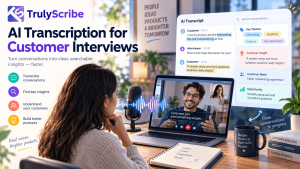
Customer interviews are one of the most valuable sources of insight a product, marketing or research team can have. In a single conversation, a customer can reveal why they bought, what nearly stopped them, which workarounds they invented and what they wish you would build next. The problem is that these insights are fragile. Notes are incomplete, memories shift and the most telling phrases are usually the ones nobody wrote down.
AI transcription for customer interviews solves that problem. By converting recordings into accurate, searchable text, it gives you a reliable record of what customers actually said, and frees you to focus on the conversation itself. In this guide, we explain the benefits, practical use cases, a step-by-step workflow, best practices and the tools to consider, including how TrulyScribe fits into a customer research process.
Key Takeaways
- AI transcription turns customer interviews into searchable text in minutes, so researchers and founders spend their time on insight instead of typing notes.
- You listen better when you are not writing. A reliable transcript lets you stay present, probe deeper and catch the follow-up questions that surface real needs.
- Exact quotes beat paraphrased memories. Verbatim transcripts make findings more credible and give product, marketing and sales teams customer language they can reuse.
- Speaker labels, timestamps and an editor matter most. They make interviews easy to scan, verify and tag, which is where TrulyScribe is strongest.
- The real value comes after transcription: tagging themes, comparing interviews and building a searchable library of customer evidence.
- Always get consent and protect the data. Tell participants how recordings and transcripts are used, and choose tools with sound security practices.
What Is AI Transcription for Customer Interviews?
AI transcription uses speech recognition to convert recorded conversations, whether phone, video or in-person, into written text. For customer interviews, the most useful transcripts include speaker labels, so you can tell your questions from the customer’s answers, and timestamps, so you can jump back to the exact moment a comment was made. A good editor then lets you correct names, product terms and numbers against the original audio.
Transcription is the foundation for everything that follows: tagging themes, pulling quotes, comparing interviews and sharing findings. If you are new to the technology, our beginner’s guide explains what AI transcription is and how it works.
Key Benefits of Transcribing Customer Interviews
1. Stay present in the conversation
Taking detailed notes while interviewing splits your attention. You miss body language, tone and the natural pause where a customer is about to share something important. When a transcript handles the record, you can maintain rapport, listen closely and ask better follow-up questions.
2. Capture exact customer language
The words customers use to describe their problems are marketing gold. Verbatim transcripts preserve those phrases, which helps copywriters, product managers and sales teams speak in the language buyers actually use rather than internal jargon.
3. Reduce bias and memory errors
After several interviews, it is easy to remember what confirmed your hypothesis and forget what challenged it. A full transcript lets you go back and check, which makes your conclusions more credible to stakeholders.
4. Analyze faster and at greater scale
Reading or searching text is much faster than replaying hours of audio. You can search every interview for a keyword like “pricing” or “onboarding”, compare how different customers described the same issue and spot patterns that a single interview would never reveal.
5. Make research reusable across the company
A transcript can be shared with product, design, support and sales without everyone sitting through the recording. Over time, a library of searchable interviews becomes a shared evidence base. Our guide to building a knowledge base from transcripts shows how to organize it.
6. Save money compared with manual transcription
Paying for human transcription of every interview is rarely realistic for lean teams. AI delivers a draft in minutes at a fraction of the cost, and you can reserve human review for the few recordings where every word matters. See our comparison of human vs AI transcription for guidance.
Common Use Cases
Customer discovery and problem validation
Early-stage teams use interviews to test whether a problem is real and painful enough to solve. Transcripts help you separate what customers say they would do from what they describe having already done.
Product and UX research
Usability sessions and feedback interviews generate a lot of detail. Timestamped transcripts let designers link a quote to the exact moment of confusion in a recording.
Churn and win/loss interviews
Conversations with customers who left, or prospects who chose a competitor, are among the most uncomfortable and valuable you will have. Accurate transcripts make sure the reasons are recorded faithfully rather than softened over time. For deal-focused calls, see our guide to AI transcription for sales calls.
Jobs-to-be-done and voice-of-customer programs
Teams running structured programs can code transcripts by job, trigger, obstacle and outcome, then compare results across segments and regions.
Case studies and testimonials
A searchable transcript makes it simple to find the strongest quote, confirm exact wording and get customer approval before publishing.
Global and multilingual research
Interviewing customers in several markets multiplies the work. A platform with broad language support helps teams review conversations they could not otherwise follow. TrulyScribe supports 100+ languages, and our article on multilingual AI transcription shares tips for getting reliable results.
A Step-by-Step Workflow for Customer Interview Transcription
- Plan and get consent. Decide what you want to learn, then ask participants for permission to record and explain how the recording and transcript will be used and stored.
- Record with the best audio you can. Use a quiet space, a decent microphone or headset, and ask participants to join from a stable connection. Clean audio is the biggest driver of accuracy.
- Upload the recording. Add the audio or video file to TrulyScribe, choose the language and let the AI generate the transcript. If you run interviews over video calls, our guide shows how to transcribe Zoom and Google Meet recordings for free.
- Review against the audio. Use the editor to compare the text with the recording. Fix product names, acronyms, numbers and any unclear passages before analysis.
- Tag and highlight. Mark pain points, goals, objections, feature requests and strong quotes. A consistent tagging scheme makes later comparison much easier.
- Synthesize across interviews. Group similar comments into themes, count how often each appears and note meaningful exceptions.
- Share and store. Export the transcript or key quotes as DOCX or PDF, summarize findings for stakeholders and file everything where the team can find it later.
How to Analyze Interview Transcripts
A transcript is raw material, not a finished insight. These habits turn it into evidence your team can act on:
- Create a simple coding scheme. Start with a handful of tags, such as problem, workaround, trigger, outcome and objection, and refine as patterns emerge.
- Separate facts from opinions. Mark what customers did in the past differently from what they say they might do in the future.
- Pull representative quotes. Choose quotes that illustrate a theme clearly, and keep the timestamp so you can return to the original context.
- Look for contradictions. Disagreement between customers is often where the most interesting insights are hiding.
- Compare across segments. Check whether themes differ by company size, role, region or experience level.
Best Practices for Accurate Interview Transcripts
- Improve the recording first. Reduce echo, mute notifications and avoid speakerphone. Our tips on transcribing audio with background noise cover what to do when conditions are less than ideal.
- Use clear speaker labels. Interviews usually have two voices, but group sessions need more. See how to handle multiple speakers accurately.
- Prepare for jargon. Industry terms and product names can trip up any AI. Review them in the editor, and read our guide to handling technical jargon for more ideas.
- Always review critical quotes. Before publishing a testimonial or quoting a customer in a report, check the wording against the audio.
- Keep a consistent file naming system. Include date, customer segment and interviewer so recordings and transcripts are easy to find later.
Choosing the Right Tools
Most customer research stacks combine several tools. The table below shows how the main categories fit together.
| Tool type | Examples | Best for |
|---|---|---|
| Transcription platform | TrulyScribe, Rev, Sonix | Turning interview recordings into accurate, speaker-labeled text you can edit and export |
| Meeting notetaker | Otter.ai, Fireflies.ai | Capturing live calls automatically with summaries and action items |
| Research repository | Dovetail, Condens | Tagging, theming and storing insights from many interviews in one place |
| General workspace | Notion, Google Docs, spreadsheets | Lightweight analysis, affinity mapping and sharing findings |
Features and pricing change often, so confirm current details on each vendor’s website before you decide.
For a closer look at the market, see our roundup of the best AI transcription tools in 2026 and the TrulyScribe vs Otter AI vs Descript comparison.
How TrulyScribe Supports Customer Interview Research
TrulyScribe is built to turn recordings into accurate, usable text, which is exactly what interview-heavy teams need. Here is what that looks like in practice:
- Speaker-labeled, timestamped transcripts. Quickly tell interviewer from customer and jump to any moment in the recording.
- Accuracy you can verify. TrulyScribe cites accuracy of up to 99.8% on clear audio, and the built-in editor lets you compare text and recording side by side.
- Unlimited approach with free monthly hours. Research programs generate a lot of audio. New users can start with free monthly hours, and you can check the pricing page for current plans.
- 100+ languages. Useful for international customer panels and multilingual teams.
- Easy exports. Download transcripts as DOCX or PDF to share with stakeholders or drop into your analysis tool.
- Secure processing. Encryption and secure servers help protect sensitive customer conversations.
TrulyScribe works with the recordings you already have, so it fits alongside whichever video call tool and research repository your team prefers. For more on research workflows, read our guide to AI transcription for research, focus groups and interviews.
Consent, Privacy and Ethics
Customer interviews often include personal or commercially sensitive information. Tell participants clearly that the session will be recorded and transcribed, explain who will see the transcript and how long you will keep it. Where regulations such as GDPR apply, follow their rules on consent, storage and deletion. Consider anonymizing names before sharing transcripts widely, and give customers a way to withdraw consent. Recording laws vary by region, so check your obligations with legal counsel. This article is general information and not legal advice.
Common Mistakes to Avoid
- Skipping the review step. AI is very good, but names, numbers and niche terms still deserve a quick check.
- Transcribing without a plan to use the output. Decide upfront how findings will be tagged, shared and stored.
- Poor audio. Noisy rooms and weak connections cost more accuracy than any other factor.
- Leading questions. Transcripts expose them. Use them as a mirror to improve your interviewing technique.
- Letting transcripts pile up. Without tags and a consistent library, the insights you captured become impossible to find.
Conclusion
Customer interviews are only as valuable as what you can recall and prove afterward. AI transcription captures every detail, speeds up analysis and turns individual conversations into a shared evidence base that the whole company can use. The payoff is sharper product decisions, stronger messaging and customer research that holds up under scrutiny.
Start with a few recent interviews. Upload them, review the transcripts and tag the key themes to see what you have been missing. If you want an accurate, affordable way to begin, you can sign up for TrulyScribe and use your free monthly hours on your next customer conversation.
Frequently Asked Questions (FAQs)
Why should I transcribe customer interviews?
Transcripts give you an accurate, searchable record of what customers said. They free you to listen during the interview, preserve exact quotes, reduce bias and make it far easier to analyze patterns across many conversations.
How accurate is AI transcription for customer interviews?
Accuracy depends on audio quality, accents, background noise and technical vocabulary. With clear audio, leading tools perform very well, and TrulyScribe cites accuracy of up to 99.8%. Always review important quotes against the recording.
Can AI transcribe interviews with multiple speakers?
Yes. Good tools add speaker labels and timestamps automatically. Accuracy is highest with clear audio and distinct voices, so it is still worth checking labels in group conversations.
Can I transcribe customer interviews in other languages?
Yes. Many platforms support multiple languages. TrulyScribe supports 100+ languages, which helps teams interviewing customers across different markets. Test your specific languages and accents first.
Do I need customer consent to record and transcribe interviews?
In most cases, yes. Laws differ by location, and data-protection rules may also apply, so tell participants how the recording will be used and consult legal counsel for your situation.
What should I do with a transcript after the interview?
Review it against the audio, tag key themes and quotes, compare it with other interviews and share a concise summary with stakeholders. Store the transcript in a searchable location so future teammates can reuse it.
Which tool is best for transcribing customer interviews?
It depends on your workflow. TrulyScribe is a strong choice for accurate, speaker-labeled transcripts of recorded interviews with an editor and easy exports. Meeting notetakers suit live capture, and research repositories help you analyze and store insights.
Is AI transcription good enough, or do I need a human transcriber?
For most research, an AI draft plus a quick human review is accurate and far cheaper. Choose human transcription only for legal, regulated or high-stakes material where every word must be verified.
Relevant Articles
Keep exploring with these related guides from the TrulyScribe blog:
- AI Transcription for Research, Focus Groups and Interviews: methods for qualitative research.
- How to Transcribe Focus Groups with Multiple Speakers Accurately: handle group conversations.
- AI Transcription for Sales Calls: benefits, use cases and tools for revenue teams.
- Build a Knowledge Base from Video Transcripts: organize what you learn.
- 25 Ways Businesses Are Using AI Transcription: practical ideas beyond research.
- Human vs AI Transcription: A Complete Comparison: when to choose speed and when to choose human review.
- Best AI Transcription Tools in 2026: an up-to-date comparison of leading platforms.