

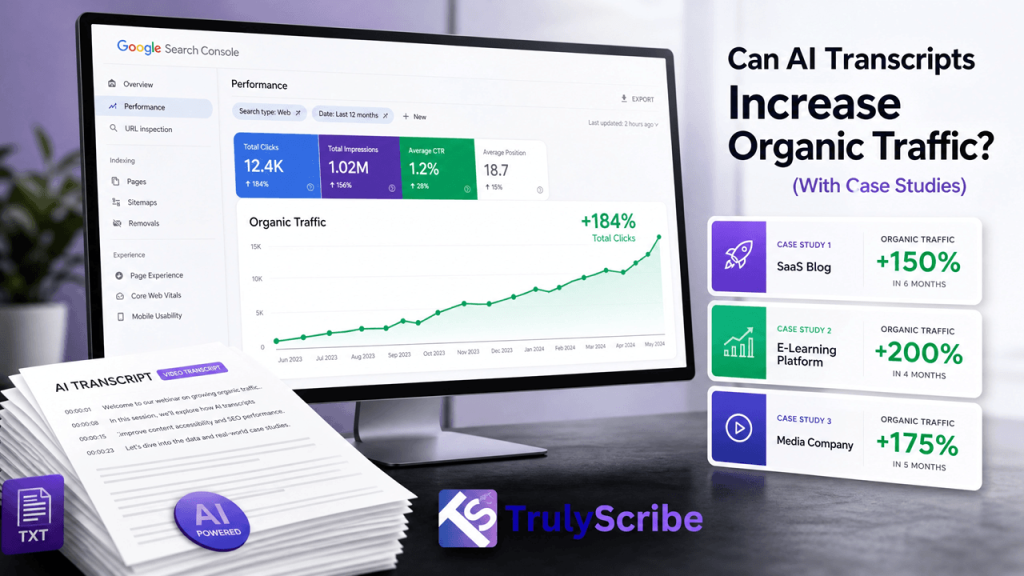
Can AI Transcripts Increase Organic Traffic? (With Case Studies)
It’s a reasonable question to be skeptical about. Adding a wall of text under a podcast player or video embed sounds more like an accessibility checkbox than a growth strategy. But this is one of the rare SEO questions with an actual, measurable paper trail behind it. Organizations have been publishing transcripts and tracking the traffic impact for well over a decade, and the results are consistent enough to draw real conclusions from. This article looks at what transcripts actually do for organic traffic, walks through documented case studies, and lays out how to apply the same approach using modern AI transcription. Why Transcripts Affect Organic Traffic in the First Place Search engines rank text. An audio or video file, on its own, gives a crawler almost nothing to work with beyond a title, a description, and whatever metadata has been added by hand. That’s a tiny fraction of what’s actually said in a 30-minute podcast episode or a 10-minute product demo. A transcript changes that completely. It converts everything spoken in the recording into indexable text, including the specific phrases, questions, and long-tail language a real listener used — language that’s often far more specific and conversational than what shows up in a polished show note or video description. That specificity matters because long-tail, conversational phrases are exactly what a meaningful share of search queries look like, especially as voice search and question-based queries have grown. Transcripts also tend to be long. A single episode can produce several thousand words of unique, topically focused text, which gives a page far more surface area to rank for related searches than a short summary ever could. And because transcripts are often the most detailed, quotable version of the content available, they tend to attract more inbound links and citations than the audio or video alone — which reinforces search authority over time. Case Study 1: This American Life This American Life — Full Archive Transcription+4.18% unique visitors · +6.68% organic search visitors · +3.89% inbound linksOne of the most cited transcript SEO studies comes from the public radio program This American Life, which transcribed its entire audio archive and published the transcripts on its website between April and October 2011. A case study conducted afterward found that unique visitors to the site increased, with the increase in visitors arriving specifically through organic search outpacing overall visitor growth. The study also found that transcript pages attracted a meaningful share of new inbound links — hundreds of external links pointed directly to transcript pages, showing that the text itself, not just the audio, was being referenced and cited elsewhere on the web.Source: 3Play Media case study, “This American Life: Boosting Podcast SEO with Transcription.” What makes this case study useful is its scope: it wasn’t a single episode or a short test, but an entire archive transcribed and tracked over time, which is closer to what most creators or brands would realistically do. Case Study 2: Davis Phinney Foundation (via Moz) Davis Phinney Foundation — Transcripts Added to Podcast Pages+15% organic traffic · +50% keyword rankings (within 3 months)SEO research firm Moz studied the impact of adding transcripts to podcast episode pages for the Davis Phinney Foundation, a health-focused nonprofit. Within just three months of publishing transcripts alongside episodes, the site saw a notable increase in organic traffic, along with a substantial lift in the number of keywords the site ranked for. The relatively short three-month window is notable, since it suggests transcripts can start contributing to search visibility well before the kind of long-term compounding effect SEO strategies often require to show results.Source: Moz research, cited via multiple podcast SEO industry reports. This case is a useful counterpoint to the idea that transcript SEO only pays off over years. A meaningful lift within a single quarter suggests the mechanism — more indexable, specific text — starts working almost as soon as it’s published and crawled. Case Study 3: A Composite Small-Business Scenario The following is an illustrative, composite scenario built from common patterns reported across podcast and content-marketing SEO case studies, rather than a single tracked company. It’s included to show how the mechanism plays out at a smaller scale than a national radio program. Illustrative Example — A Niche B2B PodcastPattern seen across smaller, niche podcasts adding transcriptsA small B2B podcast in a specialized industry (say, commercial insurance or veterinary supply) typically has limited domain authority and can’t compete head-to-head with large publishers on broad keywords. What smaller shows in this position consistently report after adding transcripts is traffic growth concentrated in long-tail, highly specific searches — phrases only mentioned once, in passing, by a guest during an interview. Because larger competitors rarely cover that exact phrase in text form, a transcript page can rank for it with relatively little competition, even on a lower-authority domain. Over dozens of episodes, this compounds into a meaningful stream of niche, high-intent organic traffic that the audio alone was never going to capture.Illustrative pattern, not a single verified case. What These Case Studies Have in Common How to Apply This With Modern AI Transcription The case studies above predate today’s AI transcription tools, which is worth noting: This American Life’s 2011 project and Moz’s early research relied on more manual or expensive transcription processes at a time when producing accurate transcripts at scale was a significant undertaking. That constraint has largely disappeared. Modern AI transcription tools can process an hour of audio or video in minutes, at a fraction of the historical cost, which means the traffic gains documented in these studies are now realistically achievable for far smaller creators and businesses — not just national media organizations with production budgets to match. A Few Realistic Caveats Transcripts aren’t a guaranteed traffic multiplier for every site. A few factors shape how much impact they’ll actually have: Final Thoughts The evidence here isn’t anecdotal — it’s measured, documented, and consistent across more than a decade of case studies, from This American Life’s full-archive project