Trulyscribe

SEO

can-ai-transcripts-increase-organic-traffic-case-studies
SEO, Case Studies, Content Strategy

Can AI Transcripts Increase Organic Traffic? (With Case Studies)

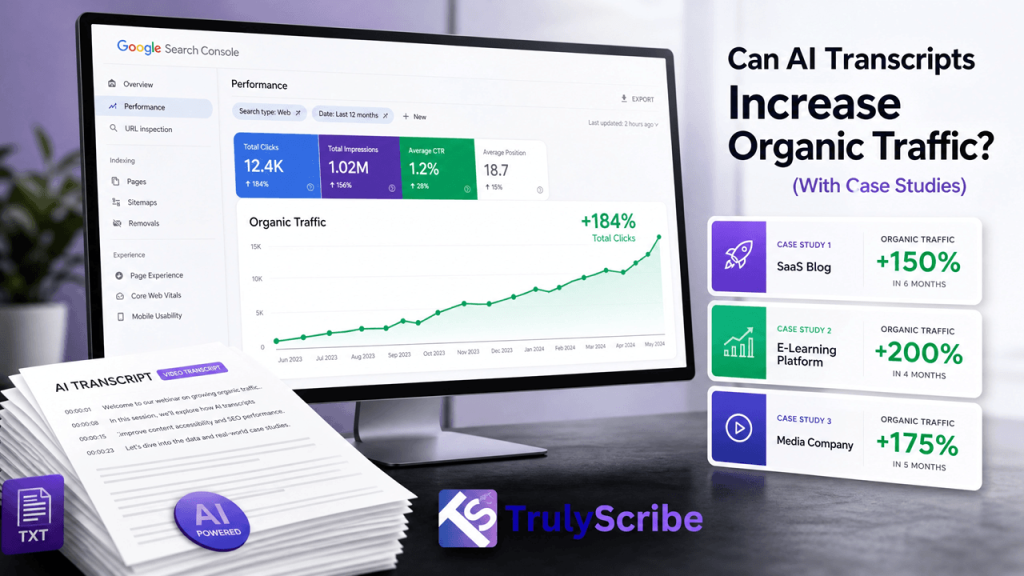
It’s a reasonable question to be skeptical about. Adding a wall of text under a podcast player or video embed sounds more like an accessibility checkbox than a growth strategy. But this is one of the rare SEO questions with an actual, measurable paper trail behind it. Organizations have been publishing transcripts and tracking the traffic impact for well over a decade, and the results are consistent enough to draw real conclusions from. This article looks at what transcripts actually do for organic traffic, walks through documented case studies, and lays out how to apply the same approach using modern AI transcription. Why Transcripts Affect Organic Traffic in the First Place Search engines rank text. An audio or video file, on its own, gives a crawler almost nothing to work with beyond a title, a description, and whatever metadata has been added by hand. That’s a tiny fraction of what’s actually said in a 30-minute podcast episode or a 10-minute product demo. A transcript changes that completely. It converts everything spoken in the recording into indexable text, including the specific phrases, questions, and long-tail language a real listener used — language that’s often far more specific and conversational than what shows up in a polished show note or video description. That specificity matters because long-tail, conversational phrases are exactly what a meaningful share of search queries look like, especially as voice search and question-based queries have grown. Transcripts also tend to be long. A single episode can produce several thousand words of unique, topically focused text, which gives a page far more surface area to rank for related searches than a short summary ever could. And because transcripts are often the most detailed, quotable version of the content available, they tend to attract more inbound links and citations than the audio or video alone — which reinforces search authority over time. Case Study 1: This American Life This American Life — Full Archive Transcription+4.18% unique visitors · +6.68% organic search visitors · +3.89% inbound linksOne of the most cited transcript SEO studies comes from the public radio program This American Life, which transcribed its entire audio archive and published the transcripts on its website between April and October 2011. A case study conducted afterward found that unique visitors to the site increased, with the increase in visitors arriving specifically through organic search outpacing overall visitor growth. The study also found that transcript pages attracted a meaningful share of new inbound links — hundreds of external links pointed directly to transcript pages, showing that the text itself, not just the audio, was being referenced and cited elsewhere on the web.Source: 3Play Media case study, “This American Life: Boosting Podcast SEO with Transcription.” What makes this case study useful is its scope: it wasn’t a single episode or a short test, but an entire archive transcribed and tracked over time, which is closer to what most creators or brands would realistically do. Case Study 2: Davis Phinney Foundation (via Moz) Davis Phinney Foundation — Transcripts Added to Podcast Pages+15% organic traffic · +50% keyword rankings (within 3 months)SEO research firm Moz studied the impact of adding transcripts to podcast episode pages for the Davis Phinney Foundation, a health-focused nonprofit. Within just three months of publishing transcripts alongside episodes, the site saw a notable increase in organic traffic, along with a substantial lift in the number of keywords the site ranked for. The relatively short three-month window is notable, since it suggests transcripts can start contributing to search visibility well before the kind of long-term compounding effect SEO strategies often require to show results.Source: Moz research, cited via multiple podcast SEO industry reports. This case is a useful counterpoint to the idea that transcript SEO only pays off over years. A meaningful lift within a single quarter suggests the mechanism — more indexable, specific text — starts working almost as soon as it’s published and crawled. Case Study 3: A Composite Small-Business Scenario The following is an illustrative, composite scenario built from common patterns reported across podcast and content-marketing SEO case studies, rather than a single tracked company. It’s included to show how the mechanism plays out at a smaller scale than a national radio program. Illustrative Example — A Niche B2B PodcastPattern seen across smaller, niche podcasts adding transcriptsA small B2B podcast in a specialized industry (say, commercial insurance or veterinary supply) typically has limited domain authority and can’t compete head-to-head with large publishers on broad keywords. What smaller shows in this position consistently report after adding transcripts is traffic growth concentrated in long-tail, highly specific searches — phrases only mentioned once, in passing, by a guest during an interview. Because larger competitors rarely cover that exact phrase in text form, a transcript page can rank for it with relatively little competition, even on a lower-authority domain. Over dozens of episodes, this compounds into a meaningful stream of niche, high-intent organic traffic that the audio alone was never going to capture.Illustrative pattern, not a single verified case. What These Case Studies Have in Common How to Apply This With Modern AI Transcription The case studies above predate today’s AI transcription tools, which is worth noting: This American Life’s 2011 project and Moz’s early research relied on more manual or expensive transcription processes at a time when producing accurate transcripts at scale was a significant undertaking. That constraint has largely disappeared. Modern AI transcription tools can process an hour of audio or video in minutes, at a fraction of the historical cost, which means the traffic gains documented in these studies are now realistically achievable for far smaller creators and businesses — not just national media organizations with production budgets to match. A Few Realistic Caveats Transcripts aren’t a guaranteed traffic multiplier for every site. A few factors shape how much impact they’ll actually have: Final Thoughts The evidence here isn’t anecdotal — it’s measured, documented, and consistent across more than a decade of case studies, from This American Life’s full-archive project

transcribing-videos-for-geo-complete-guide
SEO, AI Tools, Video Marketing

Transcribing Videos for GEO (Generative Engine Optimization): Complete Guide

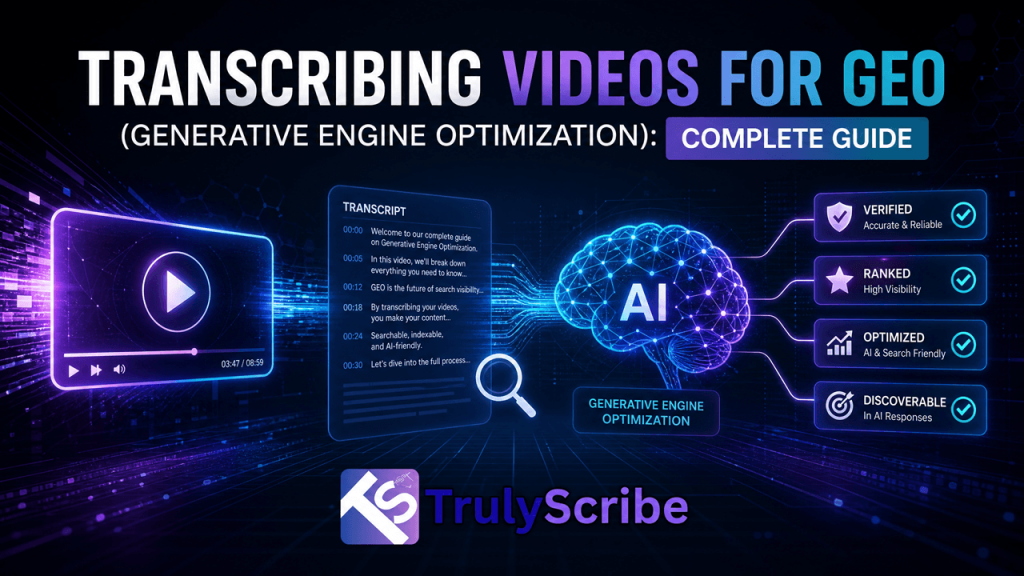
Generative Engine Optimization, or GEO, is the practice of shaping content so it gets picked up, understood, and cited by AI systems like ChatGPT, Perplexity, Google AI Overviews, and Copilot — rather than just ranked in a traditional list of search results. For anyone producing video content, GEO comes with a specific, unavoidable requirement: the video needs to exist as text somewhere, because generative AI systems work with language, not footage. Transcription is the bridge between a video sitting in your library and that same video showing up as a cited source in an AI-generated answer. This guide walks through exactly how to transcribe and structure video content so it performs well under GEO, step by step. What GEO Is, and Why It Treats Video Differently Than SEO Does Traditional SEO optimizes for ranking algorithms that crawl pages, weigh backlinks, and return a list of links for a person to click through. Video SEO within that world has always leaned heavily on titles, descriptions, thumbnails, and watch-time signals, because the algorithm was never really “reading” the video itself. GEO works differently because generative engines don’t return a list of links — they generate a direct answer, often with a citation, by pulling from text they can process and understand. A generative engine can’t watch your video, follow your presenter’s tone, or catch the nuance in a live demo. It can only work with what’s written down. That means a video with no transcript is, from a generative engine’s point of view, mostly invisible — no matter how good the content inside it actually is. This is why transcription sits at the center of any serious GEO strategy for video. It’s not an accessibility nice-to-have anymore; it’s the mechanism that makes video content eligible to be read, chunked, matched to a query, and cited in the first place. How Generative Engines Process Transcribed Video Content Step 1: Text becomes available for retrieval Once a video is transcribed and that transcript is published as text — on a webpage, in a knowledge base, or through a connected content source — it becomes something a generative engine can retrieve. Before this step, the underlying video content simply doesn’t exist in a form these systems can use. Step 2: The transcript is broken into chunks Generative engines typically don’t evaluate an entire page as one unit. They split content into smaller passages and assess each one for relevance to a specific query. A transcript, full of complete spoken statements and natural explanations, tends to chunk well — each section of dialogue often stands on its own as a clear, self-contained answer to a plausible question. Step 3: Chunks are matched against a person’s question When someone asks a generative engine something like “what’s the difference between X and Y” or “how do I fix Z,” the system searches available content for the passages most likely to answer accurately. A well-transcribed explainer video, tutorial, or expert interview often contains exactly this kind of directly responsive language, since spoken explanations tend to be phrased the way people actually ask questions. Step 4: The best match gets surfaced, often with a citation If your transcript contains the clearest, most accurate, best-structured answer to the question being asked, it stands a real chance of being the source the generative engine pulls from and cites. This is the GEO equivalent of a featured snippet or a page-one ranking — visibility inside the answer itself, not just a link beside it. A Step-by-Step Workflow for Transcribing Video for GEO What Makes a Transcript Genuinely GEO-Friendly Publishing any transcript is better than publishing none, but a few specific qualities separate a transcript that performs well under GEO from one that technically exists but rarely gets surfaced. None of these qualities require re-recording anything. They’re almost entirely a function of how the transcript is generated, lightly edited, and structured after the fact — which is why the transcription and formatting step deserves more attention in a GEO strategy than it typically gets. Common Mistakes When Transcribing Video for GEO Why This Matters More as Video Content Keeps Growing Video has become one of the primary ways expertise gets shared — through webinars, product demos, conference talks, and long-form interviews. Most of that content still lives exclusively as video, which means a large and growing share of the internet’s most substantive, specific expertise is currently invisible to generative engines. That gap is exactly the opportunity GEO-focused transcription addresses: instead of competing for visibility by producing more content, it makes existing, high-value video content newly eligible to be found and cited, often with relatively little additional work. As generative engines continue to lean more heavily on retrieval and citation, the advantage will likely keep compounding for creators and brands that treat transcription as a standard step in their publishing process, rather than an afterthought reserved for accessibility compliance. Final Thoughts GEO doesn’t change what makes video content valuable — clear explanations, specific expertise, and honest answers to real questions still matter as much as ever. What it changes is how that value gets discovered. A generative engine can’t watch a video, but it can read a transcript, and a well-structured, accurate transcript is what turns an hour of expertise sitting in a video file into dozens of citable answers a generative engine can actually find. Running video content through an accurate transcription tool like TrulyScribe, then publishing the result with clear structure, timestamps, and speaker labels, is a straightforward way to make sure the expertise already captured on camera doesn’t stay invisible to the tools more and more people are using to search. Frequently Asked Questions

ai-transcripts-rank-chatgpt-ai-search
SEO, AI Tools, Content Strategy

How AI Transcripts Help Your Content Rank in ChatGPT & AI Search

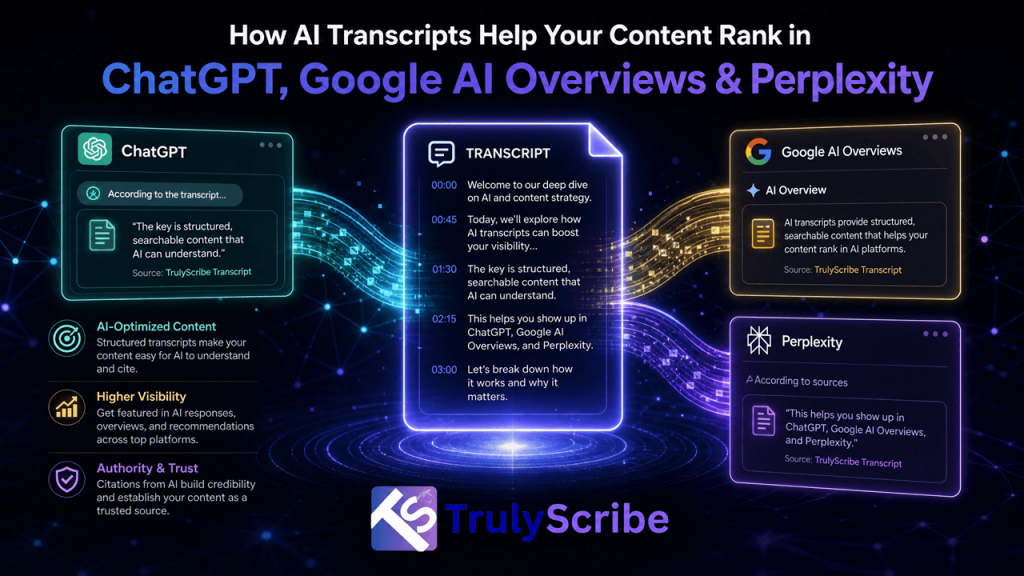
Search is changing shape. People still type questions into a search bar, but a growing share of them now ask ChatGPT, Google AI Overviews, Perplexity, or Copilot instead — and expect a direct answer, not a page of blue links. For creators sitting on hours of podcasts, webinars, interviews, and video content, this shift creates a quiet but real problem: if that content only exists as audio or video, AI systems can’t read it, quote it, or cite it. An AI transcript is what turns a locked audio file into content an AI engine can actually find, understand, and reference — and it may be one of the highest-leverage, lowest-effort SEO moves available in 2026. Why AI Search Changes the Rules for Audio and Video Content Traditional search engines have always struggled to “read” audio and video the way they read text. A podcast episode or a recorded webinar might rank for its title, but the actual substance — the specific advice, the exact numbers mentioned, the quotable insight at minute 14 — stays invisible to a crawler. Search engines have partially compensated with metadata, closed captions, and manual show notes, but none of that captures the full depth of what was actually said. AI search tools go a step further than traditional crawling. Systems like ChatGPT with browsing, Google’s AI Overviews, and Perplexity don’t just index a page — they read it, break it into semantic chunks, and use those chunks to generate a direct answer to a person’s question. That answer often includes a citation or a direct quote pulled from the source. For a chunk of your content to be selected and cited, it has to exist as clear, well-structured text in the first place. Audio and video, however valuable the content inside them, simply aren’t part of that process unless they’ve been transcribed. This is the core shift: in classic SEO, a video could rank on the strength of its title, thumbnail, and surrounding page content. In AI search, an AI model needs to be able to extract a specific, accurate statement from your content to answer a specific, narrow question. A transcript is what makes that extraction possible. What Makes AI Transcripts Valuable for AI Search Specifically Not all transcription is created equal when the goal is AI visibility rather than just accessibility. A few properties matter more than others. Put simply, a transcript doesn’t just make audio “accessible.” It turns a single recording into a long, naturally written, topically deep piece of text — exactly the kind of content AI search systems are built to extract answers from. How the Process Actually Works 1. AI models retrieve and read text-based content Whether through live browsing, a connected search index, or a retrieval system built into the AI product, these tools work primarily with text. Some can process video or audio directly in limited cases, but the reliable, consistent path to being read is a clean, well-formatted transcript published on a page the AI can access. 2. Content gets broken into chunks Rather than treating a page as one block, AI search systems typically split content into smaller passages — often a few sentences to a paragraph — and evaluate each chunk on its own for relevance to a given question. This is why a long, meandering video description performs worse than a transcript: a transcript naturally contains many self-contained, well-formed statements that work well as individual chunks. 3. Relevant chunks get matched to a query When someone asks an AI assistant a question, the system searches its available content for the passages most likely to answer it accurately, then either summarizes or directly quotes the strongest match. A transcript increases the odds that your content contains the exact phrasing, explanation, or data point the system is looking for. 4. The best-matching source gets cited Many AI search products now show a citation or source link alongside their answer. Being the source behind that citation is the AI-search equivalent of ranking on page one — it drives visibility, brand recognition, and increasingly, referral traffic, since curious users often click through to verify or learn more. This entire chain breaks down at step one if there’s no text to retrieve. A brilliant, highly specific answer buried in a video that’s never transcribed is invisible to this whole system, no matter how good the content actually is. Turning Transcripts Into AI-Search-Ready Content Publishing a raw transcript is a good start, but a few practices make transcripts significantly more effective for AI visibility. This is also where the quality of the transcription itself matters more than it might seem. A transcript full of misheard words, missing punctuation, or garbled speaker attribution isn’t just harder for a human to read — it’s a weaker, less reliable source for an AI system trying to extract an accurate answer. This is precisely the kind of use case TrulyScribe is built for: fast, accurate AI transcription with automatic speaker labeling, timestamps, and support for a wide range of languages, producing a clean transcript that’s ready to publish rather than needing hours of manual correction. For anyone sitting on a backlog of podcast episodes, webinars, or interviews, running that content through a reliable transcription tool and publishing the result is one of the more straightforward ways to make existing content newly visible to AI search. Who Benefits Most From This The common thread is that none of these groups need to create new content to benefit. The insight already exists in a recording; transcription is what makes it visible to the systems increasingly standing between that content and the people searching for it. A Simple Starting Workflow For anyone looking to act on this without overhauling an entire content strategy, a lightweight starting workflow looks like this: identify the handful of audio or video pieces that contain the most specific, valuable insight — a flagship podcast episode, a well-attended webinar, a detailed expert interview. Run each through an AI transcription tool to

Scroll to Top