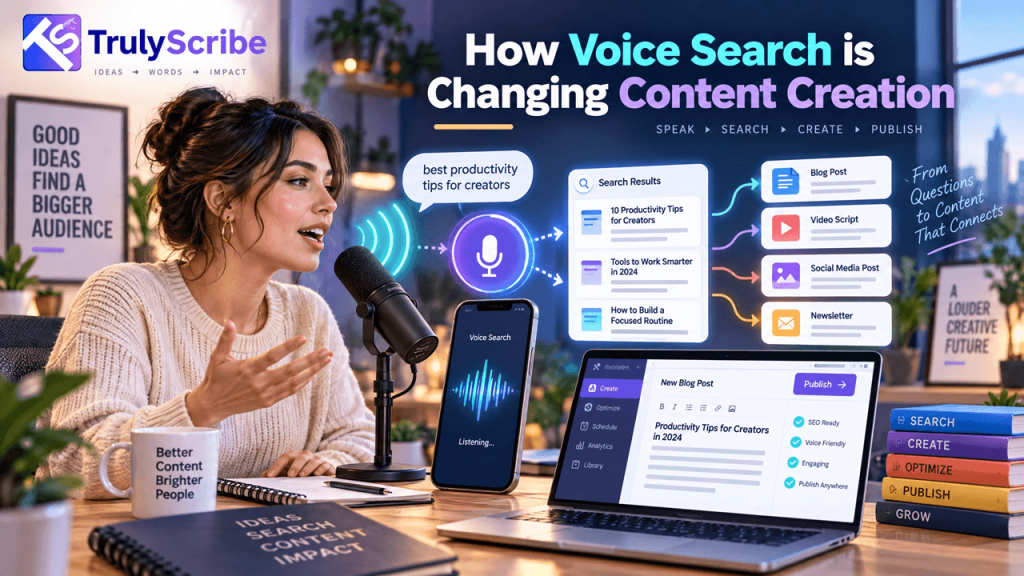
How Voice Search Is Changing Content Creation
Key Takeaways Type “best pizza place” into a search bar and most people instinctively drop the words a sentence would need. Ask a smart speaker the same question and they say it in full: “what’s the best pizza place near me that’s still open?” The query is longer, more specific, and shaped like a real sentence — because it is one. That shift in how people ask questions is quietly changing what content actually needs to look like to get found and get read aloud. Voice isn’t a niche habit anymore. According to Edison Research’s Infinite Dial 2026, reported by SSRS’s Power of Audio 2026, smart speaker ownership in the US climbed to 39% of people aged 12 and up, the largest single-year jump since 2021, alongside 91% smartphone ownership. Every one of those devices is a voice interface, and a growing share of queries now arrive as spoken questions rather than typed fragments. This piece looks at what actually changes when a meaningful share of your audience is asking out loud instead of typing, and where transcription fits into writing content that works for both. This isn’t a call to abandon everything you know about SEO. Most of the fundamentals still apply — clear structure, genuine expertise, fast-loading pages. What changes is more specific: the phrasing of your headers, where you place your answers, and how closely your sentences match the way a real person would actually ask the question out loud. How Voice Queries Differ From Typed Queries The core shift is structural, not just about volume. Typed search has trained people to strip queries down to keywords. Voice search removes that friction, so people ask the way they’d ask a person standing next to them. Factor Typed Search Voice Search Typical query “pizza near me hours” “what time does the pizza place near me close?” Query length Short, keyword-based Longer and conversational Grammar Fragments, dropped words Full questions, natural phrasing Intent signal Inferred from keywords Often explicit (“how,” “what,” “can I”) Result format A page of ranked links Usually one spoken answer That last row matters most for content strategy. A typed search gives a reader ten options to scan. A voice query generally gets one answer read aloud, pulled from whichever source the assistant judges clearest and most directly responsive to the question asked. Ranking well isn’t enough if your content doesn’t also contain an answer an assistant can lift out cleanly. That single-answer dynamic changes the competitive calculus too. Ranking fourth or fifth on a results page still earns clicks from a typed search. In voice search, there’s effectively no equivalent of page-two visibility — an assistant reads one answer, and everything else is invisible to that particular query, no matter how well it would otherwise rank. What This Means for How Content Gets Written Lead with the direct answer Voice assistants favor content that answers a question plainly within the first sentence or two, rather than building up to the point. Put the direct answer near the top of a section, then expand with context and detail afterward for readers who want more. Write headers as real questions A header like “Pizza Delivery Hours” is less likely to match a spoken query than “What time does pizza delivery stop?” Matching your subheadings to the actual phrasing people would say out loud makes it far easier for an assistant to pair the right section with the right question. Use natural, conversational phrasing throughout Content written in clipped, keyword-stuffed fragments reads fine for a search engine trained on typed queries, but it doesn’t match how people actually talk. Writing in full, natural sentences — the way you’d explain something out loud — aligns content more closely with how voice queries are phrased. Build dedicated FAQ sections A clearly labeled question-and-answer format gives assistants an obvious, low-ambiguity source to pull from. It also tends to double as useful, skimmable content for human readers, so the format earns its place even where voice traffic is a secondary concern. Don’t neglect local intent A large share of voice queries carry local intent — “near me,” “open now,” “closest.” Backlinko’s analysis of voice search behaviour notes that the average voice query runs around 29 words, considerably longer than a typed search, which reflects how much specific, local, and conversational detail people pack into a spoken question. Business listings, hours, and location details need to be accurate and consistently published, not just mentioned once on a contact page. Why Spoken Content Is Naturally Shaped for Voice Search Here’s the connection that often gets missed: a transcript of someone genuinely answering a question out loud is already close to the format voice search rewards. Real speech is conversational by default. It uses full sentences. It often states the direct answer before elaborating, the way people naturally explain things. Written content frequently has to be rewritten to sound more natural — spoken content starts there. This is a big part of why creators are increasingly dictating first drafts instead of typing them. Talking through an answer and transcribing it tends to produce more natural, conversational phrasing on the first pass than typing does, simply because speech and voice search share the same underlying rhythm — real questions, real answers, in real sentences. There’s a useful feedback loop hiding in this: the better your content matches how people actually speak, the better it tends to perform in voice search, and the easiest way to write in that register consistently is to start by speaking the answer yourself, rather than trying to simulate natural speech on a keyboard from scratch. A Practical Workflow: Turning Spoken Answers Into Voice-Search-Ready Content Step 1: Record yourself answering the actual question Pick a question your audience genuinely asks — pulled from customer emails, support tickets, or comments — and answer it out loud as if someone asked you directly. Don’t script it word for word; a natural, slightly imperfect answer is the point. Step 2: Transcribe it accurately