

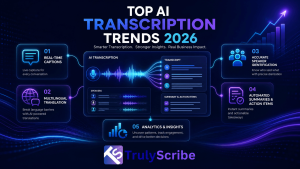
AI transcription has quietly gone from a nice-to-have convenience to core infrastructure for how businesses, educators, and creators work. Meetings, webinars, podcasts, lectures, and customer calls are all being converted into searchable, shareable, translatable text by default — not because someone remembered to hire a transcriptionist, but because the software they already use does it automatically.
2026 is shaping up to be the year this shift stops being optional. Accuracy has closed the gap with human transcription for most everyday audio, real-time captioning is becoming a baseline expectation rather than a premium feature, and transcripts themselves are becoming a distinct content asset — valuable for SEO, for AI search visibility, and for repurposing into blogs, social posts, and knowledge bases. Below, we break down the trends actually driving that shift, what’s causing them, and what they mean for how you should be using AI transcription this year.
Here’s what’s actually worth tracking, and why it matters for how you plan your content, meetings, and tooling for the rest of the year.
1. Near-Human Accuracy Becomes the Default Expectation
For years, “AI transcription” was shorthand for auto-captions that mangled names, dropped words, and needed heavy manual cleanup. That’s no longer the baseline. Modern speech recognition models now regularly hit 95–99% accuracy on clear business audio, which means the gap between AI and professional human transcription has narrowed to the point where AI transcription can match human accuracy for most everyday use cases, with humans reserved for edge cases rather than the default choice.
The practical effect: teams are trusting AI transcripts to be used directly — in meeting notes, in captions, in searchable archives — without a mandatory human retyping pass. That single shift is what makes every other trend on this list economically viable at scale.
It’s also changing how quality gets measured. Instead of asking “is this transcript perfect,” teams are increasingly asking “is this transcript good enough to act on immediately,” which is a much lower bar and one that AI comfortably clears for the vast majority of everyday recordings.
2. Real-Time Transcription Becomes a Standard Meeting Feature
Live captioning used to be a specialized accessibility feature. In 2026, it’s becoming a default expectation for any meeting, webinar, or virtual event. Sales teams want real-time notes they can act on immediately after a call; event organizers want real-time AI transcription during webinars and virtual events so international attendees can follow along as the speaker talks, not just after the recording is processed.
This trend is also changing how people handle recorded meetings after the fact. Instead of manually scrubbing through a video looking for the moment a decision was made, teams are simply transcribing their Google Meet or Zoom recordings and searching the text — turning a 45-minute recording into something they can skim in two minutes.
Expect this to keep pushing further upstream in 2026: rather than transcribing a meeting after it ends, more platforms are generating live summaries and action items as the conversation happens, so the transcript isn’t just a record of what was said but a working document the team can act on before the call is even over.
3. Multilingual Transcription Moves From Nice-to-Have to Core Feature
Global teams and global audiences have made single-language transcription feel incomplete. The trend in 2026 is transcription tools that natively support dozens of languages and dialects, so a company doesn’t need a separate vendor for every market it operates in. This ties directly into a broader multilingual content strategy built around AI transcription, where one transcript becomes the source for translated captions, dubbed audio, and localized blog content across every language a business needs to reach.
This is also feeding directly into affordable webinar localization, since the same transcription-and-translation pipeline that captions a sales call can now caption and translate a full international webinar for a fraction of what agency-based localization used to cost. What used to require a separate translation vendor per language is increasingly just a setting inside the same transcription tool a team already uses.
4. Transcripts Become SEO and AI-Search Assets, Not Just Notes
One of the biggest shifts in 2026 is that transcripts are no longer just an internal convenience — they’re being treated as a distinct SEO asset. Publishing a transcript alongside a video or podcast helps search engines read and index video content that would otherwise be invisible to crawlers, turning a video-only page into one that can actually rank on text queries.
This trend has accelerated further with the rise of AI-powered search and answer engines. Well-structured transcripts are increasingly a factor in how content gets surfaced in ChatGPT and other AI search tools, which is pushing more creators and businesses toward a broader GEO (generative engine optimization) approach to video content where the transcript is treated as seriously as the video itself.
5. Speaker Diarization Gets Smarter
Telling speakers apart used to be one of AI transcription’s weakest points, especially in group settings. That’s changing fast. Improved diarization models are now handling panel discussions, interviews, and focus groups with multiple speakers accurately, correctly attributing overlapping dialogue and fast back-and-forth exchanges that older tools would jumble into a single unlabeled block of text.
For researchers, HR teams, and journalists working with recorded interviews, this trend matters enormously: accurate speaker labels are often the difference between a transcript that’s immediately usable and one that needs a full manual review before anyone can trust it.
6. Noise-Robust Transcription for Real-World Audio
Not every recording happens in a quiet studio. As remote work and hybrid meetings stay the norm, AI transcription models are being trained to perform better on messy, real-world audio — handling background noise like traffic, other conversations, or a noisy home office without falling apart. This matters because it removes one of the biggest practical barriers to trusting AI transcripts by default: the fear that any imperfect recording will produce a garbled, unusable transcript.
7. Domain-Specific Transcription Models
General-purpose transcription is good, but 2026 is seeing a push toward models tuned for specific industries and use cases. Legal teams need transcription that can handle legal discovery and document review workflows accurately and securely. Engineering and research teams need transcription that correctly captures technical jargon in specialized fields instead of guessing at unfamiliar terms. HR teams are adopting AI transcription built for recruitment and interviews to document candidate conversations consistently and fairly.
This specialization trend reflects a maturing market: instead of one generic tool trying to serve every use case equally well, transcription platforms are building features and vocabulary handling tuned to the industries their users actually work in. For buyers, that means the right question in 2026 isn’t just “how accurate is this tool overall,” but “how accurate is it on the specific kind of audio my team actually produces.”
8. Transcript Repurposing Becomes an Automated Pipeline
Perhaps the most visible trend for content teams: transcripts are no longer an end product, they’re a starting point. A single recorded video or podcast episode can now be automatically turned into a full blog post, a set of LinkedIn and social posts, and an entry in a searchable internal knowledge base — all from the same source text, with minimal manual work.
This is a big part of why AI transcription adoption has spread so far beyond its original use case. Businesses are finding dozens of practical ways to use AI transcription across marketing, sales, HR, and operations, simply because the marginal cost of turning audio into reusable text has dropped so close to zero.
9. Accessibility Compliance Pushes Transcription Into Policy, Not Just Preference
Regulatory and institutional pressure is turning captioning and transcription from a courtesy into a requirement. Educational institutions are prioritizing transcript-based accessibility and SEO for online courses, and organizations across the board are paying closer attention to ADA and WCAG accessibility standards for video and audio content. As this compliance pressure grows, AI transcription is becoming the only practical way to caption content volume at the scale institutions now require.
10. Individual Productivity Use Cases Keep Growing
It’s not just enterprises. Individuals are adopting AI transcription for everyday productivity — turning voice notes into organized, searchable text, helping students study more effectively from recorded lectures, and letting freelance writers multiply their output by dictating drafts instead of typing from scratch. This grassroots adoption is quietly becoming one of the biggest growth drivers in the space, as more people discover that transcription tools built for teams work just as well for personal use.
11. Transcription Becomes an Integration Point, Not a Standalone App
The last major trend is more about where transcription lives than what it does. Instead of opening a separate app to transcribe a file and then manually moving the text somewhere else, transcription is increasingly built into the tools teams already use — CRMs that auto-log call transcripts against a deal record, learning management systems that attach lecture transcripts directly to course modules, and project tools that pull action items straight out of a meeting transcript.
For buyers, this means export flexibility matters as much as accuracy. A transcript that’s accurate but stuck in a proprietary format is far less useful than one that exports cleanly to SRT, VTT, DOCX, or plain text and can be piped into whatever system a team relies on next.
2026 Trends at a Glance
| Trend | What It Means in Practice |
| Near-human accuracy | AI transcripts used directly, with minimal manual cleanup |
| Real-time captioning | Live transcription becomes a default meeting/webinar feature |
| Multilingual by default | One workflow covers dozens of languages, not just English |
| Transcripts as SEO/GEO assets | Transcripts indexed by search engines and AI answer tools |
| Smarter speaker diarization | Accurate speaker labels even in group and overlapping audio |
| Noise-robust models | Reliable transcripts from real-world, imperfect audio |
| Domain-specific models | Better handling of legal, technical, and HR terminology |
| Automated repurposing | One transcript becomes blogs, social posts, and knowledge bases |
| Accessibility compliance | Captioning shifts from optional to institutionally required |
How TrulyScribe Is Built Around These Trends
TrulyScribe was designed with exactly this shift in mind. It offers real-time and post-recording transcription with speaker labels and timestamps, supports well over 90 languages so multilingual workflows don’t require switching tools, and exports directly into the formats teams need for captions, blogs, and documentation, including SRT, VTT, DOCX, and PDF.
Because accuracy is the foundation every other trend depends on, it’s worth understanding how TrulyScribe compares to tools like Otter.ai and Descript on accuracy, language coverage, and export flexibility before standardizing your team’s workflow around any single platform.
How to Prepare for These Trends This Year
- Audit where you’re still using manual transcription or note-taking, and identify the highest-volume use case to automate first — sales calls, webinars, or internal meetings are usually the easiest wins.
- Standardize on a transcription tool that covers real-time captioning, multilingual support, and clean export formats, rather than stitching together several point solutions.
- Start publishing transcripts alongside video and audio content, not just keeping them internal, to capture the SEO and AI-search benefits.
- Build a lightweight repurposing habit: every recorded webinar or podcast episode should routinely become a blog post, a few social posts, and a knowledge-base entry.
- Revisit your accessibility posture now, rather than waiting for a compliance deadline to force the issue.
- Pick one transcription tool as your source of truth for exports, so captions, translations, and repurposed content all trace back to the same accurate transcript instead of drifting out of sync across tools.
The Bottom Line
The throughline across every trend on this list is the same: AI transcription is no longer a standalone tool bolted onto a workflow, it’s becoming the layer everything else — captions, translations, SEO, knowledge management, accessibility — is built on top of. Teams that treat transcription as core infrastructure in 2026, rather than an occasional convenience, are the ones who’ll get the most leverage out of every meeting, webinar, and piece of recorded content they create.
If you’re looking to put these trends into practice, TrulyScribe is a good place to start — accurate, multilingual, real-time transcription that’s ready to plug into whatever you build on top of it next.
Frequently Asked Questions (FAQs)
What is the biggest AI transcription trend in 2026?
The biggest shift is that AI transcripts are now accurate enough to be used directly, without a mandatory human cleanup pass. That single change is what’s enabling the other trends — real-time captioning, multilingual workflows, and automated repurposing — to scale affordably.
Is AI transcription accurate enough to replace human transcriptionists in 2026?
For most everyday business, educational, and content use cases, yes — modern AI transcription reaches accuracy levels close to professional human transcription. Human review still adds value for legal, medical, or other high-stakes content where even small errors carry real consequences.
Why are transcripts becoming important for SEO?
Search engines and AI answer tools can’t “watch” a video or “listen” to a podcast, but they can read text. Publishing a transcript alongside audio or video content gives these systems indexable text to crawl, which helps the content surface in both traditional search results and AI-powered search tools.
Can AI transcription handle multiple speakers accurately?
Yes, and this is one of the fastest-improving areas. Modern speaker diarization can reliably label who said what, even in panel discussions, interviews, and group conversations with some overlapping dialogue.
Does AI transcription work well with background noise?
Current models are noticeably better at handling imperfect, real-world audio than earlier generations of transcription software, though a clean recording will always produce the most accurate results.
What languages does AI transcription support in 2026?
Leading platforms, including TrulyScribe, now support well over 90 languages and dialects, making it realistic for global teams to run one transcription workflow across every market they operate in, rather than relying on separate tools per language.
How is AI transcription being used beyond meetings and note-taking?
Businesses are using it for webinar localization, content repurposing into blogs and social posts, accessibility compliance, legal discovery, and HR interview documentation. Individuals are using it for voice notes, study materials, and drafting written work by dictation.