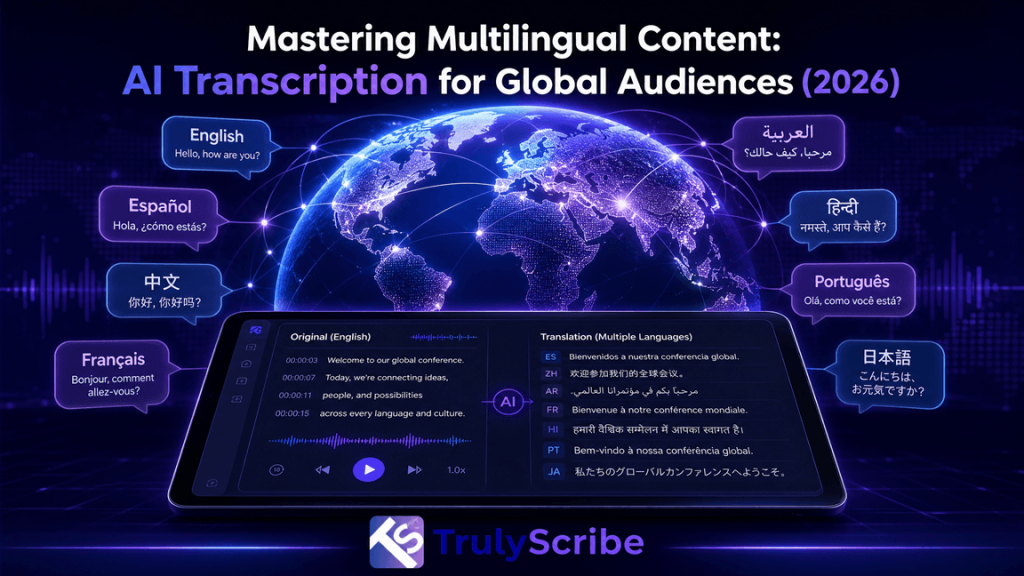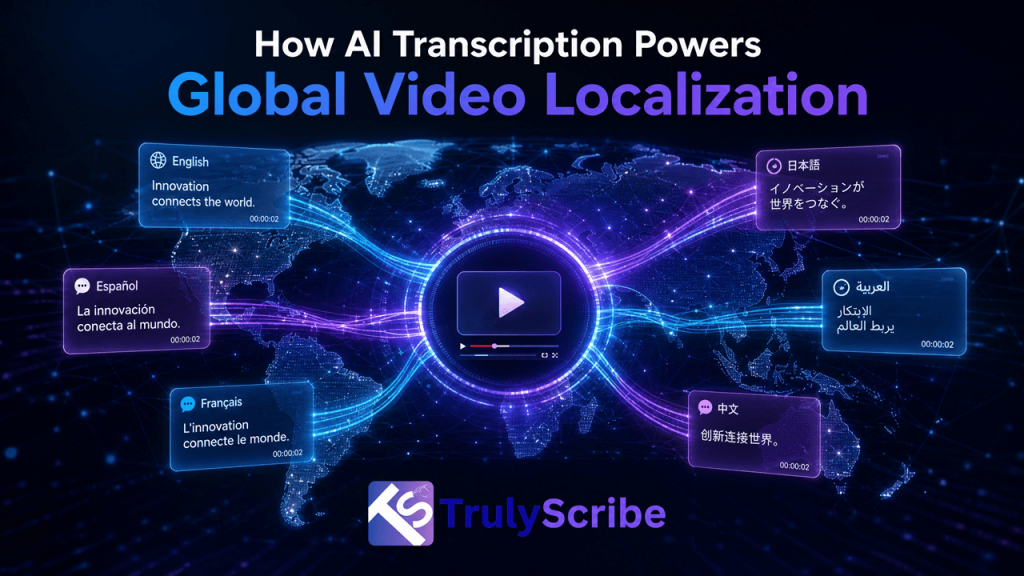
How AI Transcription Powers Global Video Localization
Video has become the dominant language of global business. A product launch video, a customer training course, a keynote from the CEO—these pieces of content carry enormous value, but only if they can actually reach and be understood by the audiences they’re meant for. That’s where localization comes in. And at the very foundation of every successful localization workflow is one critical step: transcription. Before a single subtitle can be written, before a voice-over artist opens their script, before a translated caption appears on screen—someone or something has to convert the spoken audio into accurate written text. In 2026, AI transcription has fundamentally changed what’s possible here. What was once a slow, expensive, and labor-intensive bottleneck has become one of the fastest and most cost-effective steps in the entire localization pipeline. In this post, we’ll walk through exactly how AI transcription powers global video localization—the mechanics, the workflow, the benefits, and the real-world applications across industries. Why Transcription Is the Starting Point for All Video Localization Most people think of localization as a translation problem. In reality, it’s a text problem first. You cannot translate what you cannot read—and until AI transcription arrived at scale, converting video audio to text reliably enough to base a professional localization workflow on it was genuinely difficult. Human transcriptionists are accurate, but they are slow and expensive. A 60-minute corporate training video could take four to six hours to transcribe manually, and professional rates for specialized content—technical, legal, medical—could make the cost prohibitive for anything less than high-priority content. AI transcription changes the equation entirely. A tool like TrulyScribe can process that same 60-minute video in a matter of minutes, producing a time-stamped, speaker-labeled transcript that serves as the source document for every downstream localization task. The rest of the pipeline—translation, subtitle formatting, dubbing, quality review—can start almost immediately. Key insight: AI transcription doesn’t just speed up one step. It accelerates every step that depends on it, which is essentially the entire localization workflow. The Video Localization Pipeline: Where AI Transcription Fits To appreciate how transformative AI transcription has been, it helps to understand the complete localization workflow and where transcription sits within it. A standard video localization pipeline typically looks like this: Step 1 — Transcription: The source audio is converted to text, with timestamps attached to each segment. This becomes the master script. Step 2 — Translation: The transcribed text is translated into target languages by human translators or machine translation engines (often with human post-editing for quality-sensitive content). Step 3 — Subtitle Formatting: Translated text is broken into subtitle blocks that fit within the time codes established in the original transcript. Each block must match the timing of the spoken audio. Step 4 — Review & QA: Linguists and localization engineers review the subtitles for accuracy, readability, and synchronization. Step 5 — Dubbing (if required): For dubbed content, voice-over artists read from the translated script. The dubbing script is adapted to match lip movements and timing of the original recording—a process called lip-sync adaptation. Step 6 — Final Delivery: The localized video is encoded with embedded or sidecar subtitle files (SRT, VTT, etc.) or with a dubbed audio track, then delivered to the target platform. AI transcription makes Step 1 nearly instantaneous. Because Step 1 is the dependency for every other step, compressing it from hours to minutes has a multiplier effect on total project time. Subtitle Generation: From Audio to Screen in Minutes Subtitles are the most common output of a video localization project, and AI transcription is the most direct path to producing them. When a video is transcribed with accurate timestamps, the resulting file can be exported directly as an SRT or WebVTT file—the two most widely accepted subtitle formats across streaming platforms, video hosting services, and corporate video players. For teams producing subtitles in the source language only—say, English captions for an English-language training video—AI transcription alone may be all they need. The transcript is reviewed, lightly edited, and formatted into a caption file without any translation step at all. For multilingual subtitle projects, the time-coded transcript from TrulyScribe becomes the source document handed to translators. Because timing is already embedded, translators can focus on finding natural-sounding equivalents in the target language rather than manually syncing text to video. This removes one of the most tedious and error-prone parts of the traditional subtitle workflow. The quality of the original transcription matters enormously here. A transcript with inaccurate timestamps or missed words creates downstream errors that can be expensive to fix. High-accuracy AI transcription—consistently above 98% for clear audio—makes the rest of the localization work cleaner and faster. Dubbing Workflows: How AI Transcription Enables Scalable Voice-Over Dubbing has historically been the most resource-intensive form of video localization. It requires a script, a recording studio, voice talent, audio engineers, and careful synchronization work. For most content, the economics simply didn’t justify the investment. AI transcription has made dubbing workflows significantly more scalable by automating the script creation phase. A dubbed video project begins with a verbatim transcript that captures not just the words but the rhythm and pacing of the original delivery. This transcript is then adapted by a linguistic specialist into a dubbing script—adjusted for lip-sync timing and natural-sounding phrasing in the target language. Some production studios are now combining AI transcription with AI voice synthesis to create fully automated dubbing pipelines for lower-stakes content such as e-learning modules, internal training videos, and product demos. While human voice talent remains the gold standard for premium content, AI-assisted dubbing has made it economically viable to localize a much larger portion of a content library than was previously possible. Teams using TrulyScribe as their transcription layer report that automated dubbing pipelines reduce script preparation time by over 70% compared to manual approaches. Multilingual Transcription: Beyond One Source Language Many global businesses produce original content in multiple languages simultaneously. A multinational company might record the same product briefing in English, Spanish, German, and Mandarin—four separate recordings, each needing to be