
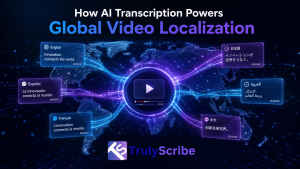
Video has become the dominant language of global business. A product launch video, a customer training course, a keynote from the CEO—these pieces of content carry enormous value, but only if they can actually reach and be understood by the audiences they’re meant for.
That’s where localization comes in. And at the very foundation of every successful localization workflow is one critical step: transcription. Before a single subtitle can be written, before a voice-over artist opens their script, before a translated caption appears on screen—someone or something has to convert the spoken audio into accurate written text.
In 2026, AI transcription has fundamentally changed what’s possible here. What was once a slow, expensive, and labor-intensive bottleneck has become one of the fastest and most cost-effective steps in the entire localization pipeline. In this post, we’ll walk through exactly how AI transcription powers global video localization—the mechanics, the workflow, the benefits, and the real-world applications across industries.
Why Transcription Is the Starting Point for All Video Localization
Most people think of localization as a translation problem. In reality, it’s a text problem first. You cannot translate what you cannot read—and until AI transcription arrived at scale, converting video audio to text reliably enough to base a professional localization workflow on it was genuinely difficult.
Human transcriptionists are accurate, but they are slow and expensive. A 60-minute corporate training video could take four to six hours to transcribe manually, and professional rates for specialized content—technical, legal, medical—could make the cost prohibitive for anything less than high-priority content.
AI transcription changes the equation entirely. A tool like TrulyScribe can process that same 60-minute video in a matter of minutes, producing a time-stamped, speaker-labeled transcript that serves as the source document for every downstream localization task. The rest of the pipeline—translation, subtitle formatting, dubbing, quality review—can start almost immediately.
Key insight: AI transcription doesn’t just speed up one step. It accelerates every step that depends on it, which is essentially the entire localization workflow.
The Video Localization Pipeline: Where AI Transcription Fits
To appreciate how transformative AI transcription has been, it helps to understand the complete localization workflow and where transcription sits within it. A standard video localization pipeline typically looks like this:
Step 1 — Transcription: The source audio is converted to text, with timestamps attached to each segment. This becomes the master script.
Step 2 — Translation: The transcribed text is translated into target languages by human translators or machine translation engines (often with human post-editing for quality-sensitive content).
Step 3 — Subtitle Formatting: Translated text is broken into subtitle blocks that fit within the time codes established in the original transcript. Each block must match the timing of the spoken audio.
Step 4 — Review & QA: Linguists and localization engineers review the subtitles for accuracy, readability, and synchronization.
Step 5 — Dubbing (if required): For dubbed content, voice-over artists read from the translated script. The dubbing script is adapted to match lip movements and timing of the original recording—a process called lip-sync adaptation.
Step 6 — Final Delivery: The localized video is encoded with embedded or sidecar subtitle files (SRT, VTT, etc.) or with a dubbed audio track, then delivered to the target platform.
AI transcription makes Step 1 nearly instantaneous. Because Step 1 is the dependency for every other step, compressing it from hours to minutes has a multiplier effect on total project time.
Subtitle Generation: From Audio to Screen in Minutes
Subtitles are the most common output of a video localization project, and AI transcription is the most direct path to producing them. When a video is transcribed with accurate timestamps, the resulting file can be exported directly as an SRT or WebVTT file—the two most widely accepted subtitle formats across streaming platforms, video hosting services, and corporate video players.
For teams producing subtitles in the source language only—say, English captions for an English-language training video—AI transcription alone may be all they need. The transcript is reviewed, lightly edited, and formatted into a caption file without any translation step at all.
For multilingual subtitle projects, the time-coded transcript from TrulyScribe becomes the source document handed to translators. Because timing is already embedded, translators can focus on finding natural-sounding equivalents in the target language rather than manually syncing text to video. This removes one of the most tedious and error-prone parts of the traditional subtitle workflow.
The quality of the original transcription matters enormously here. A transcript with inaccurate timestamps or missed words creates downstream errors that can be expensive to fix. High-accuracy AI transcription—consistently above 98% for clear audio—makes the rest of the localization work cleaner and faster.
Dubbing Workflows: How AI Transcription Enables Scalable Voice-Over
Dubbing has historically been the most resource-intensive form of video localization. It requires a script, a recording studio, voice talent, audio engineers, and careful synchronization work. For most content, the economics simply didn’t justify the investment.
AI transcription has made dubbing workflows significantly more scalable by automating the script creation phase. A dubbed video project begins with a verbatim transcript that captures not just the words but the rhythm and pacing of the original delivery. This transcript is then adapted by a linguistic specialist into a dubbing script—adjusted for lip-sync timing and natural-sounding phrasing in the target language.
Some production studios are now combining AI transcription with AI voice synthesis to create fully automated dubbing pipelines for lower-stakes content such as e-learning modules, internal training videos, and product demos. While human voice talent remains the gold standard for premium content, AI-assisted dubbing has made it economically viable to localize a much larger portion of a content library than was previously possible.
Teams using TrulyScribe as their transcription layer report that automated dubbing pipelines reduce script preparation time by over 70% compared to manual approaches.
Multilingual Transcription: Beyond One Source Language
Many global businesses produce original content in multiple languages simultaneously. A multinational company might record the same product briefing in English, Spanish, German, and Mandarin—four separate recordings, each needing to be transcribed before localization can begin.
This is where multilingual AI transcription becomes a genuine operational advantage. Rather than managing four separate human transcription projects with different vendors and turnaround times, a single platform can process all four recordings in parallel. TrulyScribe supports transcription across more than 100 languages, meaning most global content teams can run their entire multilingual transcription workflow through one tool.
This consolidation matters beyond convenience. It standardizes the output format—consistent timestamp structure, consistent file naming, consistent speaker labeling—which makes downstream handoffs to translators and localization engineers far more predictable.
Accessibility and Compliance: A Mandatory Localization Use Case
In many markets, captioned video isn’t just good practice—it’s a legal requirement. The Americans with Disabilities Act (ADA) in the US, the European Accessibility Act (EAA) across the EU, and equivalent legislation in dozens of other markets require that video content published by organizations of certain types or sizes be accessible to deaf and hard-of-hearing viewers.
AI transcription is the most practical way to meet these requirements at scale. A media company publishing hundreds of video assets per month cannot afford to manually caption each one. With AI transcription, every piece of content gets a caption file automatically, and a human reviewer spot-checks for accuracy rather than starting from scratch.
Beyond compliance, accessibility captions also improve SEO. Search engines can index the text of a transcript, making video content discoverable in ways that audio alone cannot be. Organizations that caption consistently often see measurable improvements in organic search traffic to their video pages.
The Economics: What AI Transcription Actually Saves
The cost difference between human and AI transcription is not marginal—it’s transformative. Traditional transcription services charge between $1.00 and $3.00 per audio minute for standard content, and significantly more for technical, medical, or legal material. For a library of 1,000 hours of video content, that means a transcription bill of $60,000 to $180,000 before a single translation has been ordered.
AI transcription platforms like TrulyScribe reduce that cost by 80% to 95%, and many offer unlimited or generous free tiers that make it economically viable to transcribe content speculatively—that is, to transcribe a video before you’ve even decided whether it will be localized, so the transcript is ready the moment you need it.
The savings compound across the workflow. Faster transcription means faster project kick-off. Cleaner transcripts mean fewer errors for translators to navigate, which reduces review cycles. Standardized output means less reformatting time for localization engineers. The total cost reduction across a full localization project is consistently higher than the transcription savings alone.
A localization team that transcribes 500 hours of video content per year can save $40,000 to $100,000 annually by switching from human to AI transcription—before accounting for any downstream efficiency gains.
Real-World Applications Across Industries
Media & Entertainment: Streaming platforms localize series, films, and documentary content for dozens of markets simultaneously. AI transcription produces the master subtitle file that kicks off parallel translation projects across every target language.
Corporate Learning & Development: Global companies localize employee training videos into local languages for every market they operate in. AI transcription makes it practical to localize the entire training library rather than just the highest-priority content.
Marketing & Brand Content: Product launch videos, customer testimonials, and brand campaigns are localized faster than ever, allowing marketing teams to hit simultaneous global launch dates rather than staggering releases by market.
Software & SaaS: Product tutorial videos, onboarding walkthroughs, and help center content are transcribed and localized to support international user bases. TrulyScribe’s export formats make it easy to drop transcripts directly into localization management systems.
Healthcare & Medical Education: Clinical training videos, patient education content, and medical conference presentations are localized into local languages for healthcare providers and patients around the world.
Legal & Compliance: Law firms and regulatory bodies localize deposition recordings, court proceedings, and compliance training materials. Accurate, verbatim transcription is non-negotiable in these contexts.
Challenges and How to Address Them
AI transcription is not without limitations, and understanding them helps you build a workflow that accounts for them.
Audio Quality: Background noise, overlapping speakers, and low-quality recordings reduce transcription accuracy. The best mitigation is source audio quality—recording in a controlled environment with good microphones. When that’s not possible, manual review of the AI transcript before it enters the localization pipeline is essential.
Technical and Domain-Specific Vocabulary: AI models may struggle with specialized terminology—medical Latin, legal jargon, brand-specific product names. Many platforms allow custom vocabulary lists or glossary uploads. TrulyScribe’s editor also makes it straightforward to correct terminology before the transcript is passed downstream.
Strong Accents and Non-Standard Dialects: While AI transcription has improved dramatically for accent coverage, some dialects remain challenging. For high-stakes content with non-standard speech, a human review step remains best practice.
Data Privacy: Video content often contains sensitive information. Businesses handling confidential or regulated content should verify that their AI transcription provider uses end-to-end encryption and complies with relevant data protection regulations. TrulyScribe treats data security as a core platform requirement, not an afterthought.
Building a Scalable AI-Powered Localization Workflow
For teams looking to move from ad-hoc localization to a repeatable, scalable workflow, here’s a practical starting structure:
1. Standardize your source content: Record all original video with localization in mind—clear audio, minimal background noise, controlled pacing. The better the source, the cleaner the transcript.
2. Transcribe immediately on upload: Don’t wait until a localization project is confirmed. Upload every video to your transcription platform at the point of creation, so transcripts are available the moment they’re needed. TrulyScribe makes this practical with its multi-format upload support.
3. Review and approve transcripts before translation: A short human review of the AI transcript catches errors before they propagate through translation. This is far cheaper than correcting issues at the subtitle or dubbing stage.
4. Connect transcription output to your translation management system (TMS): Most modern TMS platforms accept SRT, VTT, and plain text files. A clean, timestamped transcript from TrulyScribe flows directly into tools like Phrase, Lokalise, or Smartcat without reformatting.
5. Build a terminology glossary: As you localize more content, document brand-specific terms, product names, and technical vocabulary. Apply this glossary consistently across transcription review and translation to keep terminology aligned across languages.
6. Measure and optimize: Track time-from-source-upload to localized-video-delivery. AI transcription typically cuts this timeline by 30% to 50% for teams moving from manual transcription, and continuous process refinement can push that further.
The Future: Real-Time and Automated Localization
The trajectory of AI transcription points toward increasingly real-time and fully automated localization. Live event captioning—already possible with current AI—is becoming standard for webinars, virtual conferences, and live-streamed content. Near-real-time multilingual subtitle generation, where captions are translated and displayed within seconds of being spoken, is now commercially available for major language pairs.
The next frontier is fully automated end-to-end localization: a video is uploaded, AI transcribes it, machine translation produces subtitle files in 20 languages, and those files are automatically validated and published—all without human intervention for straightforward content. Human linguists remain essential for premium, high-stakes, or nuanced content, but the volume of content that can be localized without human intervention is growing rapidly.
For businesses thinking about their localization strategy in 2026 and beyond, building on a strong AI transcription foundation—a platform that is accurate, fast, multilingual, and integrates cleanly with downstream tools—is the most important infrastructure decision they can make. TrulyScribe is designed with exactly this workflow in mind, giving content teams a reliable transcription layer they can build an entire global distribution strategy on top of.
Frequently Asked Questions (FAQs)
Q: What is video localization and how is it different from translation?
A: Video localization is the process of adapting video content for a specific target market or language—including subtitles, dubbing, on-screen text, and cultural references. Translation is one component of localization, but localization also involves timing, formatting, cultural adaptation, and technical delivery. AI transcription is the first step that makes all of these tasks possible.
Q: How accurate does AI transcription need to be for professional localization work?
A: For professional localization, you want a minimum of 95% word-level accuracy, and ideally 98%+ for clean audio. Even small errors compound when they are passed to translators—a mistranscribed word can result in an incorrect translation that is then embedded in subtitle files distributed across multiple platforms. High-accuracy platforms like TrulyScribe minimize this risk.
Q: Can AI transcription handle videos with multiple speakers or background noise?
A: Yes, though performance varies with conditions. Modern AI transcription tools include speaker diarization to label different speakers, and they perform well on clean multi-speaker recordings such as interviews and panel discussions. Background noise reduces accuracy, which is why source recording quality is the most important variable you can control. For noisy recordings, a human review step before translation is recommended.
Q: What file formats does AI transcription output for subtitle work?
A: Most professional AI transcription platforms export SRT (SubRip), VTT (WebVTT), and plain text formats. SRT is the most widely supported subtitle format across video platforms. VTT is preferred for web video. TrulyScribe supports multiple export formats including PDF and DOCX, giving localization teams flexibility depending on their downstream workflow.
Q: Is AI transcription suitable for all types of video content?
A: AI transcription works well for the vast majority of professional video content—meetings, training videos, marketing content, interviews, webinars, and product videos. It performs best with clear speech at a natural pace. Highly musical content, content with heavy background audio, or recordings with extreme acoustic distortion may require additional review. For live event captioning, purpose-built real-time transcription tools are typically used.
Q: How does AI transcription help with accessibility compliance?
A: AI transcription produces caption files that can be attached to video content published online, satisfying accessibility requirements under the ADA, EAA, and equivalent legislation in many markets. By transcribing every video automatically at the point of upload, organizations can build accessibility into their publishing workflow rather than retrofitting it after the fact.
Q: What languages does TrulyScribe support for transcription?
A: TrulyScribe supports transcription in over 100 languages, covering the major world languages as well as a wide range of regional languages. This multilingual capability makes it a practical single-platform solution for global content teams that produce or receive video in multiple languages.
Q: How do I integrate AI transcription into an existing localization workflow?
A: The simplest integration is to add AI transcription as the first step before any translation order is placed. Upload the source video, generate the transcript, review it briefly, and pass it to your translators or TMS. Most localization management systems accept SRT or plain text files directly. For teams processing high volumes, API integration allows transcription to trigger automatically whenever new video is uploaded.
Conclusion: Transcription Is the Foundation of Global Reach
Every video that reaches a global audience starts with the same thing: someone converting the spoken words into text. For decades, that step was a bottleneck—slow, costly, and error-prone enough to limit how much content organizations could realistically localize.
AI transcription has removed that bottleneck. In 2026, the question is no longer whether you can afford to localize your video content. The question is how quickly you can build the workflow to do it at scale.
The answer starts with choosing the right transcription foundation. TrulyScribe offers high-accuracy, multilingual AI transcription with the speed, format flexibility, and data security that global content teams require. With 15 free hours available every month, there’s no barrier to getting started—upload your first video, see the transcript in minutes, and start building the workflow that takes your content global.
Start transcribing for free at trulyscribe.com — 15 free hours every month, no credit card required.