

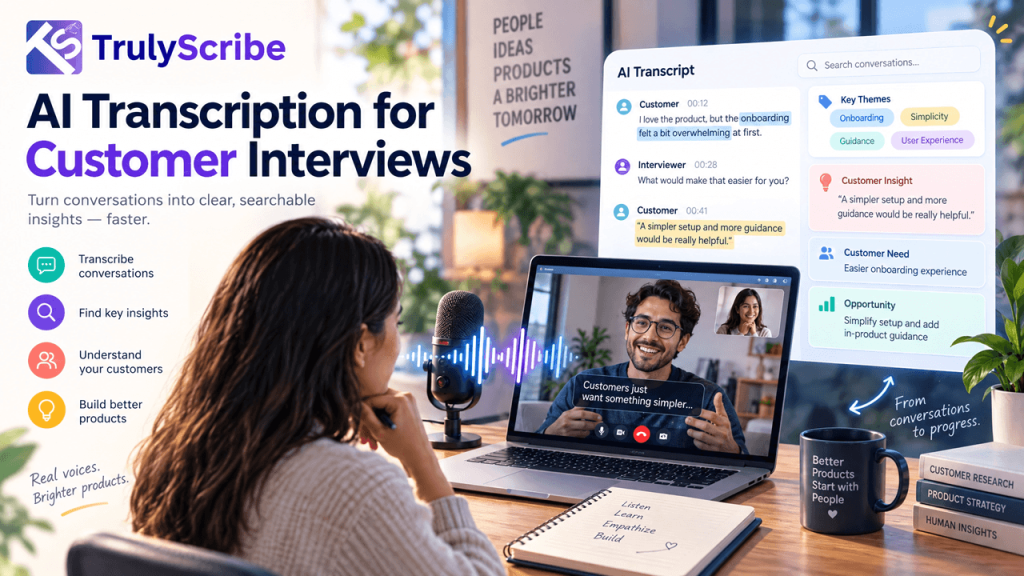
AI Transcription for Customer Interviews: A Practical Guide
Customer interviews are one of the most valuable sources of insight a product, marketing or research team can have. In a single conversation, a customer can reveal why they bought, what nearly stopped them, which workarounds they invented and what they wish you would build next. The problem is that these insights are fragile. Notes are incomplete, memories shift and the most telling phrases are usually the ones nobody wrote down. AI transcription for customer interviews solves that problem. By converting recordings into accurate, searchable text, it gives you a reliable record of what customers actually said, and frees you to focus on the conversation itself. In this guide, we explain the benefits, practical use cases, a step-by-step workflow, best practices and the tools to consider, including how TrulyScribe fits into a customer research process. Key Takeaways What Is AI Transcription for Customer Interviews? AI transcription uses speech recognition to convert recorded conversations, whether phone, video or in-person, into written text. For customer interviews, the most useful transcripts include speaker labels, so you can tell your questions from the customer’s answers, and timestamps, so you can jump back to the exact moment a comment was made. A good editor then lets you correct names, product terms and numbers against the original audio. Transcription is the foundation for everything that follows: tagging themes, pulling quotes, comparing interviews and sharing findings. If you are new to the technology, our beginner’s guide explains what AI transcription is and how it works. Key Benefits of Transcribing Customer Interviews 1. Stay present in the conversation Taking detailed notes while interviewing splits your attention. You miss body language, tone and the natural pause where a customer is about to share something important. When a transcript handles the record, you can maintain rapport, listen closely and ask better follow-up questions. 2. Capture exact customer language The words customers use to describe their problems are marketing gold. Verbatim transcripts preserve those phrases, which helps copywriters, product managers and sales teams speak in the language buyers actually use rather than internal jargon. 3. Reduce bias and memory errors After several interviews, it is easy to remember what confirmed your hypothesis and forget what challenged it. A full transcript lets you go back and check, which makes your conclusions more credible to stakeholders. 4. Analyze faster and at greater scale Reading or searching text is much faster than replaying hours of audio. You can search every interview for a keyword like “pricing” or “onboarding”, compare how different customers described the same issue and spot patterns that a single interview would never reveal. 5. Make research reusable across the company A transcript can be shared with product, design, support and sales without everyone sitting through the recording. Over time, a library of searchable interviews becomes a shared evidence base. Our guide to building a knowledge base from transcripts shows how to organize it. 6. Save money compared with manual transcription Paying for human transcription of every interview is rarely realistic for lean teams. AI delivers a draft in minutes at a fraction of the cost, and you can reserve human review for the few recordings where every word matters. See our comparison of human vs AI transcription for guidance. Common Use Cases Customer discovery and problem validation Early-stage teams use interviews to test whether a problem is real and painful enough to solve. Transcripts help you separate what customers say they would do from what they describe having already done. Product and UX research Usability sessions and feedback interviews generate a lot of detail. Timestamped transcripts let designers link a quote to the exact moment of confusion in a recording. Churn and win/loss interviews Conversations with customers who left, or prospects who chose a competitor, are among the most uncomfortable and valuable you will have. Accurate transcripts make sure the reasons are recorded faithfully rather than softened over time. For deal-focused calls, see our guide to AI transcription for sales calls. Jobs-to-be-done and voice-of-customer programs Teams running structured programs can code transcripts by job, trigger, obstacle and outcome, then compare results across segments and regions. Case studies and testimonials A searchable transcript makes it simple to find the strongest quote, confirm exact wording and get customer approval before publishing. Global and multilingual research Interviewing customers in several markets multiplies the work. A platform with broad language support helps teams review conversations they could not otherwise follow. TrulyScribe supports 100+ languages, and our article on multilingual AI transcription shares tips for getting reliable results. A Step-by-Step Workflow for Customer Interview Transcription How to Analyze Interview Transcripts A transcript is raw material, not a finished insight. These habits turn it into evidence your team can act on: Best Practices for Accurate Interview Transcripts Choosing the Right Tools Most customer research stacks combine several tools. The table below shows how the main categories fit together. Tool type Examples Best for Transcription platform TrulyScribe, Rev, Sonix Turning interview recordings into accurate, speaker-labeled text you can edit and export Meeting notetaker Otter.ai, Fireflies.ai Capturing live calls automatically with summaries and action items Research repository Dovetail, Condens Tagging, theming and storing insights from many interviews in one place General workspace Notion, Google Docs, spreadsheets Lightweight analysis, affinity mapping and sharing findings Features and pricing change often, so confirm current details on each vendor’s website before you decide. For a closer look at the market, see our roundup of the best AI transcription tools in 2026 and the TrulyScribe vs Otter AI vs Descript comparison. How TrulyScribe Supports Customer Interview Research TrulyScribe is built to turn recordings into accurate, usable text, which is exactly what interview-heavy teams need. Here is what that looks like in practice: TrulyScribe works with the recordings you already have, so it fits alongside whichever video call tool and research repository your team prefers. For more on research workflows, read our guide to AI transcription for research, focus groups and interviews. Consent, Privacy and Ethics Customer interviews often include personal or commercially sensitive