

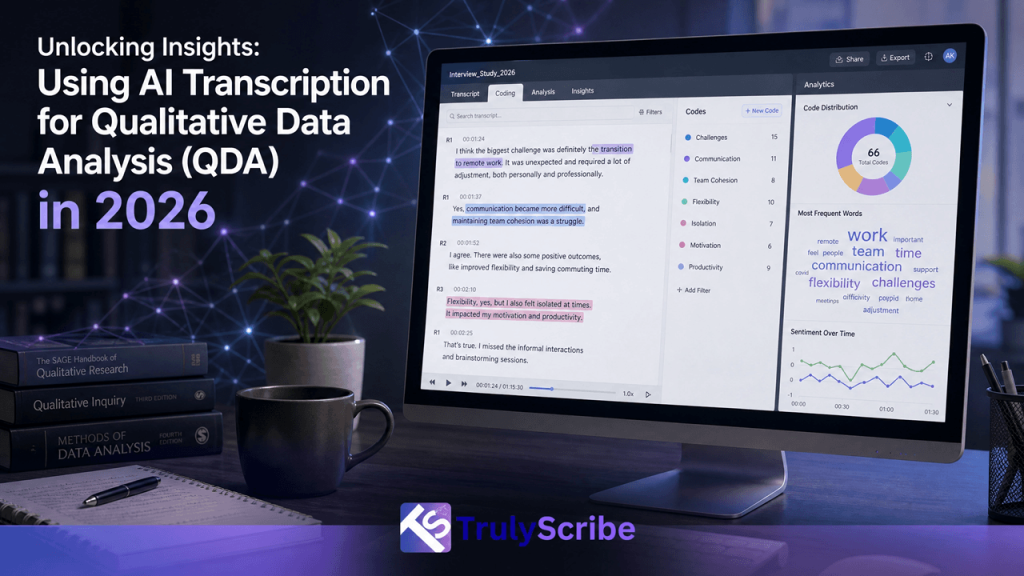
Unlocking Insights: Using AI Transcription for Qualitative Data Analysis (QDA) in 2026
If your qualitative research pipeline still starts with hours of manually typing out interviews and focus groups, 2026 is the year to change that. Qualitative Data Analysis (QDA) has always promised rich, human insight — the kind numbers alone can’t deliver. But that richness has a cost: every hour of recorded conversation traditionally took four to six hours to transcribe by hand before analysis could even begin. AI transcription has quietly rewritten that equation, and researchers who haven’t adopted it yet are leaving both time and insight on the table. In this guide, we’ll look at why AI transcription has become foundational to modern QDA, how it fits into a real research workflow, and how tools like TrulyScribe help researchers move from raw audio to coded themes faster, more accurately, and more securely. What Is Qualitative Data Analysis, and Why Does Transcription Matter So Much? Qualitative Data Analysis is the process of systematically examining non-numerical data — interviews, focus groups, open-ended survey responses, field recordings — to identify patterns, themes, and meaning. Unlike quantitative analysis, QDA depends on close reading: researchers need to sit with the actual words participants used, not just a summary of them. That’s exactly why transcription sits at the center of the QDA workflow. Every coding scheme, every theme map, every quote you pull for a report starts with an accurate, searchable text version of your audio or video. If the transcript is wrong, incomplete, or missing who said what, the analysis built on top of it inherits those flaws. Transcription isn’t a clerical afterthought in qualitative research — it’s the foundation everything else stands on. Why AI Transcription Has Become Essential for QDA in 2026 A few years ago, AI transcription was a convenience. Today, it’s close to a prerequisite for any research team that wants to stay competitive on turnaround time without sacrificing rigor. A few shifts explain why: 1. Accuracy Has Reached Research-Grade Levels Modern AI transcription engines now regularly achieve accuracy rates upward of 99% on clear audio, and they handle accents, overlapping speech, and domain-specific vocabulary far better than earlier speech-to-text models. TrulyScribe, for example, is built around 99.8% accuracy, which means researchers spend their time reviewing edge cases rather than re-typing entire sessions. 2. Speaker Labeling Turns Audio Into Analyzable Dialogue Focus groups and multi-participant interviews are where manual transcription becomes painful — someone still has to track who said what. AI transcription with automatic speaker labels does this in real time, giving researchers a transcript that’s already structured for coding by participant, not just a wall of undifferentiated text. 3. Timestamps Keep Transcripts Tied to Original Context Good QDA often requires going back to the original recording — to check tone, hesitation, or emphasis that text alone can’t capture. Timestamped transcripts let researchers jump straight to the relevant moment in the audio or video instead of scrubbing through an hour-long file to find one quote. 4. Multilingual Research No Longer Requires a Bigger Team Cross-cultural and international studies used to require hiring transcribers fluent in each language. AI transcription platforms that support dozens of languages let a single researcher process interviews from multiple regions without waiting on external vendors, which shortens the runway from data collection to analysis considerably. 5. It Frees Researchers for the Work That Actually Requires a Human Coding, theme development, and interpretation are the parts of QDA where a researcher’s judgment matters most. Automating the transcription step means more hours go toward that thinking work instead of data entry. A Practical AI-Assisted QDA Workflow for 2026 Here’s how AI transcription fits into a typical qualitative research project, from raw recording to finished analysis. Step 1: Record with the end analysis in mind. Use a decent microphone, minimize background noise, and where possible record each participant on a separate channel. Clean audio input is still the single biggest factor in transcript accuracy, AI or not. Step 2: Transcribe with an AI tool built for research use. Upload your audio or video files to a platform like TrulyScribe, which converts them to text with speaker labels and timestamps in a fraction of the recording’s runtime, and supports export in the formats most QDA software expects, including DOCX and PDF. Step 3: Review and lightly edit the transcript. Even at 99%+ accuracy, a quick pass matters — especially for names, acronyms, or technical terms specific to your study. Use the timestamped playback to verify anything ambiguous rather than guessing. Step 4: Import into your QDA software. Tools like NVivo, ATLAS.ti, MAXQDA, or Dedoose accept clean, speaker-labeled transcripts directly, letting you begin coding immediately instead of reformatting text first. Step 5: Code, theme, and synthesize. This is where human interpretation drives the analysis — grouping excerpts into codes, developing themes, and building the narrative or framework your research question calls for. Step 6: Pull verified quotes with confidence. Because your transcript is timestamped and speaker-labeled, every quote you cite in a report or publication can be traced back to its exact source and moment, which matters for both accuracy and research integrity. Key Benefits Researchers Are Seeing Addressing the Common Concerns “Can AI really handle messy, real-world audio?” Modern models handle a wide range of accents, cross-talk, and background noise far better than earlier generations of speech recognition. It’s not flawless — heavily overlapping speech or very poor audio quality will still need manual cleanup — but for the vast majority of interviews and focus groups, AI transcription now gets researchers 90-99% of the way there automatically. “What about participant confidentiality and data security?” This is a legitimate and important concern, especially for research involving sensitive topics or vulnerable populations. Look for a transcription provider with encrypted storage, secure processing, and clear data-handling policies — and check what your institution’s IRB or ethics board requires before uploading any identifiable data. Reputable platforms are built specifically with this kind of confidential, professional use case in mind. “Will it work for my niche field’s terminology?” Domain-specific vocabulary — medical terms,