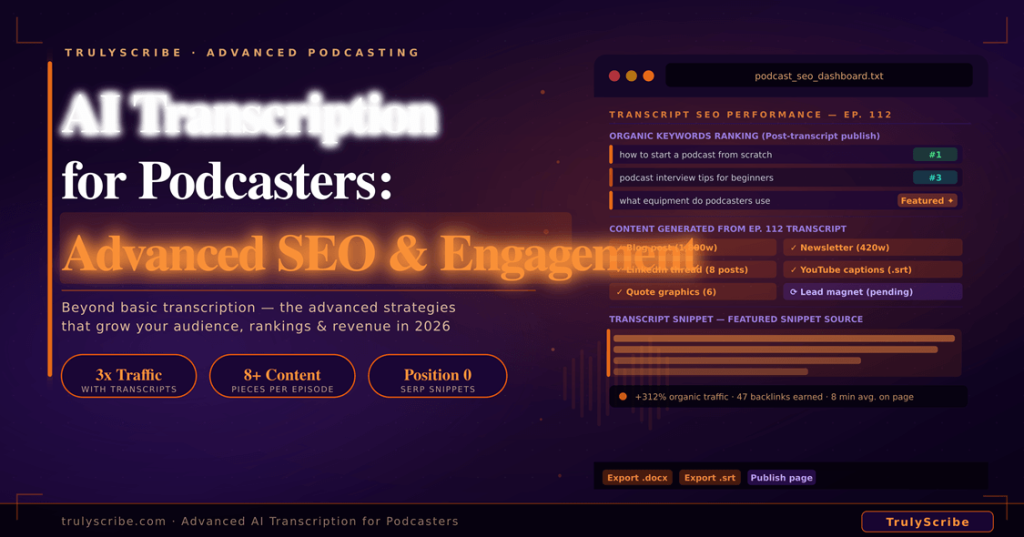
AI Transcription for Podcasters: Advanced Strategies for SEO & Engagement (2026)
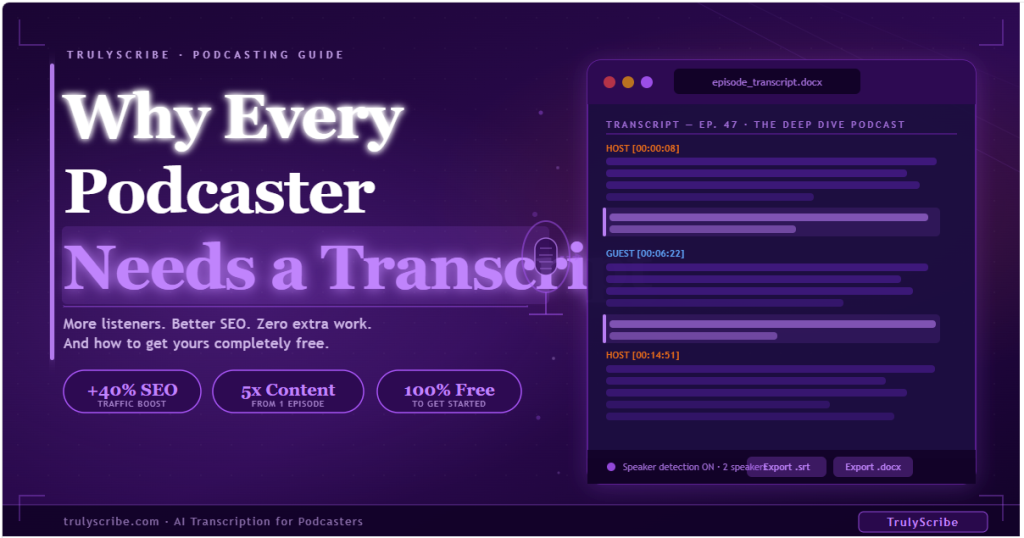
Most podcasters who discover AI transcription use it the same way: get the transcript, publish it on the episode page, feel good about the accessibility box being ticked, and move on. That’s a start. But it’s also leaving most of the value on the table. Transcripts are not just a convenience feature or an accessibility compliance tool. In 2026, they are the most underutilised growth lever available to independent podcasters. A single well-executed transcript strategy can triple your organic search traffic, generate eight or more pieces of original content from one episode, earn backlinks from publications that would never link to an audio file, and build the kind of audience engagement that turns casual listeners into loyal subscribers. This guide is for podcasters who already know the basics — or who want to skip past them entirely. It covers the advanced strategies: how to structure transcripts for SEO dominance, how to use them for answer engine optimisation, how to build a content repurposing system that runs on autopilot, how to design engagement loops that transcripts power, and how to monetise the content assets that transcription creates. These are not theoretical strategies. They are the approaches that consistently-growing podcasts use to build audiences and income at a scale that audio-only distribution alone cannot achieve. Why Most Podcasters Are Underusing Their Transcripts The typical podcast transcript workflow looks like this: transcribe the episode, paste the text into a collapsible section on the episode page, label it “Transcript,” and publish. Done. This approach captures perhaps 10 to 15% of the available value from transcription. The remaining 85 to 90% — the SEO compound effect, the content repurposing potential, the engagement infrastructure, the monetisation opportunities — is left entirely unrealised because the transcript is treated as a document to archive rather than a content engine to activate. 72% of podcast episodes have no published transcript — a competitive gap for podcasters who do 3x more organic traffic earned on average by podcast episode pages with structured published transcripts vs audio-only pages 47 average number of long-tail keywords a single 45-minute podcast episode transcript ranks for within 90 days of publishing The gap between what most podcasters do with transcripts and what the most sophisticated podcasters do is the gap this guide is designed to close. Part 1: Advanced Transcript SEO — Turning Episodes into Search Traffic The SEO opportunity in podcast transcription is one of the least contested in digital marketing. Most of your competitors are not doing this. The ones who are, are not doing it well. The window to build a significant organic search advantage through podcast transcript SEO is still wide open in 2026. The SEO Foundation: Why Transcripts Are a Search Traffic Machine Audio is invisible to search engines. Every insight, every expert quote, every keyword-rich exchange in your podcast exists in a format that Google cannot read, index, or rank. Publishing a transcript changes that entirely. A 45-minute podcast episode contains approximately 6,000 to 8,000 words of natural language content. Published as a structured transcript, that content: The Advanced Transcript SEO Strategy Matrix SEO Strategy How Transcripts Enable It Expected Impact Long-tail keyword targeting Transcript text naturally covers hundreds of related queries Rank for queries you never explicitly targeted Featured snippet capture Q&A sections in transcripts match question-format queries Position 0 for “how to” and “what is” searches Topical authority building Library of transcripts on related themes signals expertise Higher domain authority and cluster rankings Internal linking Cross-link between transcripts covering related topics Better crawl depth and topic coherence signals Backlink acquisition Written content earns 3x more links than audio-only pages Domain authority growth from editorial links Video SEO (YouTube) .srt captions from transcript improve video search rank Higher YouTube CTR and watch time from captions Answer engine optimisation Transcripts provide structured text for AI answer sources Citations in Perplexity, ChatGPT, Gemini responses Strategy 1: Keyword Cluster Architecture The most sophisticated podcasters don’t publish transcripts in isolation — they build keyword cluster architectures where each episode transcript targets a specific keyword cluster within their niche, and all clusters link back to pillar content pages. Here’s how to implement this: 💡 SEO compounding effect: A topic cluster architecture means that as you publish new episode transcripts, every new piece adds authority to the entire cluster. A podcast with 50 episodes in a tight niche, all interlinked through a cluster architecture, can build topical authority that rivals dedicated niche websites with far fewer episodes. Strategy 2: Featured Snippet Optimisation Featured snippets — the answer boxes that appear at position zero in Google results — are disproportionately valuable for podcasters because they capture search traffic before a user even clicks a result. Podcast transcripts are unusually well-suited to earning featured snippets for a specific reason: the conversational Q&A structure of most podcast episodes. When a host asks a guest “What is the single most important thing a new podcaster should do?” and the guest gives a clear, structured answer, that exchange is almost exactly what Google looks for to populate a featured snippet. The question matches a user search query; the answer is the snippet content. How to optimise transcript content for featured snippets: Strategy 3: Answer Engine Optimisation (AEO) In 2026, search behaviour has shifted significantly toward AI-powered answer engines. When someone asks Perplexity, ChatGPT Search, Google’s AI Overview, or Gemini a question in your niche, the answer they receive is assembled from sources that the AI can read, cite, and trust. Audio cannot be cited. Transcripts can. Answer engine optimisation (AEO) is the practice of structuring your content specifically to be cited by AI answer systems. Podcast transcripts are a natural fit for AEO because they contain expert opinion, specific facts, and conversational explanations in a format that AI systems can extract and summarise. AEO strategies for podcast transcripts: Strategy 4: YouTube SEO via Transcript Captions If you publish a video version of your podcast — or even a simple static image video for YouTube distribution — your transcript