

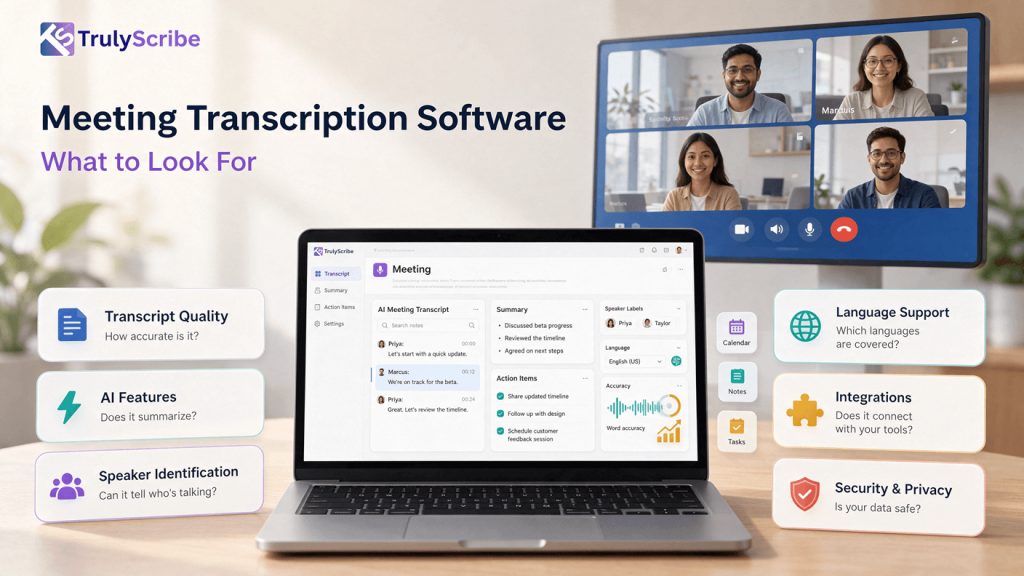
Meeting Transcription Software: What to Look For
Meetings are where decisions get made and, just as often, where they get forgotten. Someone takes notes, someone else remembers it differently, and a week later nobody is sure what was agreed. Meeting transcription software promises to fix that by turning every conversation into searchable text. But the market is crowded, the feature lists all look alike and the wrong choice can mean poor accuracy, awkward workflows or a bill that grows faster than your team. This guide explains what to look for in meeting transcription software: the types of tools available, the features that matter most, the red flags to avoid and a simple scorecard for comparing options. We also show where TrulyScribe fits, so you can decide whether it suits your workflow. Key Takeaways What Is Meeting Transcription Software? Meeting transcription software uses speech recognition to convert spoken conversations, whether in video calls, in-person meetings or phone calls, into written text. Good tools add speaker labels and timestamps, make the transcript searchable and often generate summaries and action items. If you are new to the technology, our beginner’s guide explains what AI transcription is and how it works. The category is broader than it looks. Before comparing features, it helps to know which type of tool you are actually shopping for: Type of tool How it works Best for Meeting bot / AI notetaker A bot or app joins the meeting, records it and produces a transcript and summary automatically Teams that want hands-off capture across many meetings Built-in platform transcription The meeting platform generates a transcript for calls held on that platform Teams that stay within one platform and want simplicity Upload-based transcription platform You upload a recording and get an accurate, editable transcript Teams that already record meetings and want accuracy, editing and flexible exports Conversation intelligence Analyzes many calls for trends, coaching and deal insights Sales and customer-facing teams needing analytics None of these is better in every situation. A bot-based notetaker is convenient but can feel intrusive in sensitive calls. Platform transcripts are simple but limited. Upload-based tools give you control and accuracy but need you to record first. Knowing your preferred way of capturing meetings narrows the field quickly. Why Teams Transcribe Meetings The Features That Matter Most 1. Transcription accuracy Accuracy is the foundation. A transcript full of errors makes summaries unreliable and forces you to correct everything by hand. Real meetings are harder than demos: people interrupt each other, use acronyms, speak with different accents and sit at different distances from the microphone. Always test with your own recordings rather than trusting a headline percentage. Our tips on handling technical jargon and transcribing audio with background noise explain what affects results. 2. Speaker identification A transcript without speaker labels is hard to follow. Look for tools that separate voices clearly and let you rename speakers once and apply the change throughout. Overlapping speech is the toughest test, so check it. See our guide to transcribing multiple speakers accurately. 3. Timestamps and search Timestamps let you jump to the exact moment in the recording, and search lets you find topics, names and decisions across many meetings. Together they turn transcripts into a usable archive rather than a pile of files. 4. An editor that makes corrections easy No AI is perfect, so you will want to fix names, product terms and numbers. The best editors let you play the audio alongside the text, which makes checking fast. TrulyScribe’s built-in editor is designed around exactly this workflow. 5. Language and accent support If your team is global, check that the tool handles every language and accent you use, not just the total number advertised. Our article on multilingual AI transcription explains what to test. TrulyScribe supports 100+ languages. 6. How meetings are captured Decide whether you want a bot that joins calls, a transcript generated by your meeting platform or the ability to upload recordings. Bots add convenience and sometimes raise comfort or consent concerns with guests. Upload-based tools work with recordings from any platform, including Zoom, Google Meet and Teams. See our guide to transcribing Zoom and Google Meet recordings for free. 7. Live vs post-meeting transcription Live transcription is useful for real-time captions and accessibility during the meeting. Post-meeting transcription of a recording is typically better for accuracy and editing. Many teams use post-meeting transcripts for the official record. 8. Summaries and action items AI summaries save time, but they are only as good as the transcript underneath. Treat them as a convenient layer, and check that you can always get back to the full text to verify. 9. Integrations and workflow fit Calendar, chat, CRM and project-management integrations can remove manual steps, but only if they match the tools you already use. Do not pay for a long integration list you will never touch. If you do not need them, a simple upload-and-export workflow may be enough. 10. Export options Make sure you can get transcripts out in formats your team uses, such as DOCX, PDF or text. Avoid tools that lock your content inside their own app. 11. Security, privacy and compliance Meetings contain strategy, financials, personnel matters and customer data. Look for encryption, clear data-retention and deletion controls, transparent policies on how your data is used and, for larger organizations, admin controls and access permissions. TrulyScribe uses encryption and secure servers to help protect your recordings. 12. Pricing model Pricing can matter as much as features. Per-seat plans grow with headcount, minute allowances run out in busy months and unlimited plans offer predictability but may have fair-use or per-file terms. Calculate your real monthly cost at your own volume before you compare. Feature Priorities at a Glance Feature Priority Why it matters Transcript accuracy Must-have Everything else depends on it Speaker labels and timestamps Must-have Show who said what, and let you jump to the moment Security and privacy controls Must-have Meetings contain sensitive business information Searchable transcripts Must-have Turns past meetings into a usable archive Editing