

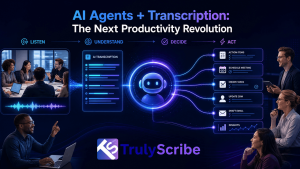
AI agents — software that can plan, take action, and complete multi-step tasks with minimal supervision — have moved from demo videos to daily use inside sales teams, support desks, and operations departments. But an agent is only as useful as the information it can act on, and a huge share of what happens inside a business is still spoken, not written: sales calls, customer support conversations, interviews, standups, and strategy sessions.
That’s the quiet but critical role transcription plays in this shift. Before an agent can log a CRM update, draft a follow-up email, or flag a compliance risk from a recorded call, that call has to become text an agent can actually read and reason over. Transcription isn’t a side feature in the agent era — it’s the raw material the whole system runs on. This piece looks at how AI agents and transcription are combining in practice, what’s actually driving the shift, and what to look for if you’re building or buying into this workflow.
It’s worth being precise about what’s actually new here. Transcription itself isn’t new, and neither is basic automation. What’s changed is that agents can now chain several steps together — read a transcript, extract what matters, decide what to do, and take that action — without a human manually handing off between each step. That chaining is what turns a transcript from a static record into an active input driving real work.
Why Transcripts Are the Fuel for AI Agents
AI agents work by reading context, reasoning over it, and taking action — updating a record, drafting a message, triggering a workflow. Text is the format agents understand natively. Audio and video, by contrast, are opaque to most agent systems unless they’re converted into text first.
This makes transcription the connective tissue between spoken business activity and automated action. A sales call an agent never “reads” can’t update a deal stage. A support call an agent can’t parse can’t trigger a refund workflow. An interview an agent hasn’t seen as text can’t be summarized into a hiring recommendation. The accuracy and structure of that transcript — speaker labels, timestamps, correct terminology — directly determines how reliable the agent’s downstream actions will be.
In other words: garbage transcript in, garbage agent output out. As agents take on more consequential tasks, the quality of the transcription layer underneath them matters more, not less.
This is a meaningful shift in how businesses should think about transcription quality. When a transcript was purely for human reading, small errors were self-correcting — a reader would spot an obviously wrong word and mentally fix it without a second thought. An agent doesn’t have that instinct by default. It reads the text it’s given and acts on it, which means the tolerance for transcription error effectively shrinks the moment an agent is the one reading.
How AI Agents and Transcription Work Together in Practice
1. Meeting Agents That Update Your CRM Automatically
Instead of a rep manually logging notes after a sales call, an agent reads the transcribed conversation from Zoom or Google Meet, extracts the deal stage, next steps, and objections raised, and writes them directly into the CRM — no manual data entry required. The rep’s actual job becomes reviewing and correcting rather than transcribing from memory.
2. Sales Agents That Draft Follow-Ups From the Call Itself
Once a call is transcribed, an agent can draft a personalized follow-up email referencing the specific points a prospect raised, rather than a generic template. This only works if the underlying transcript correctly separates who said what — which is why accurate speaker labeling in multi-participant conversations matters as much for agent workflows as it does for human readers.
3. Research Agents That Synthesize Across Dozens of Interviews
A single interview transcript is useful; an agent that can search and synthesize patterns across fifty of them is transformative. Research and product teams are increasingly feeding batches of transcribed interviews into an agent that surfaces recurring themes, contradictions, and quotes — work that used to take a human analyst days to do manually.
4. Support Agents That Learn From Every Recorded Call
Customer support teams are using transcribed call logs to train agents on how issues actually get resolved, then having those agents draft responses to similar future tickets. The transcript becomes training data and a live reference simultaneously, and its reliability depends entirely on how accurately the AI handles background noise, accents, and overlapping speech common in real support calls.
5. Content Agents That Repurpose Recordings Automatically
Marketing teams are chaining transcription directly into content agents: a webinar or podcast gets transcribed, and an agent automatically drafts a blog post, a set of social captions, and an email newsletter section from the same source text. This mirrors what teams already do manually to turn transcripts into blog posts and repurpose them into social and LinkedIn content — the difference is an agent now does the drafting, with a human reviewing rather than writing from scratch.
6. Compliance Agents That Flag Risk Language at Scale
In regulated industries, agents are being used to scan transcribed calls and meetings for specific risk language, disclosure requirements, or missed compliance steps — something no team could realistically do by listening to every recording manually. This builds directly on how businesses already use transcription for legal discovery and document review, with an agent now doing the first pass of review instead of a paralegal.
7. Knowledge Agents That Answer Questions From Your Entire Archive
Perhaps the biggest shift: once an organization has a searchable archive of transcribed meetings, calls, and training sessions, an agent can answer questions by searching across all of it — “what did we tell this client in March” or “how did we usually handle this objection last quarter.” This depends on having a structured, searchable knowledge base built from video and audio transcripts in the first place; an agent can only search what’s actually been transcribed and organized.
8. Localization Agents That Translate and Republish Automatically
Global teams are chaining agents onto multilingual transcription pipelines: transcribe a webinar or training session, translate it into target languages automatically, and have an agent handle republishing captions and show notes across each regional channel. This is the same logic behind affordable AI-powered webinar localization, with an agent now managing the distribution step as well as the translation.
Agent + Transcription Use Cases at a Glance
| Use Case | What the Agent Does | What It Needs From the Transcript |
| CRM logging | Extracts deal stage, next steps | Accurate speaker attribution |
| Follow-up drafting | Writes personalized emails | Correct names and specifics |
| Research synthesis | Finds patterns across interviews | Consistent formatting at scale |
| Support response | Drafts replies from past calls | Noise-robust accuracy |
| Content repurposing | Drafts blogs and social posts | Clean punctuation and structure |
| Compliance review | Flags risk language at scale | Verbatim accuracy, timestamps |
| Knowledge search | Answers questions from archives | Searchable, organized transcripts |
| Localization | Translates and republishes content | Multilingual transcription accuracy |
Why This Is Happening Now
Two trends converged to make this combination practical rather than theoretical. First, transcription accuracy crossed a threshold where AI transcripts can be trusted as direct input without a mandatory human cleanup pass — a shift covered in more depth in our look at 2026’s broader AI transcription trends. Second, agent frameworks matured enough to reliably chain multiple steps together — read, extract, act — without constant human intervention at every stage.
Neither trend alone was enough. Accurate transcription without capable agents just produces better documents. Capable agents without accurate transcription have nothing reliable to act on. It’s the combination that unlocks genuine automation of work that used to require a human to listen, take notes, and then act.
There’s also a practical adoption pattern worth noting: most teams aren’t starting with the most ambitious agent workflows. They’re starting with the boring, high-volume, low-risk ones — meeting notes, call summaries, basic CRM updates — and only expanding into higher-stakes territory like compliance review or customer-facing communication once the transcription-to-agent pipeline has proven reliable on lower-stakes work first.
What to Look for in a Transcription Layer for Agent Workflows
- High baseline accuracy: agents compound small transcription errors into larger downstream mistakes, so accuracy that holds up against human-level transcription matters more here than in casual note-taking use.
- Reliable speaker labeling: agents that draft follow-ups or log CRM data need to know definitively who said what, not just that something was said.
- Structured, exportable output: agents work best with clean, consistently formatted text — timestamps, punctuation, and predictable structure — rather than loosely formatted transcripts.
- Real-time capability where needed: agents supporting live workflows, like real-time transcription during meetings and webinars, need transcripts available as the conversation happens, not just after the fact.
- Multilingual support: any agent workflow operating across regions needs a transcription layer that performs consistently across languages, not just English.
- Data security: feeding transcripts into agent systems means sensitive conversations are being processed by multiple tools, so encryption and clear data-handling policies matter more, not less.
Where TrulyScribe Fits Into Agent Workflows
TrulyScribe is built to be the reliable transcription layer underneath exactly these kinds of agent workflows. It converts meetings, calls, and recordings into accurate, speaker-labeled, timestamped transcripts across 100+ languages, and exports into clean, structured formats — DOCX, TXT, PDF, SRT, and VTT — that are straightforward for downstream agents and automation tools to consume.
Because accuracy compounds through every step an agent takes afterward, TrulyScribe’s built-in editor lets you review and correct a transcript before it feeds into an automated workflow, catching a misheard name or term before it propagates into a CRM record, a drafted email, or a compliance flag. For teams comparing transcription providers specifically for automation-heavy workflows, it’s worth reviewing how TrulyScribe compares to tools like Otter.ai and Descript on accuracy, export flexibility, and language coverage.
What to Watch Out For
Error amplification
A small transcription error that a human reader would catch and mentally correct can be taken literally by an agent and acted on directly — logged into a system, sent in an email, or used to trigger a workflow. This is why review checkpoints matter more, not less, as more of the pipeline becomes automated.
Over-automation of judgment calls
Not every action an agent could take should happen without review. Compliance flags, customer-facing communications, and anything involving sensitive information generally warrant a human-in-the-loop step, even when the underlying transcription and agent reasoning are both highly accurate.
Data handling across multiple tools
Every additional tool a transcript passes through — transcription service, agent platform, CRM, storage — is another point where sensitive conversation data needs to be handled securely. Reviewing the security posture of each link in that chain matters as much as reviewing the transcription accuracy itself.
Frequently Asked Questions (FAQs)
What exactly is an AI agent, in simple terms?
An AI agent is software that can plan and carry out multi-step tasks with limited human supervision — reading information, deciding what to do with it, and taking action, rather than just answering a single question or generating a single piece of text.
Why does transcription accuracy matter more for agent workflows than for casual use?
Because agents act directly on the text they’re given. A human reading a slightly imperfect transcript can usually infer the correct meaning; an agent updating a CRM record or drafting a customer email may take a transcription error at face value, turning a small mistake into a larger downstream problem.
Can AI agents work with any transcription tool?
Technically, most agents can ingest plain text from any source. In practice, agents perform better with transcripts that include consistent formatting, accurate speaker labels, and timestamps, which is why the choice of transcription tool matters for reliable automation, not just raw accuracy.
Is it safe to feed sensitive meeting transcripts into AI agent systems?
It depends on the security practices of every tool in the chain — the transcription service, the agent platform, and wherever the output is stored. Look for encryption in transit and at rest, clear data-retention policies, and GDPR-compliant handling at each step, particularly for legal, medical, or HR-related conversations.
Do businesses still need humans in these workflows?
Yes, particularly for reviewing agent-drafted outputs before they’re sent externally or logged into critical systems. The realistic model for most teams right now is agents handling the first draft or first pass, with a human reviewing before anything customer-facing or high-stakes goes out.
What’s the easiest place to start combining AI agents with transcription?
Meeting and call transcription is usually the simplest starting point — automatically transcribing calls and feeding summaries or action items into a CRM or task tool delivers clear value quickly, before expanding into more complex workflows like compliance review or cross-interview research synthesis.
The Bottom Line
AI agents get the attention, but transcription is the quiet infrastructure making most of the useful ones possible. Every agent that logs a CRM update from a sales call, drafts a follow-up from a support conversation, or answers a question from an old meeting is really running on top of a transcript — and the accuracy of that transcript sets a hard ceiling on how reliable the agent can be.
As agent adoption accelerates through 2026, the businesses getting the most value won’t just be the ones with the most sophisticated agents — they’ll be the ones with the most reliable transcription layer underneath them. TrulyScribe is built to be that layer: accurate, structured, multilingual transcription ready to feed straight into whatever agent workflow you build on top of it.