

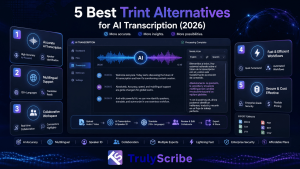
Trint helped popularize a genuinely useful idea: turn a recording into a searchable, time-coded transcript, then let teams collaborate on it like a shared document. For newsrooms and media teams working under deadline, that workflow has real value, and it’s a big part of why Trint built such a loyal following among journalists.
But Trint’s pricing sits firmly in enterprise territory, with no pay-as-you-go option for smaller or occasional projects, and users regularly point to unclear charges, limited subtitle editing precision, and accuracy that holds up on clean audio but slips on noisy or multi-speaker recordings. For teams that don’t need a full newsroom collaboration suite, those trade-offs add up fast.
This guide breaks down where Trint holds up, where it falls short, and the best Trint alternatives worth considering in 2026, depending on whether your priority is cost, language coverage, live meeting capture, or certified accuracy.
We’re weighing each alternative against the specific gaps Trint leaves open — pricing accessibility, language breadth, and subtitle precision — rather than just listing competitors. A tool that’s cheaper than Trint but still can’t handle a non-English recording cleanly, or still lacks a usable subtitle editor, isn’t actually solving the problem most teams go looking for a replacement to fix.
Key Takeaways
- Trint pioneered searchable, collaborative transcription but has no pay-as-you-go pricing, limited subtitle editing controls, and accuracy that varies on complex audio.
- TrulyScribe is the strongest all-around alternative: fast, accurate AI transcription across 100+ languages at a fraction of Trint’s per-seat pricing, with real-time meeting and webinar support.
- Otter.ai is the better fit if your workflow is almost entirely live meetings that need automatic capture and summaries.
- Descript suits creators editing podcasts or videos directly through the transcript.
- Rev and Sonix round out the list for certified human accuracy and multilingual automation at scale, respectively.
Why Look for a Trint Alternative?
Trint built a strong reputation on turning recordings into searchable text with real-time collaboration and story-building tools that let journalists work without leaving the platform. Even with those strengths, some limits show up consistently across user reviews:
- Costs escalate quickly: per-seat pricing reaches enterprise levels fast, which can strain small teams or solo creators who don’t need advanced newsroom collaboration tools.
- Billing can feel unpredictable: users report unclear charges tied to uploads or duplicate files, making costs harder to plan around.
- Accuracy varies with real-world audio: clear, single-speaker recordings transcribe well, but noisy or multi-speaker audio often needs manual cleanup.
- Editing tools are limited: without a dedicated subtitle editor or precise timing controls, polishing a transcript into publish-ready captions takes extra work.
- Security gaps exist: without SOC 2 certification or multi-factor authentication as standard, Trint may not fit teams handling sensitive or regulated content.
None of this makes Trint a weak tool for its core audience — collaborative newsroom transcription — but for broader business, meeting, or multilingual use cases, it’s worth comparing what else is available.
It’s also worth noting that Trint’s newer AI Assistant features, aimed at summaries and quote extraction, are a useful addition but don’t change the underlying cost and language-coverage trade-offs — they sit on top of the same per-seat pricing and roughly 40-language transcription base as the rest of the platform.
What to Consider Before Choosing a Transcription Tool
Prioritize accuracy on real-world audio
Clean, single-speaker audio transcribes easily almost anywhere. For interviews, panels, or field recordings, look for a tool that balances AI speed with strong real-world performance, or offers human review as an option.
Balance speed and quality
Some tools return a transcript in minutes; others prioritize careful, verified accuracy that takes longer but saves cleanup time later. The right choice depends on which trade-off matters more for a given project.
Look for smooth collaboration and editing
Simple sharing, inline notes, and live editing matter when a team is reviewing clips or quotes together. Fewer exports and file versions to juggle means a smoother workflow overall.
Check integrations
A tool that connects to Zoom, Slack, or your existing content workflow keeps production moving without forcing you to rebuild processes around transcription.
Value transparent pricing
Per-seat, per-minute, and hidden usage limits can all affect real costs very differently depending on your volume. Knowing exactly what you’re paying for prevents surprises as usage scales.
Make security non-negotiable
Look for encryption, access controls, and recognized compliance standards, especially if you’re handling client recordings or confidential material.
Top Trint Alternatives for 2026
1. TrulyScribe — Best Overall Alternative
Best for: Teams and individuals who want Trint’s collaborative transcript workflow without the enterprise pricing or narrower language coverage.
TrulyScribe covers the core job Trint does well — turning recordings into searchable, accurate, timestamped transcripts — while extending language support well past Trint’s roughly 40 languages. TrulyScribe supports over 90 languages and dialects, with speaker labels and punctuation included automatically, and exports directly to TXT, DOCX, PDF, SRT, and VTT.
Where TrulyScribe pulls ahead of Trint specifically is accessibility and pricing: there’s no enterprise-only seat structure to work around, which matters for small teams or solo creators who found Trint’s per-seat cost hard to justify. TrulyScribe also supports real-time transcription for meetings and webinars and can process recordings directly from Zoom and Google Meet, and its built-in editor lets you compare the transcript against the original audio to fix names or terminology before exporting — all under GDPR-compliant encryption.
One honest trade-off: Trint’s Story Builder and newsroom-specific editorial tools are more specialized than anything TrulyScribe offers, so large media organizations with deeply collaborative editorial workflows may still find Trint’s niche tooling worth the premium. For everyone else, TrulyScribe’s accuracy holds up well against traditional transcription methods at a fraction of the cost.
- Pros: 100+ language support, real-time and meeting-based transcription, no enterprise-only pricing tier, GDPR-compliant encryption, flexible export formats.
- Cons: No dedicated newsroom story-building suite for large editorial teams.
TrulyScribe also fits naturally into workflows beyond a single transcript. Because the same accurate, timestamped output can feed translated captions and repurposed content, teams switching from Trint for interview or meeting transcription often end up using TrulyScribe for affordable webinar and event localization as well, without adding a separate tool for that step.
2. Otter.ai — Best for Live Meeting Capture
Best for: Teams whose primary need is automatic meeting notes rather than file-based transcription.
Otter.ai centers everything around live conversations, automatically joining Zoom, Google Meet, or Teams calls and delivering transcripts with summaries and action items shortly after the call ends. It’s fast to adopt and connects well with tools teams already use, though language coverage is narrow and some users report inconsistent support quality.
- Pros: Reliable calendar-based auto-join, fast post-meeting summaries, strong integrations with CRM and productivity tools.
- Cons: Limited language support, and reported concerns around meeting-bot behavior and minute limits.
3. Descript — Best for Content Creators
Best for: Podcasters and video creators who want to edit media by editing the transcript itself.
Descript’s signature feature is text-based editing: delete a sentence from the transcript, and the clip disappears from the video or audio too. It bundles AI transcription with tools like Studio Sound for cleanup and an AI co-editor for scripts and drafts, making it a strong pick when publishing polished audio or video, not just a transcript, is the end goal.
- Pros: Intuitive text-based editing, integrated podcasting and screen-recording tools, active development.
- Cons: Reported stability issues and limited mobile support, plus a real learning curve if all you need is plain text.
4. Rev — Best for Certified Accuracy
Best for: Legal, media, and research teams that can’t risk a misquote or transcription error.
Rev pairs fast AI transcription with an option for full human verification, backed by compliance certifications that matter for regulated industries. Where Trint emphasizes collaboration speed, Rev centers on reliability and precision — the better choice when a transcript may need to hold up as evidence or documentation, not just as a working draft.
- Pros: Certified human transcription available, strong compliance credentials, reliable turnaround for verified work.
- Cons: Human transcription priced per minute, which adds up at high volume; English-first design.
5. Sonix — Best for Multilingual Automation at Scale
Best for: Global teams processing high volumes of multilingual audio quickly.
Sonix automates transcription and translation across dozens of languages, with AI analysis features like topic detection and automatic chapter creation layered on top. It trades Trint’s newsroom-style editing for stronger multilingual throughput, with integrations for tools like Adobe Premiere and Google Drive.
- Pros: Broad language coverage, built-in content analysis, useful editing integrations.
- Cons: Hourly billing that can be harder to predict, and mixed feedback on customer support.
Trint Alternatives Comparison
| Tool | Best For | Standout Feature | Key Limitation |
| TrulyScribe | Overall replacement | 100+ languages, real-time + meeting transcription | No newsroom story-building suite |
| Otter.ai | Live meeting capture | Calendar-synced meeting bot | Narrow language support |
| Descript | Content creators | Text-based audio/video editing | Reported stability issues |
| Rev | Certified accuracy | Human-verified transcription | Per-minute human pricing |
| Sonix | Multilingual automation at scale | Built-in content analysis | Hourly billing, mixed support feedback |
Pricing and language counts change frequently across all of these platforms, so confirm current plans directly on each provider’s site before committing.
Final Verdict: Which Trint Alternative Is Right for You?
The right choice comes down to what matters most for your workflow: cost, multilingual reach, live meeting capture, or certified accuracy. For most teams outside large newsroom operations, TrulyScribe offers the strongest overall balance — broad language support, real-time capture, and fast, accurate transcription without Trint’s enterprise-only pricing.
- Choose Otter.ai if your work is almost entirely live meetings and English-language capture.
- Choose Descript if publishing a polished podcast or video, not just a transcript, is the actual goal.
- Choose Rev if a transcript may need to hold up as evidence or formal documentation.
- Choose Sonix if you’re processing high volumes of multilingual audio and want built-in content analysis.
It’s also worth testing any shortlist against your own audio before committing to an annual plan — performance on a demo clip rarely tells the full story once real-world accents, overlapping speakers, or background noise enter the picture.
Whichever tool you land on, weigh the switch against how much of your current workflow is actually tied to Trint-specific features. Basic transcription and collaboration transfer easily to any of the alternatives above; deeply built-out Story Builder workflows are the one piece worth thinking through before moving a large editorial team off the platform.
What to Look For Beyond the Transcript Itself
A transcript is rarely the end goal. The most useful transcription tools now also support accessibility compliance for published video and course content, feed a broader multilingual content strategy, and help teams repurpose recordings into blog posts and articles without a separate tool for that step. This is part of a wider shift covered in 25 practical ways businesses are using AI transcription, where the transcript itself has become as valuable as the recording it came from.
Frequently Asked Questions (FAQs)
Is TrulyScribe more affordable than Trint?
Yes. Trint’s pricing sits in enterprise territory with per-seat plans and no pay-as-you-go option, while TrulyScribe offers accessible plans that don’t require committing to a full enterprise seat structure, making it a better fit for individuals and small teams.
Does TrulyScribe support as many languages as Trint?
TrulyScribe supports well over 90 languages and dialects, which covers considerably more ground than Trint’s roughly 40 supported languages for transcription.
Which Trint alternative is best for live meetings?
Otter.ai is purpose-built for live meeting capture with calendar-based auto-join. TrulyScribe also supports real-time transcription for meetings and webinars, with the added benefit of much broader language support.
Is there a certified human-transcription alternative to Trint?
Rev is the strongest option for certified, human-verified transcripts, particularly for legal, medical, or evidentiary use where accuracy needs formal verification rather than AI-only output.
Can I use a Trint alternative for newsroom-style collaborative editing?
TrulyScribe and Sonix both support collaborative review and editing, though large newsroom teams with deeply specialized editorial workflows may still find Trint’s Story Builder and related tools more tailored to that specific use case.
Do Trint alternatives support subtitle and caption export?
Most do. TrulyScribe exports directly to SRT and VTT alongside DOCX, PDF, and TXT, which covers subtitle, documentation, and accessibility needs without requiring a separate subtitle tool.
The Bottom Line
Trint helped define what collaborative, searchable transcription could look like, and it still serves large newsroom teams well. But for the much broader range of teams that need accurate, multilingual, real-time transcription without enterprise-only pricing, one of these alternatives will likely fit better. For most individuals and businesses, TrulyScribe is the most complete Trint alternative in 2026 — covering the core transcription workflow Trint does well, at a price and language range built for a much wider range of teams.