

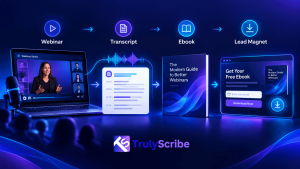
Most webinar series follow the same lifecycle: months of planning, an hour of live delivery, a replay link emailed out once, and then silence. The recording sits on a landing page nobody revisits, while the actual content — the frameworks, the stories, the expert answers to real audience questions — never gets used again. That’s a lot of genuinely valuable material going to waste, especially for a series that took real effort to plan and promote.
An ebook is one of the most effective ways to give that content a second life. It’s a format people still actively trade an email address for, it positions your team as the expert who already said all of this out loud, and unlike writing an ebook from scratch, you’re not starting with a blank page — you’re starting with hours of expert commentary that just needs to be transcribed, structured, and edited into something readable. This guide walks through exactly how to do that, from raw webinar recording to a polished, gated lead magnet.
This matters most for teams who already run a regular webinar program but have never treated the recordings as anything beyond a courtesy replay for people who missed the live session. If that describes your team, there’s likely a usable ebook or two already sitting in your past twelve months of webinars, waiting for someone to notice the content is there.
Why Turning Webinar Transcripts Into an Ebook Works
- Evergreen lead generation: unlike a live webinar with a fixed date, a gated ebook keeps generating leads indefinitely, with no ongoing promotion required to keep working.
- Speed over writing from scratch: transcribing and editing existing spoken content is dramatically faster than commissioning original long-form writing, since the ideas, structure, and expert voice already exist.
- Authentic expertise, not generic content: an ebook built from real webinar Q&A and expert commentary reads as genuinely knowledgeable, rather than assembled from generic research.
- More mileage from existing marketing spend: the promotion, planning, and speaker time that went into the original webinar series gets a second return, instead of value stopping at the live event.
- A natural fit for gated, high-intent content: ebooks remain one of the few content formats audiences still expect to exchange contact information for, unlike blog posts or social content.
It’s worth being clear-eyed about why this format still works when so much other gated content has stopped converting well. A generic ebook assembled from research and stock advice competes with thousands of similar downloads. A webinar-derived ebook built from your own team’s actual expertise, delivered in your team’s actual voice, is much harder for a competitor to replicate — which is exactly what makes it worth the extra editorial effort.
What Makes a Webinar Series Good Ebook Material
Not every webinar translates well into an ebook, and picking the right source material makes the entire process easier.
- A themed series works better than a single one-off session — three to five related webinars naturally map onto ebook chapters.
- Sessions with a clear teaching structure (frameworks, step-by-step processes, defined stages) translate to readable chapters more easily than loosely structured conversations.
- Strong audience Q&A segments are often an ebook’s best material, since they surface the specific questions your actual target audience cares about.
- Sessions featuring a recognizable expert or executive add credibility that’s worth highlighting prominently in the finished ebook.
- Webinars with concrete examples, case studies, or numbers tend to translate better than purely conceptual discussions, since readers can act on specifics in a way they can’t on general advice alone.
The Workflow: From Webinar Recording to Finished Ebook
Step 1: Choose and Transcribe Each Session
Start by selecting the webinars that form a coherent theme, then transcribe each one accurately. If the series was recorded on a standard platform, you can transcribe directly from Zoom or Google Meet recordings in a few minutes per session, or capture the transcript in real time during the webinar itself if you’re planning the ebook before the series even airs.
Step 2: Clean Up and Organize by Theme, Not by Session
Rather than treating each webinar as one chapter, review all the transcripts together and organize the content by topic. A five-part webinar series rarely maps neatly onto five clean chapters — more often, the best material is scattered across sessions and needs to be regrouped around the themes your audience actually cares about.
Step 3: Edit Spoken Language Into Readable Prose
This is the step people most often skip, and it’s the one that makes or breaks the finished product. Spoken language is full of filler words, false starts, and tangents that work fine live but read poorly on a page. Editing means trimming filler, tightening run-on sentences, and reorganizing ideas into a logical written flow — while preserving the speaker’s actual voice, examples, and phrasing wherever possible, rather than rewriting it into generic corporate copy.
A useful test while editing: read a paragraph out loud. If it still sounds like something a person would actually say, you’ve probably struck the right balance between cleaning up the language and preserving the voice that made the original webinar worth listening to in the first place.
Step 4: Add Structure a Live Audience Didn’t Need
A live audience follows along in real time; a reader needs the page to do more work. Add chapter summaries, pull-quote callouts for the strongest lines, “key takeaway” boxes at the end of each section, and a clear table of contents — none of which existed in the original spoken delivery, but all of which make the written version far more usable.
Step 5: Design and Format It Like an Actual Ebook
A plain document of edited transcript text won’t perform like a designed lead magnet. Invest in basic layout: a cover, consistent typography, pull quotes, and enough white space that it doesn’t read like a wall of text. This is the difference between something that looks like a repurposed transcript and something that looks like a product your audience is glad they downloaded.
Step 6: Gate It Behind a Simple, High-Intent Landing Page
Keep the exchange simple: a clear headline describing the outcome the ebook delivers, a short list of what’s inside, and a form asking for the minimum information you actually need. Overly long forms are one of the most common reasons a well-made ebook underperforms as a lead magnet.
It’s worth treating the landing page itself as part of the deliverable, not an afterthought tacked on once the ebook is finished. A strong ebook behind a weak landing page still underperforms, while a clear, benefit-focused page can meaningfully lift conversion even before anyone opens the PDF.
Step 7: Promote It Using the Same Source Material
The same transcripts that built the ebook can drive its promotion. Pull individual quotes and insights into social and LinkedIn posts announcing the ebook, or turn a chapter into a standalone blog post that links to the gated download for readers who want the full version.
Step 8: Translate for Additional Markets
If your webinar series drew an international audience, translating the finished ebook multiplies its reach as a lead magnet in additional markets. This follows the same logic behind a broader multilingual content strategy — one accurate source transcript, translated once, generates a localized asset without re-running the entire production process.
From Raw Transcript to Finished Ebook
| Stage | What It Looks Like | Output |
| Raw transcript | Verbatim, unedited, full of filler words | Not reader-ready |
| Organized transcript | Grouped by theme across sessions | Rough chapter structure |
| Edited prose | Filler removed, sentences tightened | Readable chapter drafts |
| Structured content | Summaries, pull quotes, takeaway boxes added | Complete manuscript |
| Designed ebook | Cover, layout, typography applied | Finished, gate-ready PDF |
Common Mistakes When Turning Transcripts Into Ebooks
- Publishing a near-verbatim transcript: unedited spoken language reads poorly on the page and undermines the perceived value of a “gated” resource.
- Organizing by session instead of by topic: this usually produces a repetitive, disjointed reading experience rather than a coherent narrative.
- Skipping design entirely: even excellent content underperforms as a lead magnet if it looks like an exported Word document rather than a polished asset.
- Asking for too much information on the gate: a long form before the download discourages exactly the prospects most likely to convert.
- Treating it as a one-time project: the most successful teams build this into a repeatable process for every major webinar series, not a single experiment.
- Forgetting to update or refresh the ebook over time: an evergreen lead magnet still benefits from an occasional review to keep statistics, examples, and screenshots current.
Where TrulyScribe Fits Into This Workflow
Every step of this process depends on starting with an accurate, well-structured transcript of each webinar session. TrulyScribe handles that starting point: accurate, speaker-labeled, timestamped transcripts across 100+ languages, exported directly into DOCX for easy editing into ebook chapters.
Its built-in editor lets you review the transcript against the original recording and correct any names, product terms, or technical vocabulary before the editing pass begins, which saves real time once you’re deep into shaping chapters. And because the same transcripts can also power blog posts, social content, and translated versions, the webinar series that becomes your ebook can simultaneously fuel a searchable internal knowledge base and months of additional repurposed content — the ebook doesn’t have to be the only thing you get out of the recordings.
This approach applies just as well beyond marketing webinars. Coaches and consultants running recurring client or training sessions use the same transcript-to-content workflow to turn recorded calls into lead magnets, course material, or published guides — the underlying process of transcribe, organize, edit, and design stays the same regardless of the source.
Frequently Asked Questions (FAQs)
How many webinars do I need to build a full ebook?
Three to five related sessions is usually enough to produce a substantial ebook, especially if each one runs 30–60 minutes. A single webinar can still work as a shorter guide, but a themed series gives you more material to organize into distinct chapters.
Can I really just edit a transcript into an ebook, or do I need to write it from scratch?
Editing works well for most webinar content — the ideas, structure, and voice already exist in the recording. The work is in trimming filler language, reorganizing by theme, and adding the structural elements a reader needs that a live audience didn’t, not in generating new content from nothing.
How long does this process typically take?
Transcription itself takes minutes per session. The editing and design work is the larger time investment, typically a few days to a couple of weeks depending on how many sessions you’re pulling from and how much design polish you want on the finished product.
Should the ebook be entirely new content, or can it reuse webinar slides too?
Reusing slide visuals, data, and diagrams from the original webinar is a good way to add visual variety and reinforce key points, as long as they’re re-formatted to fit the ebook’s layout rather than pasted in as raw screenshots.
What’s the best way to gate the finished ebook?
A short landing page with a clear value proposition and a minimal form — typically just name and email — tends to convert best. Longer forms reduce conversions without meaningfully improving lead quality for most use cases.
Can this same process work for podcast episodes instead of webinars?
Yes — the underlying workflow is identical. Any themed series of recorded spoken content, whether webinars, podcast episodes, or recorded training sessions, can go through the same transcribe-organize-edit-design process to become an ebook.
The Bottom Line
A webinar series that ends with a single replay link is leaving most of its value on the table. The same content, transcribed, organized by theme, and edited into readable prose, can become a lead magnet that keeps generating leads long after the live sessions are over — without requiring anyone to write an ebook from scratch.
The process starts with an accurate transcript of every session, and TrulyScribe is built to make that step fast and reliable, so the real work goes into shaping the content into something your audience is genuinely glad to trade their email address for.