

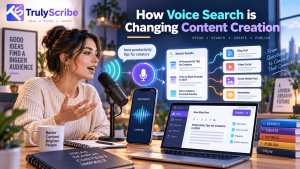
Key Takeaways
- Voice queries are longer, more conversational, and more question-shaped than typed queries, which rewards content written the way people actually talk.
- Smart speaker ownership in the US jumped to 39% of people 12 and older in 2026, its biggest single-year gain since 2021, according to Edison Research’s Infinite Dial.
- Voice assistants typically read back one answer, not ten blue links, so content needs a single, clear, extractable answer near the top, not just good rankings.
- Spoken content is naturally shaped like a voice-search answer. A transcript of someone genuinely answering a question already has the rhythm and phrasing voice queries use.
- Dictating a first draft and lightly editing the transcript is becoming a practical way to produce more natural, voice-search-friendly content, not just a productivity shortcut.
Type “best pizza place” into a search bar and most people instinctively drop the words a sentence would need. Ask a smart speaker the same question and they say it in full: “what’s the best pizza place near me that’s still open?” The query is longer, more specific, and shaped like a real sentence — because it is one. That shift in how people ask questions is quietly changing what content actually needs to look like to get found and get read aloud.
Voice isn’t a niche habit anymore. According to Edison Research’s Infinite Dial 2026, reported by SSRS’s Power of Audio 2026, smart speaker ownership in the US climbed to 39% of people aged 12 and up, the largest single-year jump since 2021, alongside 91% smartphone ownership. Every one of those devices is a voice interface, and a growing share of queries now arrive as spoken questions rather than typed fragments.
This piece looks at what actually changes when a meaningful share of your audience is asking out loud instead of typing, and where transcription fits into writing content that works for both.
This isn’t a call to abandon everything you know about SEO. Most of the fundamentals still apply — clear structure, genuine expertise, fast-loading pages. What changes is more specific: the phrasing of your headers, where you place your answers, and how closely your sentences match the way a real person would actually ask the question out loud.
How Voice Queries Differ From Typed Queries
The core shift is structural, not just about volume. Typed search has trained people to strip queries down to keywords. Voice search removes that friction, so people ask the way they’d ask a person standing next to them.
| Factor | Typed Search | Voice Search |
| Typical query | “pizza near me hours” | “what time does the pizza place near me close?” |
| Query length | Short, keyword-based | Longer and conversational |
| Grammar | Fragments, dropped words | Full questions, natural phrasing |
| Intent signal | Inferred from keywords | Often explicit (“how,” “what,” “can I”) |
| Result format | A page of ranked links | Usually one spoken answer |
That last row matters most for content strategy. A typed search gives a reader ten options to scan. A voice query generally gets one answer read aloud, pulled from whichever source the assistant judges clearest and most directly responsive to the question asked. Ranking well isn’t enough if your content doesn’t also contain an answer an assistant can lift out cleanly.
That single-answer dynamic changes the competitive calculus too. Ranking fourth or fifth on a results page still earns clicks from a typed search. In voice search, there’s effectively no equivalent of page-two visibility — an assistant reads one answer, and everything else is invisible to that particular query, no matter how well it would otherwise rank.
What This Means for How Content Gets Written
Lead with the direct answer
Voice assistants favor content that answers a question plainly within the first sentence or two, rather than building up to the point. Put the direct answer near the top of a section, then expand with context and detail afterward for readers who want more.
Write headers as real questions
A header like “Pizza Delivery Hours” is less likely to match a spoken query than “What time does pizza delivery stop?” Matching your subheadings to the actual phrasing people would say out loud makes it far easier for an assistant to pair the right section with the right question.
Use natural, conversational phrasing throughout
Content written in clipped, keyword-stuffed fragments reads fine for a search engine trained on typed queries, but it doesn’t match how people actually talk. Writing in full, natural sentences — the way you’d explain something out loud — aligns content more closely with how voice queries are phrased.
Build dedicated FAQ sections
A clearly labeled question-and-answer format gives assistants an obvious, low-ambiguity source to pull from. It also tends to double as useful, skimmable content for human readers, so the format earns its place even where voice traffic is a secondary concern.
Don’t neglect local intent
A large share of voice queries carry local intent — “near me,” “open now,” “closest.” Backlinko’s analysis of voice search behaviour notes that the average voice query runs around 29 words, considerably longer than a typed search, which reflects how much specific, local, and conversational detail people pack into a spoken question. Business listings, hours, and location details need to be accurate and consistently published, not just mentioned once on a contact page.
Why Spoken Content Is Naturally Shaped for Voice Search
Here’s the connection that often gets missed: a transcript of someone genuinely answering a question out loud is already close to the format voice search rewards. Real speech is conversational by default. It uses full sentences. It often states the direct answer before elaborating, the way people naturally explain things. Written content frequently has to be rewritten to sound more natural — spoken content starts there.
This is a big part of why creators are increasingly dictating first drafts instead of typing them. Talking through an answer and transcribing it tends to produce more natural, conversational phrasing on the first pass than typing does, simply because speech and voice search share the same underlying rhythm — real questions, real answers, in real sentences.
There’s a useful feedback loop hiding in this: the better your content matches how people actually speak, the better it tends to perform in voice search, and the easiest way to write in that register consistently is to start by speaking the answer yourself, rather than trying to simulate natural speech on a keyboard from scratch.
A Practical Workflow: Turning Spoken Answers Into Voice-Search-Ready Content
Step 1: Record yourself answering the actual question
Pick a question your audience genuinely asks — pulled from customer emails, support tickets, or comments — and answer it out loud as if someone asked you directly. Don’t script it word for word; a natural, slightly imperfect answer is the point.
Step 2: Transcribe it accurately
Turn the recording into an accurate, punctuated transcript. This preserves the natural sentence structure and phrasing from the spoken answer, which is exactly what you want to carry into the written version.
Step 3: Lightly edit, don’t rewrite
Clean up filler words and tighten anything that rambles, but resist the urge to rewrite the answer into stiffer, more formal prose. The conversational quality of the original answer is the asset — over-editing it away defeats the purpose.
Step 4: Turn the question into the header
Use the actual question, phrased naturally, as an H2 or H3, and place the direct answer in the first sentence underneath it. This mirrors how turning a recording into a structured blog post already works, applied specifically to question-and-answer content.
Step 5: Repeat across your most common questions
Build this into a habit rather than a one-off exercise. A library of genuinely spoken, naturally phrased answers to your audience’s real questions becomes a meaningful voice-search asset over time, not just a single optimized page.
This workflow scales naturally too. Once you have a backlog of recorded answers, batching the transcription step rather than doing it one question at a time saves real time, and reviewing a week’s worth of answers together often surfaces patterns — the same phrasing, the same caveats — that are worth standardizing across your whole FAQ library.
Common Mistakes in Writing for Voice Search
- Keyword-stuffing headers instead of phrasing them as real questions people would actually ask out loud.
- Burying the direct answer two or three sentences into a paragraph instead of leading with it.
- Treating voice search as identical to typed search optimization rather than a distinct, conversational query pattern.
- Ignoring local business information, which carries disproportionate weight in voice queries.
- Over-polishing dictated drafts until they lose the natural, conversational phrasing that made them voice-search-friendly in the first place.
Where TrulyScribe Fits Into This Workflow
TrulyScribe is built around exactly this kind of spoken-to-written workflow. Its voice-to-text converter turns a dictated answer into an accurate, punctuated transcript in minutes, preserving the natural phrasing that makes spoken content easy to turn into voice-search-ready copy. Speaker labels and clean punctuation mean less manual cleanup before publishing, and support for 100+ languages means the same workflow extends to non-English audiences without starting from scratch in each language.
This fits naturally alongside a broader content strategy: the same transcription that produces a voice-search-friendly FAQ answer can also feed a full blog post, social content, or a searchable video or podcast archive, so one recorded answer does more than one job.
Frequently Asked Questions (FAQs)
Is voice search actually a big part of search traffic now?
It’s a meaningful and growing share, not the majority. Smart speaker ownership and smartphone voice assistant use have both climbed steadily, and the behaviour spills over into typed search too — people who are used to asking questions out loud tend to type more conversational, question-based queries as well.
Do I need to write differently for voice search, or does good SEO already cover it?
Strong general SEO is a solid foundation, but voice search rewards specific things on top of it: conversational phrasing, question-formatted headers, and a direct answer stated early. Content optimized only for typed keyword matching can still miss these.
Does dictating content actually produce better writing than typing?
Not automatically better, but often more naturally conversational on a first pass, since spoken language tends to default to full sentences and a direct-answer-first structure. It still needs a light editing pass — the gain is in starting from a more natural-sounding draft, not in skipping editing altogether.
How important is local content for voice search specifically?
Very important for any business with a physical location or service area. A large share of voice queries include local intent — “near me,” hours, directions — so accurate, consistently published business information carries more weight than it might for general content.
Should every page have an FAQ section now?
Not necessarily every page, but any page answering common audience questions benefits from a clearly labeled question-and-answer format, since it gives both voice assistants and skimming readers an easy, low-ambiguity way to find the answer.
What’s the easiest way to start optimizing for voice search?
Pick your most commonly asked customer question, answer it out loud naturally, transcribe it, and publish it as a question-formatted header with the direct answer in the first sentence. Repeat for your next most common question, and build from there.
The Bottom Line
Voice search isn’t just a new channel to optimize for — it’s a reminder that the most findable content is often the content that sounds like an actual answer to an actual question. Writing that way on purpose, instead of hoping a keyword-optimized paragraph happens to match a spoken query, is what separates content that gets read aloud by an assistant from content that doesn’t.
Spoken answers are naturally shaped for this, which is exactly why transcription is becoming part of the content creation toolkit, not just a transcription-for-meetings utility. TrulyScribe makes that spoken-to-written step fast, so your most natural, conversational answers can become some of your most voice-search-ready content.
Related Articles
- Why Every YouTube Video Needs a Searchable Transcript
- Turn Your Video into a Blog Post Using AI Transcription
- AI Agents + Transcription: The Next Productivity Revolution
- What Is AI Transcription & How It Works: A Beginner’s Guide
- Mastering Multilingual Content with AI Transcription
- Human vs. AI Transcription: A Full Comparison