
Newsrooms run on interviews, and interviews run on deadlines. A reporter chasing a same-day story doesn’t have the luxury of spending three hours transcribing a 40-minute conversation by hand — but they also can’t afford to get a direct quote wrong, misattribute a statement, or expose a source who spoke on the condition of anonymity. That combination of speed and precision is exactly where journalism’s transcription needs diverge from almost every other industry using AI transcription today.
This piece looks at what makes newsroom transcription different, where AI genuinely helps reporters and editors work faster without cutting corners on accuracy, and where the human judgment of a journalist still has to stay firmly in the loop.
It’s worth saying upfront: nothing here suggests AI transcription should replace editorial judgment. It replaces the mechanical, time-consuming part of the process — turning speech into text — so reporters can spend more of their limited time on the parts of the job that actually require a trained journalist: asking the right follow-up questions, verifying claims, and deciding what the story actually is.
Why Journalism Has Different Transcription Needs
Verbatim accuracy isn’t optional
A misquote isn’t just an inconvenience in journalism — it’s a correction, a credibility hit, or in the worst cases, a legal problem. Direct quotes need to match what was actually said, word for word, which means AI transcription output has to be treated as a strong first draft that still gets checked against the original audio before publication, not as a final, citable source on its own.
This is arguably the single biggest mindset shift newsrooms need when adopting AI transcription: the tool changes how fast a transcript gets produced, not who’s responsible for verifying it. That responsibility stays exactly where it’s always been — with the reporter and editor signing off on the story.
Field conditions are rarely ideal
Reporters record in press scrums, on street corners, over phone lines, and in loud public spaces — not quiet studios. Transcription accuracy on audio with real-world background noise matters enormously here, since a clean-room-only tool falls apart on exactly the kind of audio journalism actually produces.
Multiple speakers, often without warning
Press conferences, panel interviews, and roundtable discussions involve several speakers who aren’t always identified clearly in advance. Reliable speaker labeling in multi-participant recordings is the difference between a usable transcript and one that requires a full manual re-listen to figure out who said what.
Confidentiality can be a matter of real consequence
Investigative and beat reporters regularly handle recordings involving sensitive sources, whistleblowers, or off-the-record conversations. Whatever tool processes that audio needs genuinely secure handling, encryption, and clear data retention practices — a leaked or improperly retained recording isn’t just a privacy issue, it can put a source’s safety or livelihood at risk.
Deadlines don’t move
A breaking story doesn’t wait for transcription to catch up. Whether it’s a daily news cycle or a same-day broadcast segment, turnaround speed on interview transcription directly affects how much time a reporter actually has left to write, verify, and file.
This is where the value of AI transcription compounds across an entire newsroom, not just for a single reporter. A daily desk running dozens of source calls, press briefings, and stand-ups can absorb hours of collective time savings, freeing editorial capacity for enterprise reporting rather than transcription backlog.
The Real Cost of Manual Transcription for Journalists
Manually transcribing an interview is famously slow — a widely cited rule of thumb puts it at roughly four to five times the length of the recording itself, once pausing, rewinding, and typing are factored in. A single 45-minute interview can easily eat two to three hours of a reporter’s day, time that isn’t spent reporting, verifying, or writing.
For journalists conducting multiple source interviews per story, that cost compounds fast. It’s one of the reasons freelance and staff writers report some of the largest weekly time savings from adopting AI transcription — the hours saved on typing translate directly into more time for the reporting work that actually requires a journalist’s judgment.
That math changes even more for investigative or long-form work, where a single story might draw on ten or more source interviews before a word gets written. At four to five hours of manual transcription per hour of audio, that’s easily a full work week spent typing before the actual reporting and writing even begins — time an AI-assisted first pass gives back almost entirely.
How AI Transcription Fits the Newsroom Workflow
1. Fast Turnaround for Same-Day Deadlines
Instead of budgeting hours for manual transcription, a reporter can get an accurate first-pass transcript back in minutes, leaving the remaining time for fact-checking quotes and actually writing the story.
2. Reliable Accuracy on Real Field Audio
Interviews conducted over phone calls, in busy locations, or through video calls with imperfect connections still need to transcribe cleanly enough to be usable without a full manual rewrite.
3. Speaker Labels for Press Conferences and Panels
Accurate speaker attribution turns a chaotic multi-voice recording into a transcript a reporter can actually scan for who said what, without re-listening to the full recording to sort it out.
4. A Searchable Archive Across an Entire Beat
Reporters covering a long-running story or beat benefit enormously from being able to search across every past interview transcript for a specific name, quote, or topic, rather than relying on memory or manually scrubbing through old recordings.
5. Multilingual Interviews and Foreign Correspondence
For international reporting or interviews conducted in a source’s native language, accurate multilingual transcription and translation — covered in more depth in a broader look at multilingual content workflows — removes a major bottleneck that used to require a separate translator or fixer just to get a usable transcript.
6. Structuring the Story From the Transcript Up
A clean, searchable transcript makes it easier to build an article around what a source actually said, rather than working from memory or scattered notes — letting the structure of the piece emerge from the interview itself instead of forcing quotes to fit a predetermined outline.
7. Publishing Transcripts Alongside Investigative Pieces
For high-stakes or investigative stories, publishing a full interview transcript alongside the article adds transparency and lets readers verify context directly — while also giving search engines and AI tools indexable text that helps the piece surface for related searches long after publication.
Manual vs. AI-Assisted Newsroom Transcription
| Factor | Manual Transcription | AI-Assisted Transcription |
| Time for a 45-min interview | 2–3+ hours | A few minutes, plus review |
| Speaker attribution | Manual, error-prone under deadline | Automatic, still worth verifying |
| Searchability across a beat | Limited to memory or manual notes | Full-text search across archives |
| Multilingual interviews | Requires a separate translator | Built into the transcription step |
| Quote verification | Built in by necessity | Still required, just moved earlier |
Best Practices for Journalists Using AI Transcription
- Always verify direct quotes against the original audio before publishing — AI transcripts are a starting point, not a citable source on their own.
- Understand and follow your outlet’s editorial policy on AI tool disclosure, since standards vary by publication and are still evolving.
- Choose a transcription tool with clear, documented data retention and deletion practices, particularly for sensitive or anonymous-source recordings.
- Keep raw recordings according to your organization’s retention and legal requirements, even after a transcript has been generated and reviewed.
- Double-check speaker attribution manually in any multi-source recording before quoting, since misattributing even an accurate quote to the wrong speaker is still a correction.
- Build a consistent naming and filing convention for interview recordings and transcripts, so a searchable archive stays organized as a beat grows over months or years.
Where TrulyScribe Fits Into Newsroom Workflows
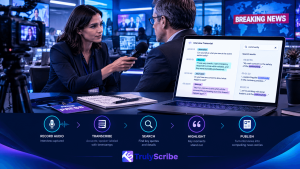
TrulyScribe‘s free interview transcription tool is built around exactly this use case: fast, accurate transcription with automatic speaker labeling to separate interviewer from source, timestamps for quickly locating a specific moment, and export into SRT for video interviews or DOCX and PDF for print and digital stories.
All interview files and transcripts are processed under encrypted, GDPR-compliant handling, which matters directly for reporters working with sensitive sources or material that can’t risk exposure. And because the same accurate transcript can support the article, a published transcript for transparency, or translated versions for international coverage, it fits naturally into a newsroom’s broader workflow rather than solving just one narrow step of it.
For newsrooms comparing tools specifically on export flexibility — a common requirement when transcripts need to move between editorial systems, video editors, and CMS platforms — it’s worth reviewing which AI transcription tools support JSON and SRT export alongside DOCX and PDF, since newsroom workflows often span both editorial text and video production in the same story.
Frequently Asked Questions (FAQs)
Is AI transcription accurate enough to quote directly in a published article?
AI transcription is accurate enough to work from, but any direct quote should still be checked against the original audio before publication. Treat the AI transcript as a fast, reliable first draft rather than a final, citable source in itself.
Can AI transcription handle press conferences with multiple speakers?
Yes, modern transcription tools handle multi-speaker audio significantly better than earlier generations, though speaker labels in a chaotic press conference setting are still worth a manual double-check before quoting a specific person.
How should journalists handle confidential source recordings?
Use a transcription tool with clear, documented encryption and data retention practices, and understand exactly how long files are retained and who can access them. This matters more for source protection than almost any other use case for transcription.
Do newsrooms need to disclose the use of AI transcription tools?
Editorial policies vary by outlet and are still evolving industry-wide. As a general practice, treating the AI transcript purely as a production tool — with a human journalist responsible for verifying and writing the final story — keeps the tool’s role clearly distinct from editorial judgment.
How much time does AI transcription actually save reporters?
Manual transcription typically takes four to five times the length of the recording. AI transcription cuts that initial pass down to a few minutes, leaving the reporter’s remaining time for verification and writing rather than typing.
Can AI transcription handle interviews conducted in a foreign language?
Yes, provided the tool supports the relevant language with strong accuracy. This is particularly useful for international reporting, where translating an accurate source-language transcript is far faster than working through a separate translation process from scratch.
Should broadcast and video journalists use AI transcription differently than print reporters?
The core benefit is the same — fast, accurate text from spoken audio — but broadcast and video teams typically also need subtitle-ready SRT exports for on-air captions or published clips, which is worth confirming any transcription tool supports alongside standard document formats.
The Bottom Line
AI transcription doesn’t replace a journalist’s judgment, fact-checking, or editorial rigor — and it shouldn’t be asked to. What it replaces is the hours once spent manually typing out interviews word by word, freeing that time for the reporting and verification work that actually requires a human. For newsrooms working against constant deadlines while still needing airtight accuracy, that trade-off is a genuine productivity gain, not a shortcut around the standards journalism depends on.
TrulyScribe is built to support that workflow: fast, accurate, secure interview transcription that gives reporters back their time without asking them to compromise on verification.
Key Takeaways
- Newsroom transcription has different demands than general business use: verbatim accuracy for direct quotes, reliable handling of field audio, and strict confidentiality for sensitive sources.
- Manual transcription remains one of the biggest hidden time costs in journalism — often several hours of work for a single hour-long interview.
- AI transcription fits directly into deadline-driven workflows: fast turnaround, searchable archives across a beat, and multi-speaker labeling for press conferences and panel interviews.
- Every AI-generated quote still needs to be verified against the original audio before publication — speed doesn’t remove the fact-checking step, it just moves it earlier.
- Security and confidentiality matter more in journalism than almost any other use case, since a leaked interview file can put a source at real risk.
Related Articles
- Best AI Transcription Tools With JSON & SRT Export
- Is AI Transcription Secure? Data Retention and Encryption Explained
- How to Transcribe Focus Groups With Multiple Speakers Accurately
- How to Transcribe Audio With Background Noise
- Mastering Multilingual Content With AI Transcription
- Human vs. AI Transcription: A Full Comparison