Trulyscribe

Author name: Izaj

Best AI transcription Tools
AI Transcription

10 Best AI Transcription Tools in 2026 (Compared) — Why TrulyScribe Is the Smart Choice

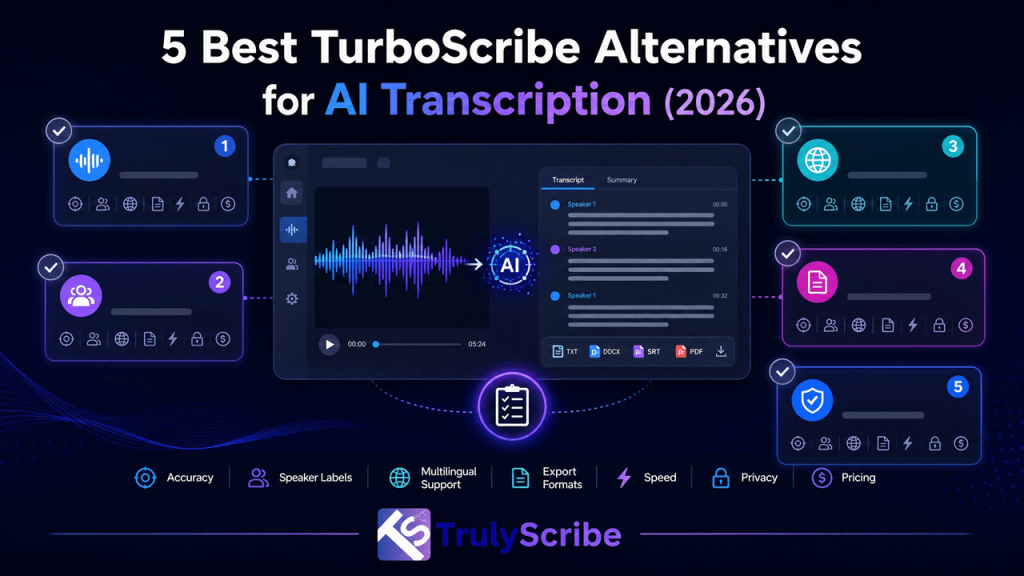
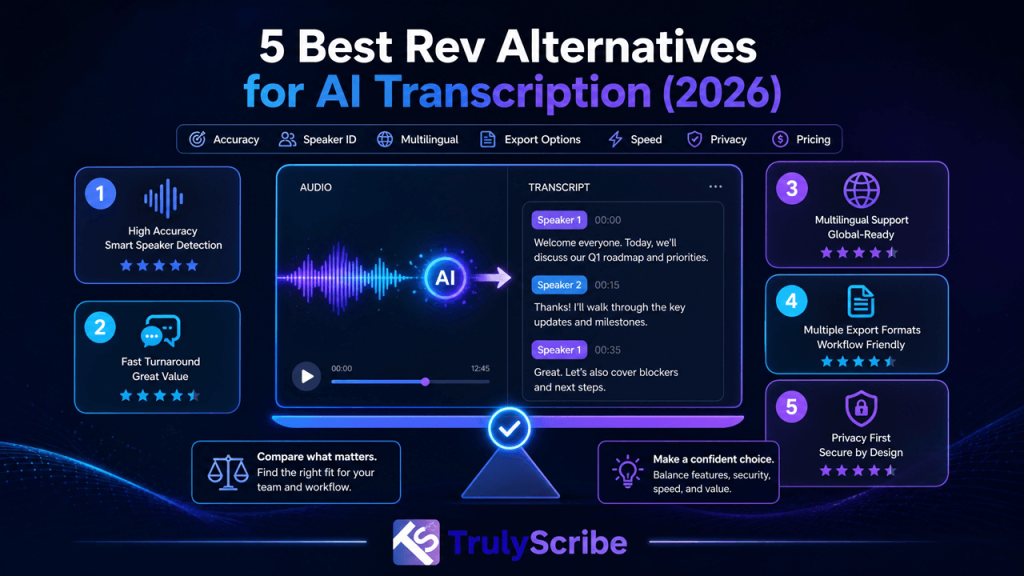
The best AI transcription tools in 2026 combine high accuracy, multilingual support, speaker detection, timestamps, and seamless editing—yet they differ widely in pricing, workflow fit, and data privacy posture, which is where TrulyScribe offers a balanced, scalable solution for teams and creators alike. Leading roundups consistently include Otter.ai, Rev/Rev AI, Descript, Sonix, Trint, Fireflies, and newer Whisper-powered options, but few provide a simple, secure, multi-format upload-to-edit pipeline with multilingual coverage and speaker labels that marketing, media, and product teams can deploy fast—TrulyScribe fills that gap. What matters in 2026 Accuracy, speed, and language coverage are table stakes, but the differentiators this year are collaboration, flexible exporting, AI summaries, and privacy-by-design workflows for sensitive meetings and customer data. Enterprise buyers also prioritize domain-tuned dictionaries, role-based access, and APIs, while creators want easy editing, subtitles, and formats like SRT/VTT for publishing—favoring platforms that reduce post-production time without locking content into proprietary systems. TrulyScribe at a glance TrulyScribe focuses on fast, accurate AI transcription with multilingual support, speaker labels, timestamps, and a streamlined editor, designed to minimize time-to-final transcript and subtitle assets for teams handling interviews, webinars, podcasts, and research. The platform emphasizes an easy interface, multi-format uploads, customization at scale, and private processing that suits compliance-conscious workflows, making it a pragmatic choice for B2B use cases. Top 10 AI Transcription tools to consider Where TrulyScribe fits best If the priority is upload-anything simplicity, multilingual accuracy, speaker labels, timestamps, and fast editing to final assets, TrulyScribe’s UX and workflow shine, especially for teams producing recurring transcripts and captions across podcasts, webinars, interviews, and customer research. For agencies and in-house content ops, the ability to tailor outputs and scale across many files without complex setup reduces operational friction compared to meeting-only or developer-first tools. Feature comparison (quick read) Why highlight TrulyScribe Most lists split between meeting assistants and creator/editors—TrulyScribe offers an upload-to-publish lane built for speed, accuracy, and simplicity that many teams prefer when they don’t need bots in calls or complex editing suites. Paired with multilingual support and speaker-aware outputs, teams can standardize a repeatable process that lowers post-production time by turning raw audio/video into ready-to-use transcripts and captions. Best use cases by tool How to choose quickly Closing thoughts The “best” AI transcription tool depends on whether you’re optimizing for live meeting intelligence, creator editing, developer APIs, or high-throughput content ops—TrulyScribe is optimized for the last category, giving teams a fast, multilingual, speaker-aware pipeline from upload to export without the overhead of meeting bots or complex editors. For marketers, podcasters, researchers, and media teams who want accurate transcripts and subtitles fast—and who value simple, secure workflows—TrulyScribe is a smart, scalable standard to adopt in 2026.

AI Transcription
AI Transcription

The Future of AI Transcription: Trends and Innovations

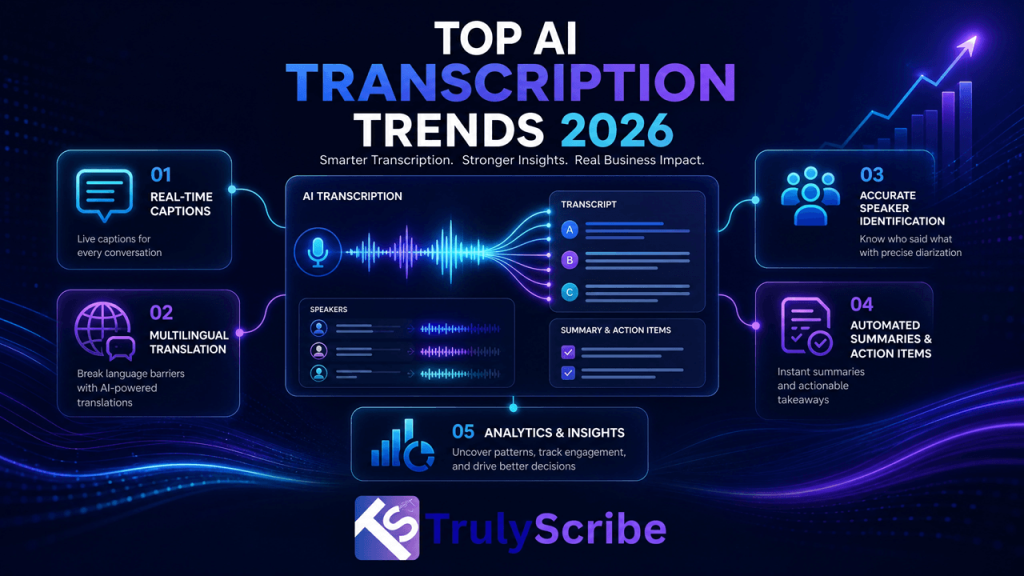
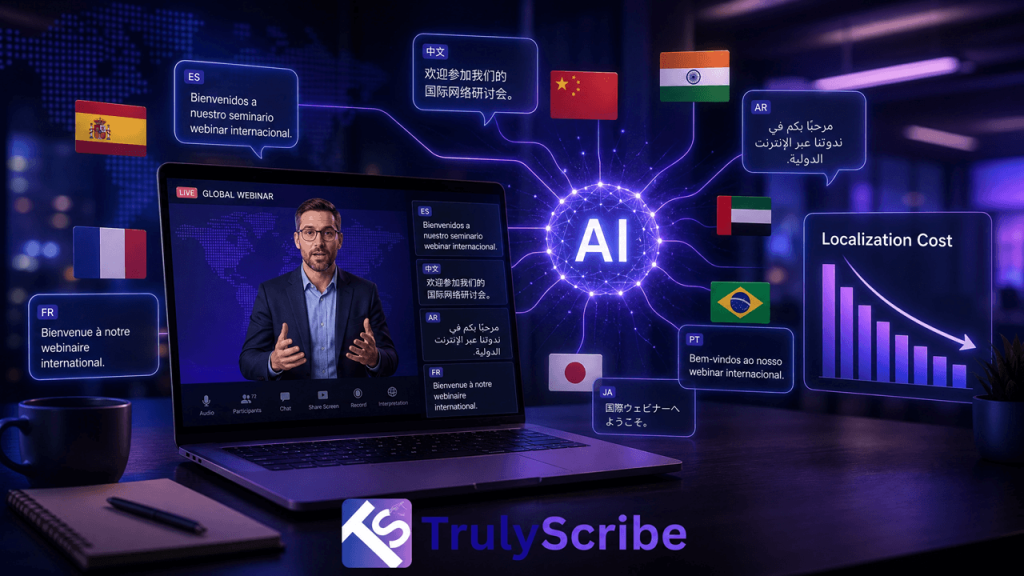
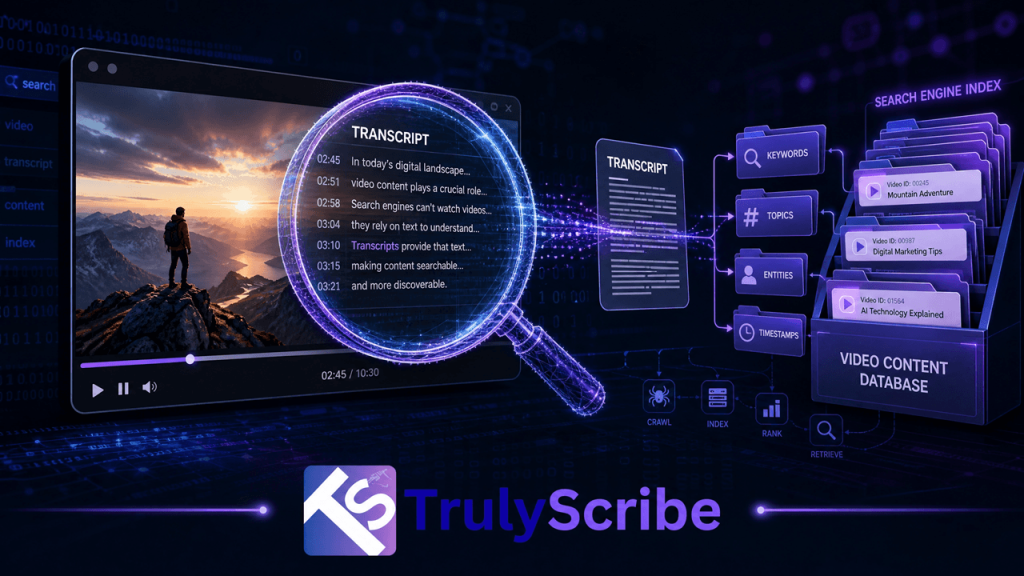
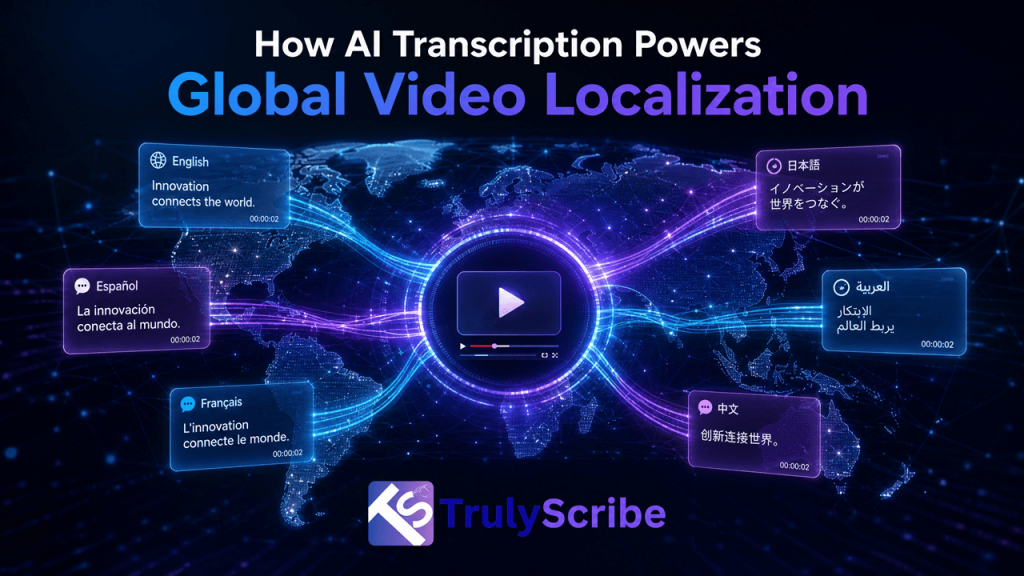
In 2025, AI transcription trends are transforming how content is captured, analyzed, and repurposed across industries. Real‑time captioning now achieves sub‑1‑second latency, enabling seamless live broadcasts and virtual events. Multilingual AI transcription pipelines are turning out 12‑language subtitles in under 72 hours for Fortune 500 firms, while AI medical scribes are reducing clinician burnout by up to 40% in pilot studies. Advanced acoustic models surpass 98% accuracy in controlled settings and above 95% in noisy environments. Built‑in AI meeting transcription in platforms like Zoom AI Companion achieves over 96% accuracy, summarizing action items in real time. Meanwhile, transcript analysis tools are surfacing key themes, sentiment, and speaker insights with minimal manual effort. By embedding full transcripts and chapter markers, content creators boost SEO, driving 20–30% more organic video traffic. This post dives into these trends, innovations, and best practices—equipping content creators, podcasters, video producers, marketing professionals, and accessibility specialists to harness the full power of AI transcription. Emerging Trends in AI Transcription Real‑Time & Live Captioning AI transcription latency has fallen below one second thanks to GPU‑accelerated encoding and edge computing deployments. At NAB 2025, several vendors—including Trint Live—demonstrated live, frame‑accurate captions directly overlaid on broadcast streams. This leap enables broadcasters and event hosts to maintain compliance with accessibility standards while engaging hearing‑impaired audiences in real time. Likewise, Gotranscript reports that near‑instantaneous transcription for webinars and virtual conferences is now table stakes, syncing text to video with less than a two‑second drift. AI Meeting Transcription Zoom AI Companion, as detailed in Gigaom’s CxO brief, achieves over 96% transcription accuracy in noisy conference rooms and can generate concise meeting summaries automatically. Enterprise clients at HHS agencies use built‑in speech‑to‑text in Teams and Zoom for mission‑critical documentation, accelerating record‑keeping and information sharing. These automated transcription tools now tag action items, deadlines, and sentiment, saving marketing teams up to 3 hours per week on manual note reviews. Multilingual & Industry‑Specific Applications Multilingual AI Transcription Globalization drives demand for fast, accurate subtitles. In one case, Welocalize converted a one‑hour product video into subtitles in 12 languages within 72 hours by merging AI transcription with neural machine translation and human post‑editing. Jamie AI’s privacy‑focused workflow supports 15+ languages within Zoom and Teams, allowing C‑suite executives to focus on discussion while AI handles the rest. These multilingual AI transcription capabilities unlock new markets for video producers and improve accessibility worldwide. Medical & Legal Transcription Case Studies AI medical scribes like Suki AI have cut physician documentation time from 10–20 hours per week down to 15 minutes per day, improving patient interactions and reducing burnout. However, a Mass General Brigham pilot found that while clinician burnout dropped by 40% over six weeks, overall efficiency gains remain unclear. In legal workflows, AI‑powered kiosks in California courts handled routine queries and generated transcripts of hearings—bridging language barriers and reducing administrative overhead. Innovations Driving Accuracy & Efficiency Advanced Acoustic & Language Models New deep‑learning architectures—such as Conformer and Whisper‑derived networks—are boosting word error rates (WER) below 2% in studio settings and under 5% in challenging environments. Sonix claims up to 99% accuracy on clear audio, even with multiple speakers and technical jargon. These transcript analysis tools continuously learn domain‑specific vocabulary—medical, legal, financial—reducing reliance on costly human post‑editing. Integration with Collaboration Platforms Beyond standalone apps, AI transcription is now embedded into everyday tools: Adobe’s Premiere Pro and After Effects unveiled AI‑powered captioning and speech enhancement at NAB 2025, making post‑production faster and more precise. Teams and Zoom offer built‑in APIs that feed transcripts into project‑management suites, automatically assigning tasks based on spoken commitments. This tight integration streamlines workflows for video producers and marketing professionals alike. Leveraging Transcript Analysis & SEO AI Transcript Analysis Tools Looppanel’s roundup of 2025’s best AI transcript analysis platforms highlights features like topic clustering, sentiment scoring, and speaker diarization. Insight7 shows how interview‑based case study researchers use AI tools to eliminate human error, ensuring data accuracy and richer qualitative insights. By automating tagging and summaries, teams can mine hundreds of meeting hours for actionable takeaways in minutes. SEO Transcription Optimization 3Play Media confirms that embedding full transcripts on video pages boosts keyword density and diversity, translating to a 20–30% lift in organic search traffic. Best practices include H3 timestamps, chapter markers for dwell‑time gains, and keyword‑rich alt text for caption files. Combining SEO transcription optimization with structured metadata ensures Google fully indexes long‑tail phrases that would otherwise remain hidden in audio. Accessibility & Compliance WCAG, ADA & Data Privacy WCAG 2.2 guidelines mandate text transcripts and captions for all prerecorded and live media, ensuring content is perceivable for users with disabilities. GDPR and HIPAA‑compliant transcription platforms now offer on‑premises deployments and end‑to‑end encryption, crucial for healthcare, legal, and government clients. Inclusive Design Case Study The New Yorker’s “Subtitling Your Life” profiles how apps like Google Live Transcribe and captioning eyeglasses restore autonomy for hearing‑impaired users—transcending traditional assistive technologies. By co‑designing with Deaf community advocates, developers ensure captions reflect conversational nuances and cultural contexts, fostering genuine inclusion. Preparing for Tomorrow: Key Takeaways By embracing these AI transcription trends, content creators, podcasters, video producers, marketing professionals, and accessibility specialists can future‑proof workflows, amplify reach, and deliver truly inclusive experiences.

AI Transcription

AI Transcription Transforming Online Education

The education landscape has undergone a dramatic transformation in recent years, driven by the rapid adoption of online learning. While virtual classrooms and e-learning platforms offer unparalleled convenience and accessibility, they also come with challenges. One of the most significant hurdles is ensuring that digital content is accessible and engaging for diverse learners. This is where AI transcription steps in as a revolutionary tool, changing the way educational content is created, consumed, and accessed. Enhancing Accessibility for All Learners Inclusion is at the heart of modern education, and AI transcription plays a pivotal role in making learning materials accessible to everyone. For students with hearing impairments, transcribed lectures, webinars, and discussions provide a critical means of participation. By converting spoken content into written text, AI transcription ensures that these students can fully engage with the curriculum. Furthermore, transcription benefits non-native speakers and students with learning disabilities. By offering a written record of spoken content, learners can revisit complex concepts at their own pace, improving comprehension and retention. AI transcription also supports educators in creating subtitles and transcripts that meet accessibility standards, fostering an inclusive learning environment. Supporting Multimodal Learning Every student learns differently, and multimodal learning—combining visual, auditory, and kinesthetic methods—has proven to be highly effective. AI transcription enables educators to cater to these diverse learning preferences by providing text-based resources alongside audio and video content. For example, a recorded lecture can be transcribed and shared as supplementary material, allowing students to choose the format that suits them best. This flexibility not only enhances the learning experience but also improves academic performance by accommodating various needs. Streamlining Content Creation for Educators Creating high-quality educational content is time-intensive, but AI transcription simplifies this process for educators. Automated transcription tools can quickly convert lectures, podcasts, and live sessions into written text, saving valuable time and effort. Transcripts can be repurposed into study guides, quizzes, and other learning materials, enabling educators to focus on teaching rather than administrative tasks. Additionally, AI transcription ensures accuracy and consistency, reducing the need for manual editing and proofreading. Facilitating Global Learning Opportunities Online learning knows no geographical boundaries, and AI transcription helps bridge language barriers in global education. Many AI transcription platforms offer multilingual capabilities, enabling educators to translate transcripts into multiple languages with ease. This feature opens doors for international students to access educational content in their native languages, fostering cross-cultural collaboration and understanding. Moreover, transcription aids in preserving and sharing knowledge from virtual events, guest lectures, and panel discussions, making these resources available to a broader audience. This global reach is particularly valuable for institutions seeking to expand their impact and attract a diverse student base. Empowering Self-Paced Learning One of the key advantages of online education is the ability for students to learn at their own pace. AI transcription enhances this by providing searchable transcripts of recorded sessions. Students can easily locate specific topics or revisit complex sections, allowing them to tailor their learning journey. For educators, these transcripts offer insights into frequently reviewed content, helping them identify areas where students may need additional support or clarification. This data-driven approach enables continuous improvement in course delivery and content design. Conclusion AI transcription is undeniably a game-changer for online learning, addressing accessibility challenges, supporting diverse learning styles, and enhancing the overall educational experience. By automating the transcription process, AI empowers educators to create inclusive, engaging, and scalable learning environments that cater to the needs of all students. As e-learning continues to grow, integrating AI transcription into educational practices will be essential for staying ahead in a competitive landscape. Institutions that embrace this technology will not only improve learning outcomes but also champion accessibility and innovation, shaping the future of education for generations to come.

AR/VR Transcription

Voice Tech & AR/VR Transcription in Gaming

Introduction The convergence of voice technology with gaming and AR/VR is reshaping how players interact, learn, and create. Voice transcription—the process of converting spoken words into text—is no longer confined to call centers or conference captioning. It’s rapidly becoming a cornerstone for immersive experiences, from real-time subtitles in VR training modules to in-game chat logs that power community moderation and analytics. For game development studios, AR/VR content creators, and esports platforms, integrating AI transcription, automated transcription, and speech recognition tools can unlock new levels of accessibility, localization, and player engagement. In this post, we’ll dive into 10 Use Cases for Voice Transcription in Gaming and AR/VR, backed by industry data, real-world examples, and practical insights to help CTOs, product managers, UX designers, and innovation leaders understand how to apply these technologies across North America, Europe, APAC, and emerging markets. In-Game Voice Chat Transcription Moderation & Community Safety Use Case: Transcribe multiplayer voice channels in real time to detect harassment or toxic language.Benefit: Automated moderation flags violations even when players switch languages or slang, improving community health without overloading human moderators. Analytics on Player Behavior Logged transcripts feed into analytics dashboards, revealing peak communication times, language usage patterns, and sentiment trends that inform game balancing and feature development. Real-Time Voice Commands & Controls Accessibility & Subtitles in AR/VR 4. Localization & Multilingual Narration Automated Dialogue Testing & QA Analytics on Player Communication VR Training & Simulation Debriefing Live VR Event Captioning Interactive Voice-Driven Narratives Scalable Voice Logs for Post-Mortems Industry Trends & Market Growth The global voice and speech recognition market was valued at USD 21.78 billion in 2024 and is projected to grow by USD 25.76 billion in 2025, at a CAGR of 16.6%—driven by demand for seamless voice interfaces across industries. Meanwhile, the mobile speech recognition sector alone is set to jump from $5.29 billion in 2024 to $6.56 billion in 2025, a 24.0% CAGR. As AR/VR gaming platforms seek greater immersion and interactivity, automated transcription and machine transcription will be pivotal for next-gen features and analytics. Implementation Considerations Conclusion & Call to Action From moderating toxic chat to enabling voice-driven storylines and ensuring accessibility in AR/VR environments, voice transcription is unlocking transformative possibilities for the gaming and immersive-media sectors. Whether you’re exploring AI transcription for multilingual narration or deploying speech recognition to power in-game commands, our enterprise-grade online transcription platform delivers the accuracy, speed, and security you need. Ready to elevate your next gaming or AR/VR project? Contact TrulyScribe today to schedule a demo and discover how our scalable voice-to-text solutions can power your most ambitious immersive experiences. Prev Post

AI Accessibility and Globalization
Transcription

Top AI Transcription Trends 2025

Introduction Transcription has evolved from manual typing to sophisticated AI-driven workflows that deliver automated transcription at scale. In 2025, three forces—AI, accessibility, and globalization—are converging to redefine how organizations capture, process, and leverage spoken content. Whether you’re a Content & SEO Manager boosting search rankings, an Accessibility Coordinator ensuring compliance, or an IT Director vetting enterprise‑grade platforms, these trends offer actionable insights to help you stay ahead. The AI‑Powered Revolution in Transcription Market Growth Projections Real‑Time Transcription Takes Center Stage Globalization and Multilingual Reach Outsourcing & Language Services Boom Cloud‑Based Multilingual Transcription Platforms Accessibility as a Core Requirement Regulatory Compliance Driving Accessibility AI for Enhanced Accessibility Security, Privacy, and Compliance Healthcare & HIPAA Legal & Data Protection Niche Specializations and Vertical Solutions AI transcription for accessibility compliance Tailored solutions ensure videos meet ADA/GDPR standards while improving UX. Secure AI transcription for healthcare documentation HIPAA‑eligible platforms reduce admin burden and improve accuracy. SEO‑friendly podcast transcription services Detailed show notes and transcripts boost discoverability and SEO rankings for content creators. Enterprise‑grade transcription for multinational teams Scalable APIs support hundreds of languages and dialects, enabling global knowledge management. Conclusion The convergence of AI, accessibility, and globalization is driving the transcription market into a new era of growth and specialization. By 2025, organizations that adopt AI-powered real-time transcription services, leverage cloud-based multilingual platforms, and uphold strict accessibility and security standards will gain a competitive edge. Ready to transform your content workflows with professional dubbing, voice‑over, subtitling, or audio description? Contact us today to discuss tailored solutions that meet your industry’s needs and compliance requirements.

Transcription Services
Transcription

How AI is Revolutionizing Transcription Services

In today’s fast-paced digital age, transcription services have become a cornerstone for industries ranging from media and education to legal and healthcare. Historically, transcription was a labor-intensive process requiring skilled professionals to listen and manually convert spoken words into text. While effective, this method was time-consuming, prone to human error, and limited in scalability. Enter artificial intelligence (AI) – a game-changing technology that is transforming transcription services as we know them. Speed: Lightning-Fast Transcriptions One of the most significant advantages of AI-powered transcription is its unparalleled speed. Traditional transcriptionists can take several hours to transcribe a single hour of audio, depending on the complexity of the content. AI transcription platforms, on the other hand, can process the same audio within minutes. AI achieves this through advanced speech recognition algorithms capable of analyzing audio data in real time. This rapid turnaround is particularly beneficial for industries where time is of the essence, such as journalism and live event coverage. With AI, businesses can meet tight deadlines and ensure timely delivery of content. Accuracy: Reducing Human Error Accuracy is paramount in transcription, especially in fields like legal proceedings or medical documentation, where errors can have serious consequences. While human transcriptionists can achieve high levels of accuracy, they are not immune to fatigue, distractions, or misinterpretations. AI transcription platforms leverage machine learning models trained on vast datasets of diverse accents, dialects, and languages. This training allows AI systems to achieve remarkable levels of accuracy, often rivaling or even surpassing human performance. Additionally, many platforms offer features like speaker identification and context-based correction, further enhancing precision. Scalability: Meeting Growing Demands Manual transcription services face inherent limitations in scalability. Hiring, training, and managing a team of skilled transcriptionists can be costly and time-consuming. This bottleneck becomes even more pronounced when dealing with large volumes of audio or video content. AI transcription eliminates these challenges by offering a scalable solution. Whether a business needs to transcribe a single interview or thousands of hours of video content, AI can handle the workload seamlessly. This scalability makes AI transcription an ideal choice for enterprises, educational institutions, and media companies looking to streamline their operations. Additional Benefits Beyond speed, accuracy, and scalability, AI transcription platforms offer several other advantages: Overcoming Challenges While AI transcription has made significant strides, it is not without its challenges. Background noise, overlapping speech, and heavy accents can still pose difficulties for AI systems. However, continuous advancements in machine learning and audio processing are addressing these issues, further improving performance over time. Conclusion AI is undeniably revolutionizing the transcription industry, offering unmatched speed, accuracy, and scalability. By automating repetitive tasks, it frees up human professionals to focus on higher-value activities, such as editing and analysis. As technology continues to evolve, the possibilities for AI transcription are limitless, promising a future where converting spoken words into text is faster, more accurate, and more accessible than ever before. Businesses and organizations that embrace AI-powered transcription will undoubtedly gain a competitive edge, enabling them to keep pace in an increasingly digital and data-driven world.

Scroll to Top