
You spend hours planning, recording, and editing each episode. You write the intro. You edit out the stumbles. You upload to Spotify and Apple Podcasts and hit publish. And then the episode sits in the feed, waiting to be found by listeners who are searching for exactly what you just said.
The problem is that search engines can’t hear audio. Every insight, every expert quote, every keyword-rich conversation in your episode is completely invisible to Google. To a search engine, your podcast episode is just a title and a description. The hundreds or thousands of words you actually spoke? Gone.
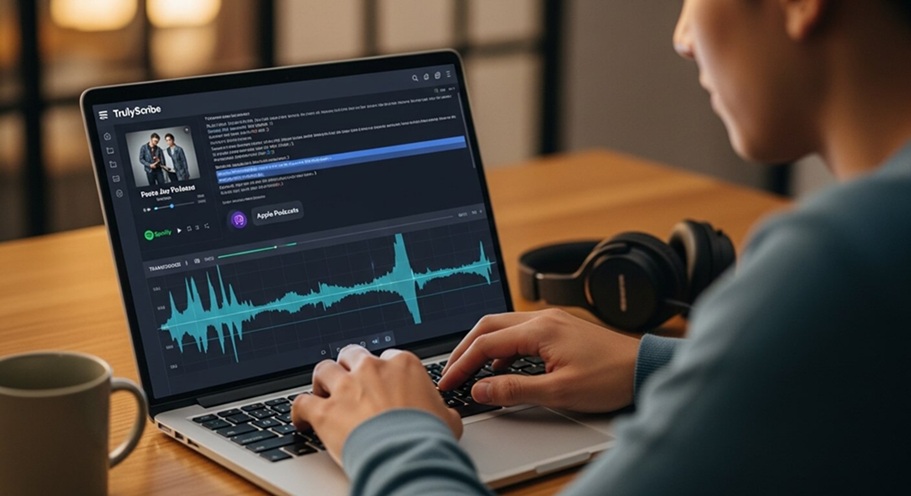
A transcript fixes that in a single step. It turns your spoken content into indexed text that search engines can crawl, readers can scan, and listeners can share. It unlocks hours of repurposable content from every single episode. It makes your show accessible to millions of listeners who are deaf or hard of hearing. And with AI transcription tools like TrulyScribe, it now takes about 10 minutes to get one, completely free.
This guide covers every reason why podcast transcripts matter in 2026, exactly how to get one, and how to use it to grow your show and your business.
The Numbers That Should Change How You Think About Transcripts
72% of podcast episodes have no published transcript, leaving their content invisible to search engines
466 million podcast listeners globally in 2024 — a growing share who prefer to read or use transcripts for accessibility
3x more inbound links earned on average by podcast pages that publish full episode transcripts vs those that don’t
8–10 pieces of repurposable content can be generated from a single episode transcript
Why Podcast Transcripts Matter: The Full Picture
| Benefit Area | Without Transcript | With Transcript |
| Google Search (SEO) | Episode audio is invisible to search engines | Full episode text is indexed and rankable |
| Content Repurposing | Re-listen to find quotes — slow and painful | Ctrl+F any quote in seconds, repurpose instantly |
| Audience Reach | Deaf/hard-of-hearing listeners excluded | Fully accessible to all listeners |
| Show Notes | Generic summary written from memory | Rich, accurate show notes from the transcript |
| Episode Discoverability | Only searchable by title and description | Every word spoken becomes a searchable data point |
| Listener Engagement | Listeners must re-listen to find key moments | Readers can scan, highlight, and share quotes |
| Monetisation | Podcast only earns from audio plays | Transcript drives blog traffic, email sign-ups, and sales |
* SEO and engagement benefits vary by niche, episode length, and publication consistency. The above represents typical outcomes reported by podcasters who publish regular transcripts.
Reason 1: Transcripts Dramatically Improve Your Podcast SEO
This is the most impactful reason to publish transcripts, and the one that most podcasters overlook entirely.
Google indexes text. It does not index audio. When someone searches for a topic you’ve covered in an episode, Google has no way of knowing that your episode contains exactly the answer they’re looking for — unless that content exists in a text format it can read and rank.
Publishing a full transcript turns your episode page from a thin content page (just a title, a short description, and an embedded audio player) into a rich, keyword-dense document that Google can crawl, index, and rank for hundreds of long-tail search queries.
H4 How podcast transcripts improve SEO in practice:
- Long-tail keyword coverage: A 45-minute podcast episode contains 6,000 to 8,000 words of spoken content. Published as a transcript, that content naturally covers dozens of related keywords and search queries you never explicitly targeted.
- Featured snippet eligibility: Google often pulls featured snippet answers from transcripts because they contain natural, conversational explanations of concepts. A well-phrased explanation in your transcript can land position zero in Google for a search query.
- Internal linking opportunities: A full transcript gives you content to link to and from across your site, building topical authority and improving your overall domain SEO.
- Dwell time improvement: Visitors who have both audio and a full transcript to read spend significantly more time on your episode page — a positive ranking signal to Google.
- Backlink magnet: Written content earns links. Journalists, bloggers, and researchers who reference your episode are far more likely to link to a page with a searchable transcript than one with audio only.
💡 SEO tip: Publish the transcript directly on your episode page rather than as a separate document. The text needs to be crawlable on the same URL as your episode for maximum SEO benefit. Add a collapsible section labelled “Full Transcript” below your show notes.
Reason 2: Transcripts Make Your Show Accessible to Everyone
There are an estimated 430 million people worldwide with disabling hearing loss, according to the World Health Organisation. Without transcripts, your podcast is completely inaccessible to this audience — regardless of how valuable your content is.
Beyond hearing impairment, transcripts also serve:
- Non-native speakers: Listeners who understand written English better than spoken English can follow along with the transcript while listening, dramatically improving comprehension.
- People in sound-restricted environments: Offices, libraries, public transport, and late-night listening sessions where audio isn’t practical.
- Listeners with attention or processing difficulties: Some listeners find it easier to process information by reading rather than listening.
- Speed readers: People who want to scan your episode content quickly to decide whether it’s worth a full listen.
Publishing transcripts isn’t just an ethical consideration — it’s an audience growth strategy. Every listener segment you exclude from your content is a segment that can’t subscribe, share, or recommend your show.
♥️ Accessibility note: The Web Content Accessibility Guidelines (WCAG) recommend transcripts for all audio content. If your podcast has a website, publishing transcripts helps you meet accessibility standards and demonstrates your commitment to inclusive content.
Reason 3: One Transcript Generates 8–10 Pieces of Content
This is the compound benefit that transforms transcripts from a nice-to-have into a content strategy cornerstone. Once you have a transcript, your episode stops being a single piece of content and becomes a content library.
| Content Type | How the Transcript Becomes It | Time Required |
| Blog post / article | Edit transcript into prose, add intro & conclusion | 30–60 min |
| Show notes | Pull key timestamps, quotes, and links from transcript | 10–15 min |
| Email newsletter | Summarise top 3 insights from transcript into email copy | 15–20 min |
| LinkedIn / Twitter thread | Extract 5 best quotes or insights, format as a thread | 10 min |
| YouTube video captions | Export transcript as .srt caption file | 2 min |
| Quote graphics | Identify 3–5 shareable quotes for Instagram/Pinterest | 5–10 min |
| Lead magnet / PDF | Compile episode transcripts into a downloadable guide | 1–2 hrs |
| Podcast SEO glossary | Aggregate key terms from multiple transcripts into a post | 2–3 hrs |
A single well-produced podcast episode, once transcribed, can realistically generate content that would otherwise require a full day of creative work: a blog post, a newsletter, a LinkedIn thread, a set of quote graphics, captions for the YouTube version, and the foundation for a future lead magnet. The transcript is the raw material; the publishing is just editing and formatting.
💡 Content multiplication tip: Don’t wait until after publishing to transcribe. Transcribe the episode before you write your show notes. Your show notes will be richer, more accurate, and faster to write when you can copy exact quotes and timestamps directly from the transcript.
Reason 4: Transcripts Produce Better Show Notes in Half the Time
Show notes are one of the most important on-page SEO and listener experience elements of a podcast episode — and one of the most consistently underwhelming parts of most podcasters’ workflows.
Without a transcript, show notes typically get written from memory immediately after recording, when you’re tired, the details are fuzzy, and you’re rushing to get the episode published. The result is a generic 150-word summary that tells listeners almost nothing and gives Google almost nothing to work with.
With a transcript, writing show notes is a different experience entirely:
- Scan the transcript for key moments: Identify the 5 to 8 most important topics, insights, or quotes from the episode.
- Pull exact timestamps: Include precise chapter markers like “[12:34] — Why most podcasters get their monetisation sequence wrong”. Listeners love this and it dramatically increases engagement.
- Extract the best quotes: Include two or three verbatim quotes from the guest or your own commentary — the ones that are punchy, surprising, or highly shareable.
- List all resources mentioned: Search the transcript for every book, tool, website, or name mentioned during the episode. Nothing gets missed.
- Write a genuinely useful summary: With the full content in front of you, you can write show notes that accurately represent what listeners will get from the episode — not what you vaguely remember saying.
Reason 5: Transcripts Unlock New Monetisation Opportunities
A transcript isn’t just a study aid for your listeners. For podcasters who want to grow their income, it’s a monetisation asset.
Direct monetization from transcripts:
- Premium transcript access: Offer full transcripts as a benefit of a paid membership tier (Patreon, Supercast, etc.). Many listeners are willing to pay for the convenience of searchable, downloadable episode content.
- Lead magnets: Compile the transcripts from a series of thematically related episodes into a downloadable PDF guide. Use it to grow your email list.
- Online courses: A transcript-based course is faster to produce than one built from scratch. If your podcast covers a topic in depth over multiple episodes, the transcripts are already your curriculum.
Indirect monetization through traffic:
- Blog traffic from transcript SEO: Episode pages with full transcripts rank for organic search queries and drive traffic that can be monetised through advertising, affiliate links, or product sales.
- Email list growth: Transcript-based blog posts are effective places to embed email sign-up forms and lead magnets.
- Sponsor value proposition: A podcast with published transcripts and indexed episode pages has more demonstrable reach than one that exists only in audio form. This can strengthen your case when negotiating sponsorship rates.
How to Get a Free Podcast Transcript with TrulyScribe
Getting a transcript for your podcast episode is a five-step process that takes less time than editing your intro.
Step 1: Export Your Episode Audio
You’ll need the audio file from your recording software or DAW — before it’s uploaded to your podcast host. The best formats for transcription are:
- .mp3: The most common podcast audio format. Works perfectly with TrulyScribe.
- .wav: Higher quality, larger file size. Excellent transcription results.
- .m4a: Common output from iPhone recordings and many DAWs.
- .mp4: If you record video as well as audio, upload the .mp4 directly — TrulyScribe extracts the audio automatically.
💡 Pro tip: Use the highest-quality version of your audio file available, before any heavy compression for podcast hosting. Better audio quality = more accurate transcript.
Step 2: Upload to TrulyScribe
- Create your free account: Go to TrulyScribe.com and sign up. No credit card required. You receive 15 free hours on signup — enough to transcribe dozens of episodes.
- Click Upload: Select your episode audio file. TrulyScribe accepts .mp3, .mp4, .m4a, .wav, and all major audio formats.
- Select your language: Choose the primary language spoken in the episode.
- Enable speaker diarization: For interview episodes with a host and guest, this automatically labels each speaker throughout the transcript — essential for accurate show notes and repurposing.
- Click Transcribe: A 45-minute episode typically processes in 8 to 12 minutes.
Step 3: Review and Edit the Transcript
AI transcription on clean podcast audio typically achieves 90 to 95% accuracy. A light review pass takes 10 to 15 minutes for a standard episode. Focus your review on:
- Names and brands: Guest names, company names, book titles, and product names are the most common AI transcription errors. Check these specifically.
- Technical or niche vocabulary: Industry-specific terms in your podcast’s subject area may be transcribed phonetically rather than correctly.
- Speaker label accuracy: Confirm the diarization has correctly attributed speech to host vs guest throughout the episode.
Step 4: Export in the Format You Need
TrulyScribe gives you multiple export options depending on how you plan to use the transcript:
- .docx: Best for writing show notes, blog posts, and other written content in Word or Google Docs.
- .txt: Plain text for pasting into your CMS, email platform, or content management workflow.
- .srt: For adding captions to the YouTube or social video version of your episode. Upload the .srt file directly to YouTube and the captions appear automatically, time-synced to the audio.
Step 5: Publish and Repurpose
With your reviewed transcript downloaded, you’re ready to publish and repurpose:
- Publish the transcript on your episode page: Add it as a collapsible section under your show notes. Label it “Full Episode Transcript” for SEO clarity.
- Write your show notes from the transcript: Pull timestamps, quotes, and key topics directly from the text.
- Extract your repurposed content: Write your blog post, newsletter section, and social posts using the transcript as your source material.
- Upload your .srt captions to YouTube: If you publish a video version of your episode, captions dramatically increase watch time and accessibility.
Best Practices for Publishing Podcast Transcripts
- Publish transcripts on the episode page itself, not as a separate PDF download: Text that lives on your website is indexed by Google. Text that lives in a PDF is not.
- Use a collapsible transcript section: This keeps the page looking clean for listeners who just want the show notes, while making the full transcript available and indexable for search engines.
- Include a brief written summary above the transcript: A 100 to 150 word human-written summary at the top of the transcript section helps Google understand the episode topic before crawling the full text.
- Add chapter headings to long transcripts: For episodes over 30 minutes, break the transcript into labelled sections with H3 headings. This improves readability and creates anchor links for the table of contents.
- Be consistent: The SEO benefit of transcripts compounds over time. A podcast that publishes transcripts for every episode builds significantly more indexed content than one that does it occasionally.
- Interlink between transcripts: When a transcript mentions a topic covered in a previous episode, add a hyperlink to that episode’s page. This builds topical authority and keeps listeners on your site longer.
Transcripts for Different Podcast Formats
🎤 Interview Podcasts
Interview podcasts benefit most from transcripts because the guest’s expertise, name, and credentials become searchable text. When someone Googles your guest’s name or the topic they discussed, your episode transcript can appear in search results — even months or years after the original publication date.
Enable speaker diarization when transcribing interview episodes. The resulting transcript clearly labels which statements belong to the host and which to the guest, making it far easier to write show notes, pull quotes, and repurpose content accurately.
💡 Solo / Educational Podcasts
Educational podcasts, where a single host teaches or explains a topic, produce some of the most SEO-valuable transcripts. The content is typically structured, informationally dense, and focused on topics people are actively searching for.
Solo podcast transcripts often work well as standalone blog posts with minimal editing — the natural explanation structure of a teaching episode translates directly into a well-organized article. Many solo podcasters have built significant organic search traffic almost entirely from their episode transcripts.
👥 Panel and Roundtable Podcasts
Panel episodes with three or more speakers are the most complex to transcribe because of overlapping speech and multiple similar voices. Speaker diarization helps significantly, but plan for a more thorough review of these transcripts than solo or two-person interviews.
For panels, focus your repurposing on the most quotable individual moments rather than trying to represent the full discussion. A panel transcript is more useful as a source to mine than as a document to publish verbatim.
🏙️ Narrative and Storytelling Podcasts
Scripted narrative podcasts often have transcripts readily available because the episodes were written as scripts before recording. If this is you, consider publishing those scripts as transcripts — they’re already polished prose that readers will genuinely enjoy reading.
For documentary-style podcasts that are heavily edited from unscripted material, transcribing the final mixed audio gives you a transcript that matches exactly what was published.
Frequently Asked Questions
Does publishing a podcast transcript really improve SEO?
Yes, consistently and measurably. Episode pages with full published transcripts rank for significantly more keywords than pages with audio and short show notes only. The transcript gives search engines thousands of words to index, covering the natural language queries your potential listeners are actually using. The SEO benefit compounds over time as you publish more episodes and build more indexed content.
How accurate is AI transcription for podcast episodes?
On professionally recorded podcast audio — which typically has good microphone quality, minimal background noise, and consistent audio levels — modern AI transcription tools like TrulyScribe achieve 90 to 95% accuracy. For a 45-minute episode of approximately 6,000 words, that means roughly 300 to 600 words may need correction. A 10 to 15 minute review pass is typically sufficient before publishing.
Should I publish the full transcript or just an edited summary?
Publish the full transcript. A partial or summarised version is less valuable for SEO because it contains fewer keywords and less content for search engines to index. It’s also less useful for accessibility purposes. The full transcript can be placed in a collapsible section so it doesn’t visually overwhelm the page for listeners who just want the show notes.
How do I add a transcript to my podcast website?
The method depends on your website platform. On WordPress, paste the transcript text into a Gutenberg block or use an accordion/collapsible plugin to keep the page layout clean. On Squarespace or Showit, add a text block below your episode embed. On podcast-specific platforms like Buzzsprout, Podbean, or Transistor, look for a transcript field in the episode settings. Most podcast CMS platforms now support transcript publishing natively.
Can I use my podcast transcript for YouTube captions?
Yes. Export your transcript from TrulyScribe as an .srt file. When uploading your episode to YouTube (as a video or static image ‘video’ version), go to the Subtitles section and upload the .srt file. YouTube will sync the captions to the audio automatically. This improves YouTube SEO, increases watch time, and makes your video content accessible to hearing-impaired viewers.
Is TrulyScribe free for podcasters?
Yes. TrulyScribe offers 10 minutes of free transcription every day with no credit card required. When you sign up, you receive 15 free hours of transcription — enough to transcribe 15 to 20 average-length podcast episodes before needing to consider a paid plan. For most independent podcasters, especially those starting out, the free tier covers a significant portion of their transcription needs.
What about podcasts with two different languages?
If your episode mixes two languages, transcribe in the dominant language and note language switches in your review pass. TrulyScribe supports multiple languages individually. For episodes recorded primarily in a non-English language, select that language when uploading — TrulyScribe’s multilingual support covers a wide range of major and regional languages.
Start Transcribing Your Next Episode Today
Every episode you publish without a transcript is a missed opportunity on three fronts: the SEO traffic that could have found your content through search, the listeners who needed a transcript to access your show, and the hours of repurposable content that could have grown your audience and your business.
The good news is that fixing all three takes about 10 minutes and costs nothing to get started.
Transcribe your next episode with TrulyScribe, publish the transcript on your episode page, and write your show notes from the transcript. After two or three episodes, the workflow becomes second nature — and the compound SEO and content benefits start to show in your analytics.
Your audio deserves to be found. A transcript is how it gets there.
🎧 Get your first free podcast transcript today: app.trulyscribe.com/register | No credit card required. 30 min free daily which makes 15 hours free per month on signup.