

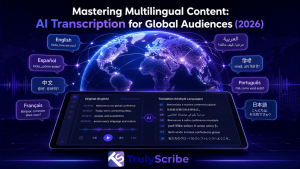
Your next customer might not speak English. In 2026, that’s not a niche consideration — it’s the default. Most of the internet’s audience consumes content in a language other than English, yet most brands still produce content in just one or two languages and hope translation “happens eventually.” It rarely does, and when it does, it’s slow, expensive, and inconsistent.
AI transcription has quietly become the fastest, most reliable starting point for going multilingual — not just for subtitles, but for blogs, SEO content, customer support documentation, and training materials. This guide breaks down exactly how AI transcription powers multilingual content workflows in 2026, what to look for in a tool, and how to avoid the mistakes that quietly tank localization quality.
Quick answer: AI transcription converts spoken audio or video into accurate text in the original language, which then becomes the foundation for translation, subtitling, and localized publishing — turning one recording into content for every market you serve, in a fraction of the time manual processes take.
Why Multilingual Content Matters More Than Ever in 2026
Three shifts have made multilingual content non-negotiable this year:
- Audiences are global by default. Podcasts, webinars, and product videos get discovered far outside their country of origin, often through search and social platforms that surface content regardless of language.
- Search engines reward localized text. Multilingual SEO has become a real growth channel, not an afterthought — search engines need clean, translated text to rank content in local markets, and video or audio alone won’t cut it.
- Compliance and accessibility expectations have grown. Captions, subtitles, and transcripts in multiple languages are increasingly expected — sometimes required — across education, government, and enterprise communications.
The brands winning international audiences in 2026 aren’t necessarily the ones with the biggest content budgets. They’re the ones with the most efficient pipeline for turning one recording into many languages.
The Multilingual Content Problem (Without AI)
Here’s what going multilingual used to look like:
- Record the original content.
- Send it to a manual transcriptionist — wait days.
- Send the transcript to a translator, per language — wait more days, pay per word.
- Format each translated transcript into subtitles, blog copy, or captions by hand.
- Repeat steps 2–4 for every additional language.
Multiply that by five or six target markets, and a single piece of content can take weeks to localize — by which point it may no longer be relevant. This bottleneck is exactly why so many companies default to English-only content, even when they know it’s limiting their reach.
How AI Transcription Powers Multilingual Content Workflows
AI transcription doesn’t replace translation — it removes the single biggest bottleneck that comes before translation: getting clean, accurate, well-structured text out of audio or video in the first place.
Step 1: Transcribe Once, in the Source Language
Upload your recording — an interview, webinar, podcast episode, or product demo — and get a clean transcript with speaker labels and timestamps in minutes instead of hours. This becomes your single source of truth for every downstream language.
Step 2: Translate and Localize at Scale
With a clean transcript in hand, translation becomes dramatically easier — whether you’re using human translators, AI-assisted translation, or a hybrid review process. Translators work from organized, accurate text instead of re-listening to raw audio, which cuts turnaround time significantly and reduces costly misinterpretations.
Step 3: Generate Multilingual Subtitles and Captions
Once translated, transcripts can be exported as SRT files for subtitles, embedded directly into video platforms, or formatted for closed captions — giving every market a native-language viewing experience without re-editing the original video.
Step 4: Repurpose Across Formats and Markets
A single transcript, once translated, can become a blog post, a set of social captions, an email newsletter, or a help-center article — all localized, all without re-recording anything. One recording, many markets, minimal extra work.
Key Features to Look for in a Multilingual AI Transcription Tool
Not every transcription tool is built for global workflows. Here’s what actually matters:
| Feature | Why It Matters for Multilingual Content |
| Broad language and dialect support | You need accuracy across the specific languages your audience speaks — not just major ones |
| Speaker diarization | Multilingual interviews and panels need clear speaker labels before translation begins |
| Accurate timestamps | Essential for generating subtitles and captions that stay in sync after translation |
| Multiple export formats (TXT, DOCX, PDF, SRT) | Different teams and platforms need different formats — subtitles, blogs, and documentation all use different files |
| Data security and compliance | Sensitive recordings — legal, medical, corporate — need encryption and privacy guarantees regardless of language |
| Editable transcripts | No AI transcript is translation-ready straight out of the box; easy in-platform editing saves real time |
Real-World Use Cases for Multilingual AI Transcription
- Global marketing teams turning one recorded webinar into localized landing pages, blog posts, and ad copy for each region.
- E-learning platforms translating course lectures into subtitles and transcripts so students can learn in their preferred language.
- Media and entertainment localization, where dubbing, subtitling, and voice-over all start from an accurate base transcript.
- Customer support teams transcribing multilingual support calls to build searchable knowledge bases and identify recurring issues across regions.
- Legal and compliance teams producing accurate records of multilingual depositions, interviews, or hearings for cross-border cases.
Multilingual SEO: Turning Transcripts Into Global Search Visibility
Search engines can’t watch your video or listen to your podcast in any language — but they can crawl text. Publishing translated transcripts as on-page content gives every regional version of your site something to actually rank for. This is one of the most underused multilingual SEO tactics available: instead of writing separate localized articles from scratch, brands can publish translated, lightly edited transcripts as blog posts or landing pages, complete with locally relevant keywords pulled from the conversation itself.
Common Challenges — and How AI Handles Them
Multilingual transcription isn’t flawless, and it helps to know where the friction usually shows up:
- Accents and regional dialects can affect accuracy; reviewing transcripts before translation catches most issues quickly.
- Code-switching (speakers mixing two languages mid-sentence) is still tricky for any speech-to-text system, AI or human — flag these sections for manual review.
- Idioms and culturally specific phrases rarely translate literally; this is where a quick human pass adds the most value, even in an otherwise AI-driven workflow.
- Technical or brand-specific terms are the most common source of transcription errors across any language — a quick proper-noun check before translation saves rework later.
The fix isn’t avoiding AI transcription — it’s pairing it with a short human review step before content goes into translation, which still ends up far faster than fully manual processes.
Best Practices for Multilingual Content Workflows in 2026
- Standardize your source transcript first. Clean up names, terminology, and formatting before sending anything to translation.
- Keep timestamps intact so subtitle and caption work stays synced after translation.
- Build a glossary of brand and industry terms translators and AI tools can reference consistently across languages.
- Localize, don’t just translate. Adjust examples, currency, and cultural references rather than translating word-for-word.
- Reuse one transcript across formats — blog, subtitles, social captions — instead of recreating content separately for each.
How TrulyScribe Helps You Go Global
TrulyScribe’s AI transcription supports 100+ languages and dialects, with speaker diarization and accurate timestamps built in — the exact foundation a multilingual content pipeline needs. Transcripts export straight to TXT, DOCX, PDF, or SRT, so the same transcript can move into translation, subtitle work, or a CMS without reformatting. And because recordings often include sensitive client, legal, or corporate conversations, every file is encrypted in transit and at rest, with GDPR-compliant processing built in by default.
For teams creating content across multiple markets, that means one upload — and a transcript that’s ready to become five different languages of content.
FAQs: AI Transcription for Multilingual Content
Does AI transcription support multiple languages, or just English?
Modern AI transcription tools, including TrulyScribe, support 100+ languages and dialects, making them suitable for global teams and multilingual content creators, not just English-language workflows.
Can AI transcription translate content, or does it only transcribe?
AI transcription converts speech to text in the original spoken language. Translation is typically a separate step — but starting from a clean, accurate transcript makes that translation step significantly faster and more reliable.
How accurate is AI transcription for non-English languages?
Accuracy varies by language, accent, and audio quality, similar to English transcription. Clear audio and a quick human review pass before translation will catch the small number of errors that AI alone may miss.
What file format should I use for multilingual subtitles?
SRT is the standard format for subtitles and captions across most video platforms, and it’s the format translators typically need for time-synced multilingual subtitle work.
Is multilingual AI transcription secure enough for sensitive content?
Yes, provided the platform encrypts files in transit and at rest and follows data protection standards like GDPR — this matters just as much for multilingual legal, medical, or corporate recordings as it does for English-only ones.
Final Thoughts
Going multilingual used to mean choosing between speed and quality — fast translations that felt rough, or polished ones that took weeks. AI transcription removes that trade-off at the source: a clean, accurate, well-organized transcript turns translation, subtitling, and localized publishing from a bottleneck into a repeatable workflow. In 2026, the brands reaching global audiences aren’t necessarily recording more content — they’re getting more languages out of the content they already have.