

Most podcasters who discover AI transcription use it the same way: get the transcript, publish it on the episode page, feel good about the accessibility box being ticked, and move on. That’s a start. But it’s also leaving most of the value on the table.
Transcripts are not just a convenience feature or an accessibility compliance tool. In 2026, they are the most underutilised growth lever available to independent podcasters. A single well-executed transcript strategy can triple your organic search traffic, generate eight or more pieces of original content from one episode, earn backlinks from publications that would never link to an audio file, and build the kind of audience engagement that turns casual listeners into loyal subscribers.
This guide is for podcasters who already know the basics — or who want to skip past them entirely. It covers the advanced strategies: how to structure transcripts for SEO dominance, how to use them for answer engine optimisation, how to build a content repurposing system that runs on autopilot, how to design engagement loops that transcripts power, and how to monetise the content assets that transcription creates.
These are not theoretical strategies. They are the approaches that consistently-growing podcasts use to build audiences and income at a scale that audio-only distribution alone cannot achieve.
Why Most Podcasters Are Underusing Their Transcripts
The typical podcast transcript workflow looks like this: transcribe the episode, paste the text into a collapsible section on the episode page, label it “Transcript,” and publish. Done.
This approach captures perhaps 10 to 15% of the available value from transcription. The remaining 85 to 90% — the SEO compound effect, the content repurposing potential, the engagement infrastructure, the monetisation opportunities — is left entirely unrealised because the transcript is treated as a document to archive rather than a content engine to activate.
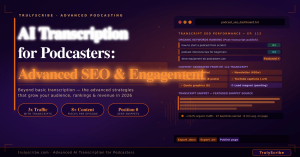
72% of podcast episodes have no published transcript — a competitive gap for podcasters who do
3x more organic traffic earned on average by podcast episode pages with structured published transcripts vs audio-only pages
47 average number of long-tail keywords a single 45-minute podcast episode transcript ranks for within 90 days of publishing
The gap between what most podcasters do with transcripts and what the most sophisticated podcasters do is the gap this guide is designed to close.
Part 1: Advanced Transcript SEO — Turning Episodes into Search Traffic
The SEO opportunity in podcast transcription is one of the least contested in digital marketing. Most of your competitors are not doing this. The ones who are, are not doing it well. The window to build a significant organic search advantage through podcast transcript SEO is still wide open in 2026.
The SEO Foundation: Why Transcripts Are a Search Traffic Machine
Audio is invisible to search engines. Every insight, every expert quote, every keyword-rich exchange in your podcast exists in a format that Google cannot read, index, or rank. Publishing a transcript changes that entirely.
A 45-minute podcast episode contains approximately 6,000 to 8,000 words of natural language content. Published as a structured transcript, that content:
- Covers hundreds of long-tail keyword variations: Your guests speak naturally about your topic, using the exact language your potential listeners use when searching. A single episode can naturally contain dozens of semantically related long-tail queries.
- Provides content depth that Google rewards: The era of thin content is over. Google’s Helpful Content updates consistently reward pages with genuine depth. A 6,000-word transcript provides that depth authentically, because it represents real expertise being shared.
- Creates a rich internal linking network: A library of transcripts on related themes gives you a dense web of internally linkable content that builds topical authority far faster than a conventional blog can.
The Advanced Transcript SEO Strategy Matrix
| SEO Strategy | How Transcripts Enable It | Expected Impact |
| Long-tail keyword targeting | Transcript text naturally covers hundreds of related queries | Rank for queries you never explicitly targeted |
| Featured snippet capture | Q&A sections in transcripts match question-format queries | Position 0 for “how to” and “what is” searches |
| Topical authority building | Library of transcripts on related themes signals expertise | Higher domain authority and cluster rankings |
| Internal linking | Cross-link between transcripts covering related topics | Better crawl depth and topic coherence signals |
| Backlink acquisition | Written content earns 3x more links than audio-only pages | Domain authority growth from editorial links |
| Video SEO (YouTube) | .srt captions from transcript improve video search rank | Higher YouTube CTR and watch time from captions |
| Answer engine optimisation | Transcripts provide structured text for AI answer sources | Citations in Perplexity, ChatGPT, Gemini responses |
Strategy 1: Keyword Cluster Architecture
The most sophisticated podcasters don’t publish transcripts in isolation — they build keyword cluster architectures where each episode transcript targets a specific keyword cluster within their niche, and all clusters link back to pillar content pages.
Here’s how to implement this:
- Map your episode archive to keyword clusters: Group your episodes by overarching topic theme (e.g., “podcast monetisation,” “podcast marketing,” “podcast equipment”). Each theme becomes a cluster.
- Create a pillar page for each cluster: Write a comprehensive 3,000 to 5,000 word “ultimate guide” page for each theme. This is your cluster pillar.
- Link all episode transcripts in the cluster to their pillar page: Every episode transcript in the “podcast monetisation” cluster links to the monetisation pillar page.
- Link the pillar page back to individual transcripts: The pillar page references and links to specific episodes where individual subtopics are covered in depth.
- Cross-link between transcripts in the same cluster: When a transcript covers a topic discussed in a previous episode, link to that episode’s transcript.
💡 SEO compounding effect: A topic cluster architecture means that as you publish new episode transcripts, every new piece adds authority to the entire cluster. A podcast with 50 episodes in a tight niche, all interlinked through a cluster architecture, can build topical authority that rivals dedicated niche websites with far fewer episodes.
Strategy 2: Featured Snippet Optimisation
Featured snippets — the answer boxes that appear at position zero in Google results — are disproportionately valuable for podcasters because they capture search traffic before a user even clicks a result. Podcast transcripts are unusually well-suited to earning featured snippets for a specific reason: the conversational Q&A structure of most podcast episodes.
When a host asks a guest “What is the single most important thing a new podcaster should do?” and the guest gives a clear, structured answer, that exchange is almost exactly what Google looks for to populate a featured snippet. The question matches a user search query; the answer is the snippet content.
How to optimise transcript content for featured snippets:
- Add explicit question headers: When publishing your transcript, add H2 or H3 headers above the section where a key question is discussed. Format the header as the exact question: “How do you grow a podcast audience from zero?”
- Tighten the answer paragraph immediately after the header: The 40 to 60 word paragraph immediately after a question-format header is Google’s primary snippet source. Edit the relevant transcript section into a crisp, direct answer.
- Use numbered lists for process questions: Questions like “how do I…” that have step-by-step answers should be formatted as numbered lists. These capture the “steps” featured snippet format.
- Use definition headers for “what is” queries: If your guest defines a concept clearly, add a “What is [term]?” header above their definition. Google frequently pulls these as definition snippets.
Strategy 3: Answer Engine Optimisation (AEO)
In 2026, search behaviour has shifted significantly toward AI-powered answer engines. When someone asks Perplexity, ChatGPT Search, Google’s AI Overview, or Gemini a question in your niche, the answer they receive is assembled from sources that the AI can read, cite, and trust. Audio cannot be cited. Transcripts can.
Answer engine optimisation (AEO) is the practice of structuring your content specifically to be cited by AI answer systems. Podcast transcripts are a natural fit for AEO because they contain expert opinion, specific facts, and conversational explanations in a format that AI systems can extract and summarise.
AEO strategies for podcast transcripts:
- Use clear attributions: AI systems value attributed quotes. When publishing your transcript, make clear who said what with consistent speaker labels (“According to [Guest Name], [company/title]” in summary sections).
- Add fact boxes and key takeaways: After publishing the full transcript, add a “Key Takeaways” section at the top of the page with 5 to 7 bullet points summarising the episode’s most citable claims. AI systems frequently pull from these summary sections.
- Write a structured episode summary separate from the transcript: A 300 to 400 word structured summary, with clear headings, above the full transcript gives AI systems a digestible extract to work from without requiring them to parse the full episode text.
- Ensure your pages are indexable: AI answer engines depend on search index access. Ensure your transcript pages are not blocked by robots.txt, load quickly, and have appropriate schema markup.
Strategy 4: YouTube SEO via Transcript Captions
If you publish a video version of your podcast — or even a simple static image video for YouTube distribution — your transcript is the source of a significant YouTube SEO advantage.
YouTube’s search algorithm considers captions when ranking videos. Auto-generated YouTube captions are often inaccurate and miss important keywords. Manually uploading a clean .srt caption file generated from your TrulyScribe transcript gives YouTube an accurate, keyword-rich text representation of your episode that significantly improves searchability.
- Export your transcript as .srt from TrulyScribe: This file contains the full transcript with timing information that YouTube uses to synchronise captions.
- Upload via YouTube Studio → Subtitles: Navigate to the video, click Subtitles, and upload your .srt file. YouTube uses this for both caption display and search indexing.
- Add a keyword-rich description using the transcript: Pull the first 200 words of your transcript — the opening exchange, edited for clarity — as the basis for your YouTube description.
Part 2: The Advanced Content Repurposing System
Basic content repurposing from transcripts is straightforward: write a summary blog post, send a newsletter, post some quotes on social media. Advanced content repurposing is a system — one that extracts maximum content value from every episode with minimum additional effort after the transcript is produced.
The Advanced Repurposing Matrix
| Content Format | Advanced Transcript-to-Content Strategy | Monetisation Potential |
| SEO blog post | Structure by topic cluster, not episode order; add original commentary | Affiliate links, sponsor mentions, email opt-in |
| Email course | Chain 5–8 episode transcripts into a structured email sequence | Paid upgrade to full course; list growth |
| YouTube shorts / Reels | Use transcript timestamps to find 60-second peak moments | Platform ad revenue, follower growth |
| Paid membership content | Full transcripts as a premium subscriber benefit | Recurring subscription revenue |
| Online course module | Compile thematic transcripts into structured lesson content | One-time course sale or platform licensing |
| Lead magnet eBook | Curate 10+ episode transcripts into a definitive guide | Email list growth; sponsor placement |
| Guest resource page | Publish guest’s best quotes and insights as a dedicated page | Backlinks from guest sharing; SEO authority |
| Podcast SEO glossary | Extract all key terms across transcripts into a definitions page | Featured snippets for definition queries |
Building the SEO-First Blog Post from a Transcript
The most common mistake podcasters make when turning a transcript into a blog post is following the episode’s chronological order. A better approach is to restructure the content around the keyword cluster you want to rank for, not around the order in which ideas happened to come up in conversation.
The advanced transcript-to-blog workflow:
- Identify the primary keyword target: Before writing a word, decide which specific search query this post should target. Not “podcasting tips” but “how to grow a podcast audience without social media.”
- Extract all relevant content from the transcript: Use Ctrl+F to find every section of the transcript that relates to your keyword target. Copy these sections into a separate document.
- Structure around the reader’s journey, not the episode’s timeline: Organise your extracted content into the logical order a reader needs to understand and apply the information — regardless of when it came up in the episode.
- Add original synthesis and commentary: Between the transcript excerpts, write original analysis that connects the ideas, adds context the guest didn’t provide, and expresses your show’s editorial perspective.
- Optimise for featured snippets: Add question-format H2 headers above key sections. Tighten the first paragraph under each header into a crisp, direct answer.
- Add internal links: Link to at least three related episode transcript pages and to your pillar content page for this keyword cluster.
💡 Quality signal: A transcript-to-blog post that is genuinely restructured and enhanced with original commentary will outperform both a raw transcript paste and a blog post written without transcript source material. The transcript provides the expertise; your editorial voice provides the differentiation.
The Email Course Strategy
One of the highest-value but least-used transcript strategies is the email course. An email course is a structured sequence of emails — typically 5 to 10 — that teaches a topic systematically. It is one of the highest-converting lead magnets in content marketing and one of the best ways to build a deeply engaged email list.
For a podcaster with a niche focus, the transcript archive is the raw material for an email course already. Here’s the workflow:
- Identify a high-value topic your podcast covers systematically: A topic that multiple episodes address from different angles. “How to launch a podcast” might be covered across six different episodes.
- Pull the most actionable content from each relevant transcript: Extract the specific, actionable guidance from each episode’s transcript that addresses one stage of the topic.
- Structure into a 7-day course: Each day’s email covers one stage, using the transcript content as the source material and linking to the full episode for deeper listening.
- Write the connective tissue: Add an intro, a transition, and a specific action step to each email. These take 20 to 30 minutes each because the core content already exists.
- Gate the course behind an email opt-in: Offer the course as a lead magnet on your website, in your show notes, and in your episode CTA. Every course subscriber is a warm lead who engages with your content at a higher depth than a casual listener.
The Guest Resource Page Strategy
Every time you interview a notable guest, you have an opportunity to create a dedicated resource page for that guest that serves as both a long-term SEO asset and a relationship-building tool with the guest.
A guest resource page contains:
- A brief introduction to the guest with biographical context
- Their key quotes from the episode, formatted as pull quotes
- A curated list of their most actionable insights from the transcript
- Links to the guest’s work, book, social profiles, and company
- The full episode embed and transcript
When you send the guest this page, most will share it with their own audience — because it presents them well and requires no effort on their part. This earned promotion from high-profile guests is a consistent source of new listeners, social engagement, and backlinks from authoritative domains.
💡 SEO bonus: Guest resource pages rank for the guest’s name + “podcast” searches, which are high-intent queries from people already familiar with the guest. Over time, a library of guest pages becomes a significant source of search traffic from brand-aware queries.
Part 3: Transcript-Powered Audience Engagement
Transcripts don’t just help with SEO and content volume. Used strategically, they are the raw material for some of the highest-engagement audience interactions a podcaster can create.
The Advanced Engagement Strategy Matrix
| Engagement Tactic | How the Transcript Powers It | Audience Impact |
| Timestamped chapter markers | Map key topics to timestamps from the transcript | Listeners skip to relevant sections; longer engagement |
| Pull quote graphics | Extract 5–7 quotable moments from transcript text | Higher social shares and brand visibility |
| Guest quote cards | Create branded graphic for guest’s best line | Guest shares with their own audience; new listeners |
| Community discussion prompts | Turn key questions from the episode into forum/Discord posts | Higher community engagement and retention |
| Episode fact-checking posts | Verify and expand on claims made in the transcript | Builds credibility; earns editorial backlinks |
| Listener quiz / poll | Extract testable facts from the transcript as quiz questions | Interactive engagement; email capture opportunity |
Timestamped Chapter Markers: The Engagement Multiplier
Adding chapter markers to your episodes is one of the highest-impact listener experience improvements available to podcasters — and transcripts make it trivially easy to do well.
Without a transcript, creating chapter markers requires re-listening to the episode and noting timestamps manually. With a transcript, you can scan the text, identify where the key topic transitions occur, note the timestamp shown in the transcript, and have a full chapter list in 10 minutes.
Chapters improve engagement in multiple ways:
- Listeners stay longer: People who can navigate to the section relevant to them are more likely to listen to that section fully rather than bouncing after the first few minutes.
- Repeat listening increases: Listeners who know they can find specific sections easily are more likely to return to episodes for reference, increasing total play counts.
- Sharing improves: Sharing a specific chapter is more compelling than sharing “check this episode from 23 minutes in.” Spotify, Apple Podcasts, and YouTube all support chapter markers.
Pull Quote Graphics: The Social Shareability System
The most shareable content on social media is a combination of a strong quote and a visually compelling design. Every podcast episode transcript contains multiple share-worthy quotes. The challenge is identifying them efficiently and producing the graphics at scale.
The advanced pull quote workflow:
- During transcript review, highlight quote candidates: As you review your transcript, mark any sentence or exchange that is surprising, counter-intuitive, strongly opinionated, or highly quotable. Aim for 8 to 12 candidates per episode.
- Curate to your top 5: From your candidates, select the 5 that best represent the episode’s core value and are most likely to generate engagement on your primary social platforms.
- Create branded templates: Design 2 to 3 branded quote card templates in Canva or your design tool of choice. These should include your show name, episode number, and a consistent visual style. Once the templates exist, populating them takes 2 minutes per quote.
- Distribute across a 2-week window: Rather than posting all quotes on episode launch day, spread them across 2 weeks. Each quote becomes a reminder to non-listeners that the episode exists and provides an additional conversion opportunity.
Community Discussion Loops from Transcript Questions
If you run a podcast community — on Discord, Circle, Facebook Groups, Slack, or another platform — your transcript is the source of an unlimited supply of community discussion prompts.
Every question asked in an episode is a community discussion question. Every claim made by a guest is a discussion prompt. Every piece of advice given is an opportunity to ask your community: “Does this match your experience?”
The workflow: during transcript review, note the three to five most discussion-worthy moments in the episode. Format each as a community post: reference the episode and timestamp, quote the relevant section, and pose a follow-up question. Schedule these to post across the week following episode launch.
This approach creates a consistent content cadence in your community that is directly tied to episode content, reinforces the habit of listening before engaging, and generates discussion that new community members can read through as social proof of the community’s value.
Part 4: Monetising Your Transcript Content Assets
Transcripts create monetisable content assets beyond advertising and sponsorship — the revenue models that most podcasters default to. Advanced podcasters in 2026 are building multiple revenue streams directly from the content that transcription makes possible.
Premium Transcript Access as a Membership Benefit
For podcasts with highly practical, research-dense, or professionally valuable content, transcripts are a premium product in their own right. A 6,000-word verbatim record of a world-class expert discussing your niche in depth has genuine standalone value that many listeners will pay for.
Structure this as a membership tier on Patreon, Supercast, Memberful, or your chosen platform. Paid members receive:
- Full formatted transcripts of every episode
- Downloadable PDF versions for offline reference
- Searchable transcript archive across all episodes
- Early access to transcripts before the episode publishes
The transcript membership tier converts best among audience segments who listen for professional development or research purposes — people who want to cite specific things the guest said, build on the content in their own work, or refer back to episodes without re-listening.
Online Course Creation from Transcript Archives
A podcast with 50+ episodes on a focused niche topic is an online course waiting to be structured. The transcripts are the lecture notes. The episodes are the audio content. The transformation from podcast archive to online course is less about creating new content and more about organising and editing what already exists.
The course creation workflow from transcripts:
- Define your course curriculum: Outline the topic structure of a 6 to 12 module course in your niche. This defines what you need your content to cover.
- Map your episode transcripts to curriculum modules: Assign each episode’s transcript to the module it most closely addresses. Some modules may draw from multiple episode transcripts.
- Edit the transcript content into lesson text: Edit the relevant transcript sections into clear, structured lesson content. Remove conversational filler, add explanatory context, and reformat for reading rather than listening.
- Record short video intros for each module: A 3 to 5 minute video introduction for each module, recorded directly from the edited lesson text, provides the video component required by most course platform expectations.
- Package and price: Launch on Teachable, Kajabi, Podia, or Gumroad. Your existing podcast audience is your warmest launch list.
Sponsored Transcript Sections and Native Content
Transcripts open a native advertising format that audio alone cannot offer: sponsored content sections within the written transcript. Rather than a standard audio ad read that listeners skip, a sponsor can be integrated into the transcript as a contextually relevant written callout — positioned near the transcript section most relevant to their product or service.
This format is emerging in 2026 as advertisers recognise that podcast listeners who read transcripts are a higher-engagement, more attentive segment than passive listeners. Sponsors who understand this will pay a premium for placement in a transcript context.
Present transcript advertising in your media kit as a distinct product from audio ad reads, with its own pricing that reflects the dwell time and engagement of transcript readers. Typical format: a labelled “Sponsor note” callout box within the transcript near a relevant topic section, with a clear disclosure and a link.
The Advanced Transcript Workflow: End-to-End System
Implementing everything in this guide simultaneously is not realistic. The key is to build the system incrementally, adding one layer at a time until the full workflow runs efficiently. Here is the recommended build order:
- Week 1–2 — Foundation: Implement TrulyScribe transcription for every episode. Publish full transcripts on episode pages with structured headings. Add question-format H2 headers to featured snippet candidates.
- Week 3–4 — SEO architecture: Map existing episodes to keyword clusters. Create two pillar content pages for your most important clusters. Begin cross-linking episode transcripts within clusters.
- Month 2 — Content repurposing: Launch the blog post workflow for new episodes. Begin the pull quote graphic system. Start building one guest resource page per episode with a notable guest.
- Month 3 — Engagement systems: Add chapter markers to all new episodes. Start weekly community discussion prompts from transcript highlights. Launch the email course using your existing transcript archive.
- Month 4+ — Monetisation: Launch the premium transcript membership tier. Begin scoping the online course using the transcript archive. Introduce transcript sponsorship to your media kit.
💡 System thinking: The difference between podcasters who succeed with transcript-based growth and those who don’t is consistency, not creativity. The strategies above are not complicated. They require showing up with the same workflow for every episode. Over 12 months, a consistent transcript system produces compounding returns that irregular publishing of better individual pieces cannot match.
The Advanced Podcaster’s Transcript Toolkit
Combining TrulyScribe with these complementary tools gives you a complete advanced transcript workflow:
- TrulyScribe: AI transcription, speaker diarization, .docx and .srt export. The foundation of the entire system.
- Ahrefs or Semrush: Keyword research for identifying which episode transcripts to optimise for which target queries. Also used to track transcript rankings over time.
- Surfer SEO or Clearscope: Content optimisation tools that analyse top-ranking pages for your target keywords and recommend which terms to include in your transcript-based blog posts.
- Canva: Pull quote graphic creation. Build your episode quote card templates once; populate them in 2 minutes per quote.
- ConvertKit or Beehiiv: Email course delivery and list management. The platform that delivers your transcript-based email courses and nurtures subscribers.
- Notion or Airtable: Transcript archive management. Store your reviewed transcripts with episode metadata, keyword targets, cluster assignments, and repurposing status.
- Teachable or Podia: Online course delivery for your transcript-sourced course content.
Frequently Asked Questions
How long does it take to implement an advanced transcript SEO strategy?
The initial setup — building keyword cluster maps, creating pillar pages, and establishing the transcript review workflow — typically takes 8 to 12 hours spread over two to three weeks. After setup, the per-episode workflow adds 60 to 90 minutes to episode production time, covering transcription, review, SEO structure, and initial repurposing. The SEO compounding begins within 30 to 60 days of consistent implementation and accelerates over 6 to 12 months as the link architecture builds.
Which SEO strategies deliver the fastest results from transcripts?
Featured snippet optimisation typically delivers the fastest visible results — often within 4 to 8 weeks for episodes covering long-tail question queries with clear, structured answers. Keyword cluster architecture delivers the largest compound results but takes 3 to 6 months to build meaningful topical authority. Answer engine optimisation results are harder to measure directly but typically become visible within 60 to 90 days for well-structured pages with clear attributions and key takeaway sections.
Is it worth creating a guest resource page for every guest?
Not necessarily for every guest, but consistently for guests who have a meaningful existing audience, strong social following, or notable professional credentials. A guest with 20,000 Twitter followers who shares their resource page creates a predictable traffic and subscriber spike. Prioritise guest resource pages by the guest’s audience size, shareability, and alignment with your keyword targets. For most podcasts, the top 20 to 30% of guests by audience size warrant the resource page investment.
How do I price premium transcript access for a membership tier?
Pricing depends on the value density of your content and the professional context of your audience. For general-interest podcasts, transcript access typically works as part of a broader membership tier priced at $5 to $10 per month. For professional, research-dense, or business-focused podcasts where transcripts have clear professional utility — researchers, lawyers, consultants who need citeable records — standalone transcript access can be priced at $10 to $20 per month or more. Test with a pilot group of your most engaged listeners before setting permanent pricing.
Can I use AI to help process transcripts into blog posts?
Yes, and this is increasingly standard practice in 2026. After downloading your reviewed transcript from TrulyScribe, you can paste sections into an AI writing assistant with instructions to restructure by topic, tighten language, add transition sentences, and identify featured snippet opportunities. The key constraint is editorial judgment: the AI restructuring requires human review and enhancement to ensure accuracy, add original commentary, and maintain your show’s voice. Think of AI writing assistance as accelerating the editing step, not replacing the thinking step.
How do I measure the SEO impact of my transcript strategy?
Set up Google Search Console and connect it to your podcast website if you haven’t already. Monitor the Queries report for each episode page after publishing its transcript. Track: number of queries the page ranks for, average position across those queries, and total impressions and clicks. Compare these metrics between episodes with and without structured transcripts to quantify the impact. For longer-term tracking, use Ahrefs or Semrush to monitor your domain’s organic keyword growth as your transcript library accumulates.
Your Podcast Is a Content Business. Run It Like One.
The most successful podcasters in 2026 are not the ones with the best audio quality or the most famous guests. They are the ones who have built systems around their content — systems that extract maximum value from every episode, distribute that value across every channel where their audience lives, and compound their content investments over time.
Transcript-based SEO, content repurposing, engagement loops, and monetisation are not side projects or nice-to-haves. They are the infrastructure of a podcast that grows. Audio alone distributes to listeners who find you. Text-based content brings in listeners who have never heard of you — through search, through discovery, through the shares of guests and readers who encountered your content in written form.
Start with the transcript. Build the system around it. Let the compound effects do the rest.
🎧 Start transcribing your podcast with TrulyScribe — free, no credit card required: app.trulyscribe.com/register | 15 hours free per month on signup.