
Why Video Transcription Is the Key to Turning Videos into High-Value Blog Content
Video has become the most powerful content format across industries—from YouTube and podcasts to e-learning, corporate communications, and OTT platforms. But while video captures attention, text content still drives discoverability, SEO, and long-term value.
This is where AI transcription becomes a game-changer.
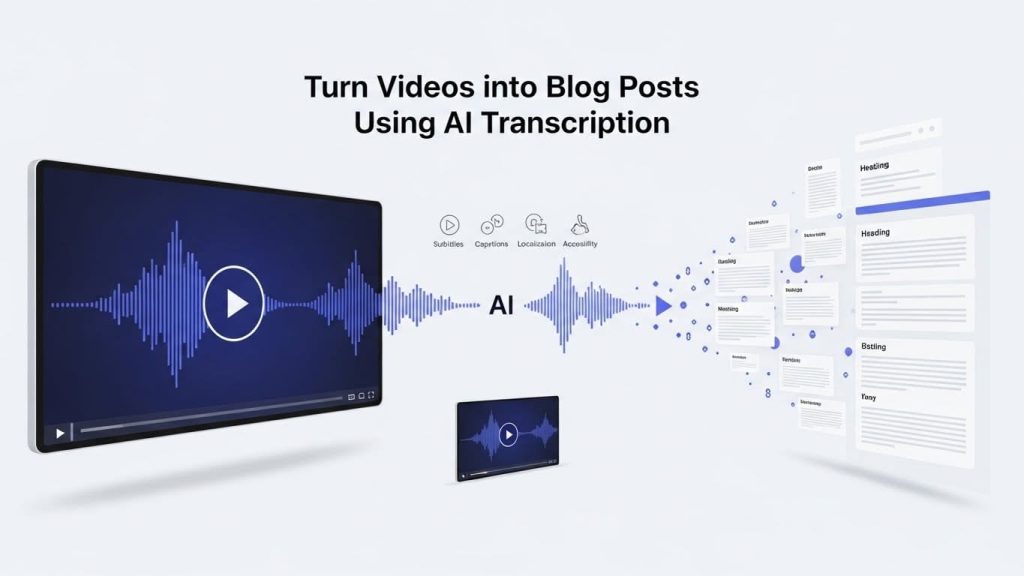
Instead of letting valuable video content live and die on a single platform, creators and organizations are increasingly using video transcription services to turn videos into high-performing blog posts, articles, and localized written assets. This approach saves time, improves accessibility, and unlocks new audiences across regions and languages.
In this step-by-step guide, we’ll walk through how to turn a video into a blog post using AI transcription, while aligning the process with professional subtitling, dubbing, voice-over, localization, and audio description workflows.
Why Turn Videos into Blog Posts?
Before diving into the process, it’s important to understand why this strategy works so well—especially for media, marketing, and localization teams.
Key benefits of converting video to blog content:
- Improves search engine visibility and rankings
- Extends the lifespan of video content
- Supports accessibility and compliance initiatives
- Creates reusable text for subtitling and localization
- Enables multilingual content distribution
- Reduces content production costs
For industries like media & entertainment, e-learning, broadcasting, corporate training, and digital marketing, video-to-text conversion is no longer optional—it’s a strategic advantage.
Step 1: Choose the Right Video for Transcription
Not every video makes a good blog post. The best candidates are videos that deliver structured, informational, or narrative value.
Ideal video types include:
- Educational YouTube videos
- Webinars and panel discussions
- Podcasts and interviews
- Product demos and explainer videos
- Corporate announcements and training videos
- Thought leadership talks
Localization project managers and post-production teams often prioritize videos that can later be adapted into subtitles, dubbed versions, or audio descriptions.
Step 2: Transcribe the Video Using AI Transcription
Once you’ve selected the video, the next step is video transcription—converting spoken audio into written text.
Why use AI transcription?
AI transcription tools dramatically reduce turnaround time while maintaining high accuracy. They are especially effective for:
- Long-form content
- High-volume video libraries
- Multi-speaker recordings
- Time-sensitive publishing schedules
Modern video transcription services can handle accents, industry terminology, and multiple speakers—making them suitable for professional environments.
Best practice:
Use AI transcription as the first draft, then review or refine the transcript for clarity, tone, and structure.
Step 3: Clean and Structure the Transcript
Raw transcripts are rarely blog-ready. Spoken language doesn’t always translate smoothly into written content, especially for SEO and readability.
What to clean up:
- Remove filler words (uh, um, you know)
- Correct grammar and sentence structure
- Clarify incomplete thoughts
- Add punctuation and paragraph breaks
What to preserve:
- Key insights and expert opinions
- Brand voice and intent
- Industry terminology
- Logical flow of ideas
This step is critical for subtitling and captioning specialists, as a clean transcript also becomes the base file for captions, subtitles, and dubbing scripts.
Step 4: Create a Blog Structure from the Transcript
Now it’s time to turn the transcript into a proper blog post.
Step-by-step video to blog content workflow:
- Identify the main theme of the video
- Break the transcript into logical sections
- Add headings (H2s and H3s)
- Reorder sections for clarity and flow
- Add context where visuals were previously relied upon
This process transforms spoken content into a reader-friendly article without losing the original message.
For SEO and accessibility, clear structure is essential.
Step 5: Optimize the Blog for SEO Using the Transcript
One of the biggest advantages of using AI transcription is SEO.
Search engines cannot “watch” videos—but they can index text.
How transcripts improve SEO:
- Natural keyword inclusion
- Rich, long-form content
- Higher topical relevance
- Better internal linking opportunities
SEO optimization tips:
- Use keywords naturally (avoid stuffing)
- Add descriptive headings
- Include internal links to related services
- Use the transcript to generate FAQs
For digital marketing teams, this step directly impacts organic traffic and lead generation.
Step 6: Adapt the Content for Localization & Multilingual Use
Once the blog is finalized in the source language, it becomes a powerful asset for video localization services.
How transcription supports localization:
- Transcripts serve as translation-ready source files
- Written content is easier to adapt than video-only assets
- Blogs can be localized alongside subtitles and dubbing
- Consistent messaging across formats and languages
For regions like Europe, Latin America, Southeast Asia, the Middle East, and Africa, this approach supports scalable multilingual publishing.
Dubbing and voice-over studios also use transcripts as the foundation for script adaptation and timing alignment.
Step 7: Use the Blog for Subtitling, Dubbing & Accessibility
A high-quality transcript doesn’t stop at blogs—it feeds multiple downstream workflows.
One transcript can power:
- Closed captions for videos
- Subtitles for social media and OTT platforms
- Dubbing and voice-over scripts
- Audio description narration
- Accessibility compliance documentation
This is especially important for:
- Broadcasting & news media
- OTT platforms
- Corporate training programs
- Public-facing content with accessibility requirements
By centralizing transcription early, teams reduce duplication and improve consistency.
Real-World Scenario: One Video, Multiple Assets
Imagine a corporate webinar recorded in English.
Using AI transcription:
- The webinar is transcribed within minutes
- The transcript becomes a detailed blog post
- Subtitles are created for social clips
- The content is localized into Spanish and French
- Voice-over versions are produced for regional markets
With a single recording, the organization creates multiple content assets across formats and regions—efficiently and cost-effectively.
Common Mistakes to Avoid
Even with AI transcription, there are pitfalls to watch out for.
Avoid these common issues:
- Publishing raw transcripts without editing
- Ignoring SEO structure
- Overlooking accessibility requirements
- Using low-quality auto-captions for professional content
- Failing to plan for localization early
Professional transcription and subtitling workflows help avoid these problems—especially for high-visibility or regulated content.
Who Benefits Most from This Workflow?
This approach is especially valuable for:
Industries
- Media & Entertainment
- Content Creation & Influencer Economy
- Video Production & Post-Production
- Localization & Language Service Providers
- Digital Marketing Agencies
- E-learning & Corporate Training
- Broadcasting & News Media
- Accessibility & Audio Description Services
Roles
- Content creators and bloggers
- YouTubers and podcasters
- Video editors and producers
- Localization project managers
- Subtitling and captioning specialists
- Dubbing and voice-over producers
- Marketing and SEO managers
- Accessibility and compliance teams
Conclusion: AI Transcription Turns Video into a Scalable Content Engine
Turning videos into blog posts isn’t just a productivity trick—it’s a strategic move that amplifies reach, improves accessibility, and supports global content growth.
With AI transcription, you can:
- Repurpose content efficiently
- Improve SEO and discoverability
- Enable professional subtitling and localization
- Support dubbing, voice-over, and audio description
- Scale content across platforms and regions
Ready to transform your video content?
We provide professional AI-powered transcription tailored for creators, agencies, and enterprises.
👉 Contact us to turn your videos into powerful, multi-format, globally accessible content.
Frequently Asked Questions (FAQ)
1. What is AI transcription for video content?
AI transcription is the process of automatically converting spoken audio from videos into accurate text using artificial intelligence. It’s widely used for blogs, subtitles, captions, dubbing scripts, and localization workflows.
2. How do I turn a video into a blog post using AI transcription?
First, transcribe your video using an AI transcription tool like TrulyScribe. Then edit and structure the transcript into readable sections, add headings, optimize for SEO, and publish it as a blog post.
3. Is AI transcription accurate enough for professional content?
Yes. Modern AI transcription services achieve high accuracy and are suitable for professional use, especially when followed by light human editing for clarity, terminology, and tone.
4. Can AI-generated transcripts be used for subtitles and captions?
Absolutely. AI transcripts are commonly used as the base file for creating subtitles, closed captions, and multilingual captioning for videos across platforms.
5. Does transcribing videos help with SEO?
Yes. Search engines cannot index video content directly, but transcribed text improves keyword visibility, indexing, and organic rankings, making video-to-blog conversion a strong SEO strategy.
6. Can I localize blog content created from video transcripts?
Yes. Once a video is transcribed, the text can be easily translated and localized into multiple languages, supporting global content distribution and video localization strategies.
7. How does AI transcription support dubbing and voice-over workflows?
Transcripts act as the foundation for dubbing and voice-over scripts, helping studios adapt content accurately while maintaining timing, tone, and consistency across languages.
8. Is AI transcription suitable for podcasts and webinars?
Yes. AI transcription works very well for podcasts, webinars, interviews, and panel discussions, enabling them to be repurposed into blog posts, articles, and written resources.
9. Can transcripts help with accessibility and compliance?
Yes. Transcripts improve accessibility by enabling captions, subtitles, and audio descriptions, helping organizations meet accessibility standards and reach wider audiences.
10. Who should use AI transcription to convert videos into blogs?
Content creators, YouTubers, podcasters, marketers, media companies, localization agencies, e-learning providers, and enterprises can all benefit from converting videos into blog posts using AI transcription.